
Chinese to English translator Helen Wang speaks to Indonesian children’s book creators Murti Bunanta and illustrator Maria Christania Winardi…
By Helen Wang
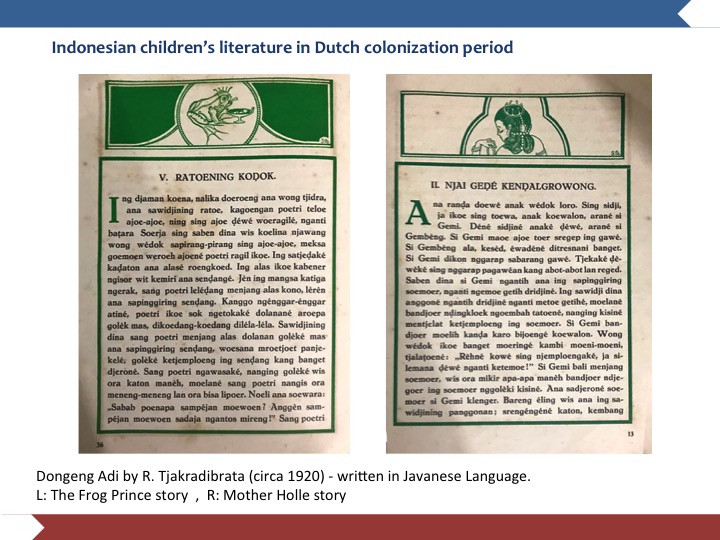
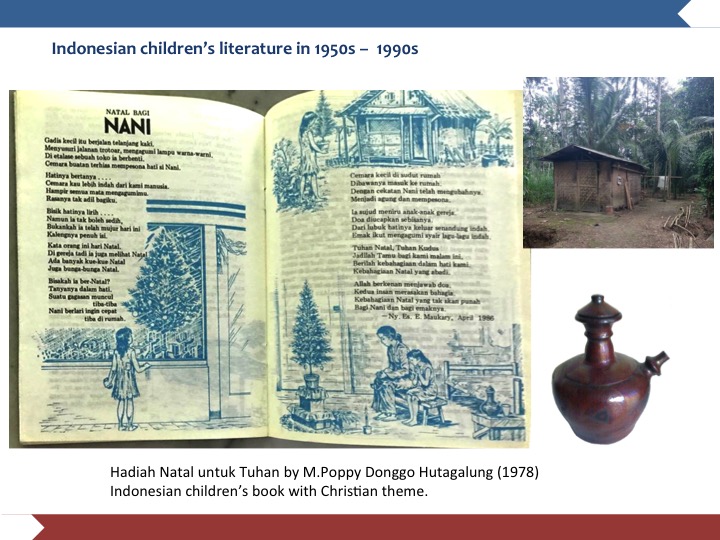
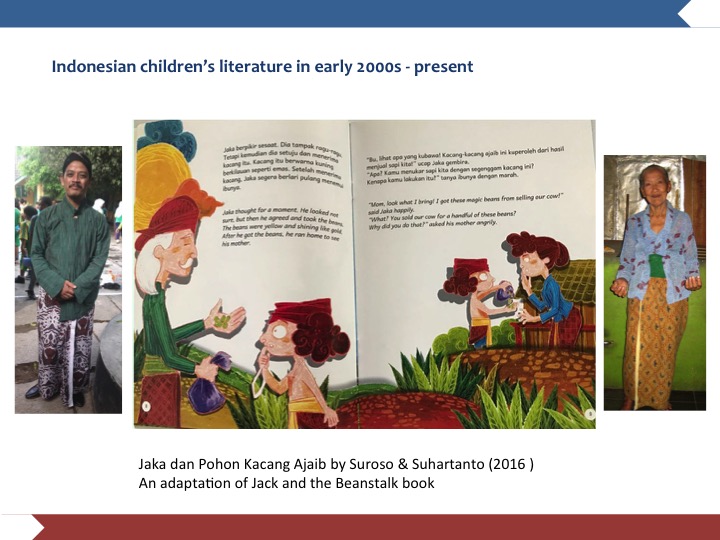
At the recent IBBY Congress in Athens, author Murti Bunanta and illustrator Maria Christania Winardi, both from Indonesia, gave a fascinating presentation “Western and Eastern cultural blend in the past and current Indonesian children’s literature”.
They gave an outline history of children’s literature in Indonesia – the foreign and local influences shifting and adapting over time –ending with the books of Murti Bunanta, which focus on traditional stories, with illustrations in a traditional Indonesian style. We’re delighted they agreed to an interview for #WorldKidLit Month.
Helen Wang: What did you most want to get across in your presentation?
Maria Christania Winardi: Our main message is to show that Indonesia is open to foreign culture. The unique blend of Indonesia’s native and foreign culture is present in many aspects, including children’s literature. The influence of foreign culture in Indonesian children’s literature can be observed since the Dutch colonial period. Within the last few years, we began to observe the influence from foreign Eastern culture, such as Japanese comics and Korean children’s books as well.
HW: Could you say a few words about where Murti’s books come in your outline history?
MCW: Murti’s books were published in the 2000s, which is categorised as being in the modern era in Indonesian children’s book timeline. We did not include them in our presentation, as we only showed Indonesian children’s book with a strong western cultural influence. However, not all Indonesian children’s books are influenced by foreign culture. To avoid any misunderstanding, at the end of our presentation we showed some examples of Indonesian children’s books that contain only the native culture. Murti’s books are one of these books.
HW: Murti, could you tell us a little about how you came to writing children’s books, and about the books you have written?
Murti Bunanta: I would say that I became a children’s book author by chance. It began in 1996, just after I completed my doctoral dissertation about the issues in retelling Indonesian folktales for children, when the head of a state owned publisher approached me to create three books. At that time, it was really difficult to find good quality Indonesian picture books. I accepted their offer on condition that theygave me full authority to determine the stories and format of the books.
As the deadline was getting closer and the first two titles and illustrators had been selected, I still could not find any suitable stories. At one point, I thought I should try to write the stories myself as I had carried out numerous researches in folktales during my doctoral study. So I did and all the three books were published on time.
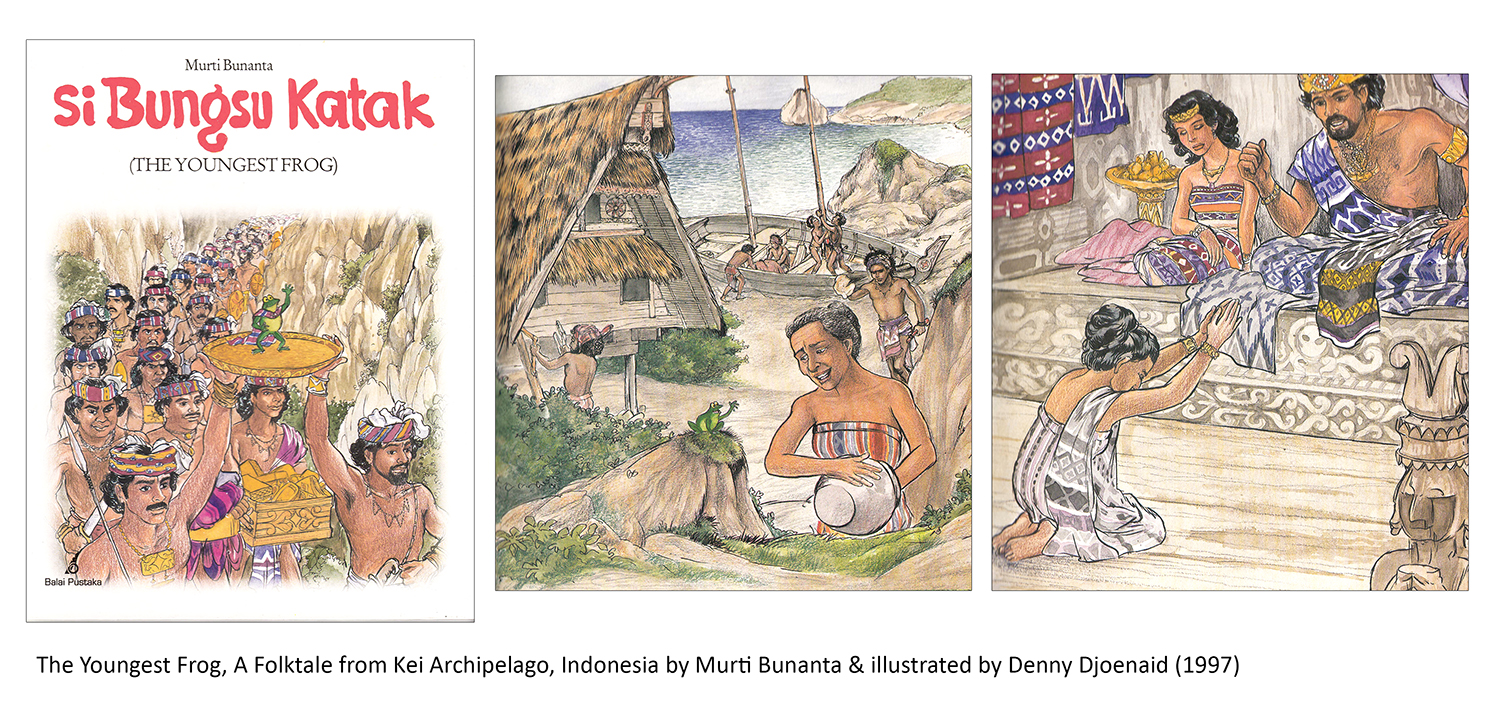
Surprisingly, my first two books received international awards. In 1998, the first book, Si Bungsu Katak / The Youngest Frog (Balai Pustaka,1997) received The Janusz Korczak International Literature Prize-Honorary Award in Poland. In 2002, the second book, Legenda Pohon Beringin / The Legend of the Banyan Tree received the Octogones Reflets D’ Imaginaries D’ Ailleurs in France. The appreciation and achievement encouraged me to write more and helped me to discover my passion and ability in writing for children and folktales.
HW: Your stories focus around traditional Indonesian tales published in bilingual editions. Who are you writing for, and why? Who does the translation? Why bilingual?
MB: I decided to publish my books in bilingual editions because I would like children whose native language is not Indonesian to be able to enjoy the books and be familiar with Indonesian traditions and stories. The other reason was that bilingual Indonesian children’s books were mostly unavailable at that time.
My colleague with a degree in English translated the first thirteen books. Katherine Paterson, who is an old close friend of mine, played a role as a language consultant. She examined the English text in the books. For the next eleven books, I did the translation myself and Dr Anne Pellowski (a librarian and storyteller) and Dr Margaret Read Macdonald (a children’s folklorist and storyteller) were the language consultants. Both of them are from the US and notable experts in their field.
HW: The illustrations in your books are very special — are they in a traditional Indonesian style? Could you tell us more about the illustrations? Who are the illustrators? How do you find them? How do you work with them?
MB: In 1986 I founded a non-profit organization Kelompok Pencinta Bacaan Anak / Society for the Advancement of Children’s Literature (SACL). Today, it has members from various backgrounds including authors, illustrators, librarians, educators, researchers, publishers, students, etc.
The illustrators who created the artwork in my books are SACL members and we have one mission: to provide high quality Indonesian children’s books. Throughout the book-making process, we worked closely together and refused to imitate the style of translated Western children’s books, which was a common practice among the local publishers at that time.
Just like myself, these illustrators grew up listening to folktales and were raised in traditional culture environments. Undeniably, their upbringing and life experiences play a huge influence in their artwork. It is worth mentioning that these illustrators are some of the most celebrated Indonesian artists, and we were all determined to create books that are unique, written and drawn in our very own styles. As we know each other really well, I usually have a specific person in mind to do the illustration of each story I write.
As a part of the book-making process, we also conducted quite a lot of research to get accurate depictions of people’s traditional ways of living such as the local architecture, traditional clothing, etc. We took it very seriously because we understand that it is important to accurately portray the culture of the origins of the stories.
I managed the book production stages myself – from the books’ design, the layout, the colour separation, to the binding styles. Through this process, I learned valuable things about picture books making. In 2010, I wrote a picture book series aimed for early readers and collaborated with the younger generation of illustrators, including Maria, whose illustration styles are in contrast with the older generation’s styles.
HW: Where can people buy your books?
MB: The Indonesian folktale books can be ordered directly from me. I can be reached by email at: murti.bunanta@gmail.com
The Tiny Boy and Tales from Indonesia (Groundwood Books, 2013) is available in Amazon.
 World Kid Lit
A fascinating post! Thank you!
LikeLike
[…] 20 Sept Children’s Literature in Indonesia: A Blend of Cultures and Styles […]
LikeLike