It’s Refugee Week in the UK and this year’s theme is “You, me and those who came before”, inviting us to “to explore the lives of refugees – and those who have welcomed them – throughout the generations.”
This week we’ll be posting recommended reads for children from tiny to teen, including lots of contributions from translator, reviewer and #worldkidlitmonth star contributor Claire Storey (@clairestorey16), who is doing a series of Refugee Week book reviews over on her blog.
Follow @worldkidlit and Claire on Twitter and sign up here for a week of global children’s books on the topic of refuge and asylum, including picture books, graphic novels and memoirs all suitable for younger readers and teens.
3 middle grade novels to read in Refugee Week
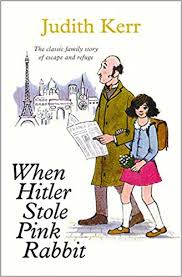
WHEN HITLER STOLE PINK RABBIT by Judith Kerr, and the following two in the trilogy, BOMBS ON AUNT DAINTY and SMALL PERSON FAR AWAY (HarperCollins Children’s Books)
Claire Storey writes:
Refugee Week is also a celebration of the contribution of refugees to our societies. And so, with all those facts in mind, what better way to kick things off than with the late Judith Kerr‘s autobiographical trilogy, When Hitler stole Pink Rabbit, Bombs on Aunt Dainty and Small Person Far Away. These books are a great introduction for older children to what it was like growing up as a German Jew during the Second World War and what it means to be a refugee.
The books follow Anna and her family as they escape from Germany just before the Nazi’s come to power, the first book accompanying her across the border to Switzerland, France and ultimately England. At this stage of her life, this is all a big adventure and this book is full of exploration, new experiences and different languages.
The second book, Bombs on Aunt Dainty, jumps ahead in time and finds the family now settled in London just as the Blitz is about to start. There is great frustration on the part of Anna’s brother, Max, that while he feels he belongs, his nationality keeps preventing him from being treated just like everyone else. In this book we see the reality of a family with very limited financial resources, living with the constant threat of great uncertainty.
The third book in the series, Small Person Far Away, jumps forward again. Anna is now married, her father is dead and her mother is back in Germany. A phone call saying her mother is ill leads Anna back to Berlin, bringing her face to face with her childhood memories.
All three books are very engaging and offer children a personal glimpse into a situation which, for them, is practically gone from living memory. I will be putting the first book, When Hitler Stole Pink Rabbit, on my 8 year old’s reading pile; however book number two, in particular, has a lot of references to bombs and destruction, which is probably more suited to the older reader.
A great legacy from someone who herself arrived as a refugee.
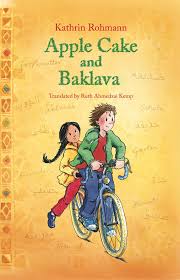 APPLE CAKE AND BAKLAVA by Kathrin Rohmann, illustrated by Franziska Harvey, translated from German by Ruth Ahmedzai Kemp (Darf, 2018)
Ruth writes:
Egotistical perhaps to include one I’ve translated but given this is published by a tiny independent publisher with no budget for marketing, I want to do everything I can to promote this loveliest of stories about Leila, a Syrian refugee starting at her new school in Germany. Of all the books I’ve translated it’s the one I’m most proud of. I wrote last year on the Federation of Children’s Book Groups blog about the fun and challenges of translating it.
But for a slightly less biased recommendation, here’s Fiona Graham at European Literature Network:
Apple Cake and Baklava sensitively depicts the heartache of a youngster desperately missing her beloved grandmother and her home. It gives equal space to Leila and Max, with alternating chapters telling the story from their contrasting viewpoints. Thus we see Max, too, struggling with the difficulty of making friends with someone very different from himself. Despite the tragic background of the war in Syria, the story is ultimately optimistic; the walnut is planted in German soil, and Leila begins to feel that it may be possible to put down roots. This beautifully written book will appeal to children between about eight and twelve. The narrative is complemented by Franziska Harvey’s evocative black-and-white illustrations. There is no doubt that this book deserves to be in primary schools throughout the UK and, indeed, the rest of Europe. It could hardly be more timely, or more urgent.
And Zoe and her daughter also review it along with The Fox Girl and The White Gazelle by Victoria Williamson (@strangelymagic) over at Playing By the Book.
 THE BOY AT THE BACK OF THE CLASS, by Onjali Q Raúf (Orion Children’s Books)
My 8-year-old and his dad enjoyed reading this at bedtime. It has deservedly been a big hit in the UK and BookTrust describe it as:
“An inspiring and sweet tale that will help children think about what it is to be a good person whatever your circumstances (the narrator is from a poor background with a single parent mum who struggles to make ends meet), and challenge prejudice and push for fairness, whenever possible. This is a beautiful, open-hearted debut from Onjali Q Raúf that should help children be the best they can be and realise the power of kindness.”
Claire is posting her review of The Boy at the Back of the Class on Friday this week; do follow her blog so you don’t miss it!
***
With huge thanks to #WorldKidLit reviewer extraordinaire, Claire Storey! For more Refugee Week reviews of published books and ones yet to be translated from German, please see her blog here.
 Claire Storey is an emerging translator based in the UK working from German and Spanish into English. She is in her final year of a part-time MA in Translation Studies at the University of Bristol and attended the Summer School run by the British Centre for Literary Translation in 2018. Her first translated picture book is due for publication later this year. In May 2019, Claire was awarded a Special Commendation by the Institute of Translation and Interpreting (ITI) in the ITI Awards category for Best Newcomer (Freelancing).
 World Kid Lit