Yesterday, Hungarian to English translators Anna Bentley and Veronika Lukács introduced us to some classic Hungarian children’s books already available in English. Today they recommend some books not yet published in English – publishers take note!
Veronika recommends…
Veronika Marék: her best, I think, are The Rabbit with the Chequered Ears and Father Christmas and the Silver Teddy Bear. Neither is available in English, though I have a draft translation of the latter made for a translation workshop and when I have a free moment I might pitch it to a publisher.
A firm favourite with older children is Judit Berg and I’m working on another of her stories about time-travelling dinosaurs. Wildly popular in Hungary, she’s an excellent writer and the books have great illustrations too.
Anna recommends…
For readers 9-15 years
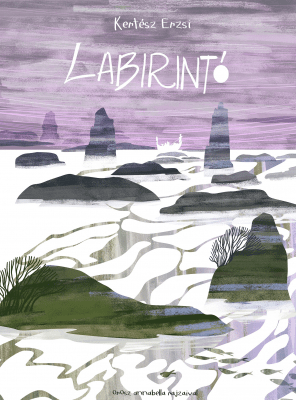 I really like Erzsi Kertész’s Labirintó (the title combines the words ‘labyrinth’ and ‘tó’ – lake) into which a young prince sets out on a gondola, taking four peculiar passengers with him: a bossy cat, a mermaid (in a bath) in search of healing mud, a thespian rabbit and Vain Hope, a fallen star who wants to get back to the sky. The tensions on board reminded me a little of John Burningham’s Mr. Gumpy’s Outing , also a little like Penelope Lively’s The Voyage of QV66. Rather like Gulliver he travels to different islands and meets all manner of odd characters, for example an island of philosophers. It’s off-beat, funny and thought-provoking. It just won a prize for the illustrations.
9-12 years
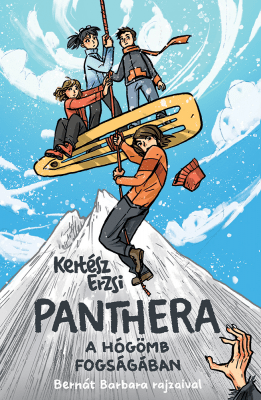 Erzsi Kertész’s Panthera series was much enjoyed by my daughter. I read the first and really enjoyed it. A group of children go to a class on mountaineering and find themselves shrunk and placed on a mountain – also shrunk – with a task to find a precious stone for their captors. The relationships between the children who are trapped and one outside, how they deal with injury and the cold, and outwit the criminals who are using, them make it an exciting and entertaining read! Published by Cerkabella, 2018.
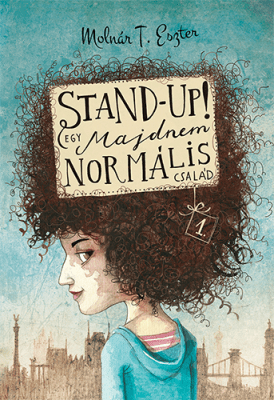 For older readers, Eszter T. Molnár’s Stand Up! A nearly normal family was set as reading for my daughter’s class (aged 13). There are two books in the Stand Up series, published by Pagony, 2016.
From the author’s website: If someone’s father is a sad comedian, sister mixes with bad guys, brother is antisocial, and aunt is a know-it-all, than it’s no wonder she prefers to spend Sundays volunteering at a dog shelter. Virág Bakos has enough problems to pull her down, but fortunately she has a lively sense of humour, a faithful hamster, a few cool classmates, and even a true friend.
Then two guys, who really shouldn’t do so, start hitting on her, and soon enough, Virág finds herself outcast. She experiences jealousy, exclusion, but as the only sane member of a family that is falling to pieces, she doesn’t have time to feel sorry for herself.
After school, she cooks dinner, unveils a robbery gang, or she fixes her father up with a nice stepmother-to-be, and only after all these can she afford to think about the worth of a friendship, and whether she should take the vulnerability that comes with love. (Tilos az Á Könyvek, 2016)
And finally, one I’ve started to pitch to publishers: A BOY FROM THE TEAM by Dóra Igaz (Pagony, 2018). Sample translations available!
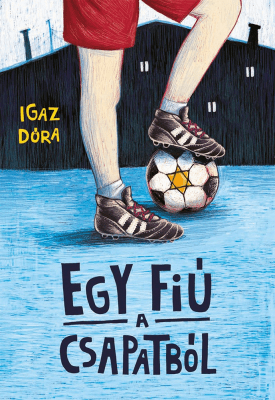 According to the book’s publisher, A Boy from the Team by is the first novel by a Hungarian writer that tells 10-12-year-old Hungarian children about how the Holocaust happened in their country. The author weaves together two threads; one the story of two boys in the present day, the other a personal story from 1944 told to the boys by one boy’s grandfather.
Danny, an 11-year-old Jewish boy in the present day, is troubled by something he has overheard about his great-grandfather being was sent to a ‘death camp’, and is feeling hurt when his friends leave him out of a football match they arranged at Sunday School. When Danny is round at his friend Tóbi’s house, Tóbi’s grandfather tells the boys how he and others in his community were passive bystanders when, in 1944, the gendarmes took away one of his football-playing friends. Danny and Tóbi, who interact on social media and play video games, gradually realise how similar they in fact are to the boys of 1944. They struggle to understand the acquiescence of people in 1944, and determine to take action in their own time to combat the casual anti-Semitism repeated by some children in their class.
Thank you Veronika and Anna for taking the time to write about these books for us!
***
 Originally a translator of contemporary Hungarian fiction, Veronika Lukács developed an interest in translating children’s literature after becoming a mother and reading Hungarian and German books to her trilingual sons. She is currently working on a funny book about the adventures of time-travelling dinosaurs written by the award-winning Hungarian author, Judit Berg, for which she is seeking a publisher. Besides doing translation, Veronika enjoys talking about translation and has run school workshops and tasters on multilingualism, reading and books in translation.
Born in Budapest, Hungary, Veronika studied English language and literature at university. She then took a
career break to raise a family and when her children were old enough to cope with her being away, she
went on to complete a Literary Translation MA at the University of East Anglia. Her prose and poetry
translations have appeared in various anthologies and, most recently, in Hungarian Literature Online.
Veronika was awarded a scholarship and two-week residency at the Hungarian Translators House in July-
August 2019. She’s a member of the Translators Association, Society of Authors, as well as the Emerging
Translators’ Network. She lives in Oxford.
 Anna Bentley has lived in Budapest since 2000 and began translating Hungarian literature in 2015. Her translation of Ervin Lázár’s well-loved children’s book Arnica, the Duck Princess was published by Pushkin Children’s Press in February, 2019. She graduated with ’outstanding’ from the Literary Translation Program at the Balassi Institute, Budapest, in 2018, for which she translated four stories by György Dragomán.
Several of her prose and poetry translations have appeared in the online journal Hungarian Literature Online. Her translation of an excerpt from Natália Szeifert’s latest novel About Sedatives was included in the 2018 year’s collection of translations published by the Hungarian Translators’ House. Her translation of Anna Menyhért’sWomen’s Literary Tradition: Five Key Hungarian Writers from the 20th Century is soon to be published by Brill. Most recently, her translation of Gabi Csutak’s short story Funeral appeared in Asymptote Magazine’s blog Translation Tuesday.
Anna’s translation of a short story by Márta Patak was longlisted by the John Dryden Translation Competition in June 2019.
 World Kid Lit