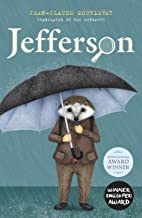
During the summer, Andersen Press released a middle grade book about a very cute little hedgehog. The book was named after its spiky hero: Jefferson. Written by Jean-Claude Mourlevat, illustrated by Antoine Ronzon and translated from French by Ros Schwartz, we thought it was the perfect excuse to ask Ros a few questions….
Claire Storey: Thank you so much for talking to us, Ros. Jefferson was published in August. Could you tell us a little about the book?
Ros Schwartz: The eponymous hero, Jefferson, is a walking, talking hedgehog. The narrative is set in an animal kingdom where all the characters have human characteristics and professions. Their world borders on the land of the humans, and travel between the two is possible. One morning, Jefferson sets off to have his quiff trimmed at the hairdressers and suddenly finds himself the chief suspect in a murder. The only way to clear his name is to turn sleuth, with the assistance of his loyal friend and sidekick, Gilbert the pig. Their adventures take them into the heart of the land of the humans, where they uncover the world of the abattoirs and the cruelty to which humans subject animals in order to produce meat for their own consumption. Sounds grim, but this is a real page-turner – a murder mystery with a nail-biting road-trip. A feel-good novel full of humour and wacky characters. There’s a powerful animal rights message at the heart of it, but the book is never preachy.
CS: The book has quite a lot of humour in it, with the personified animals getting up to all sort of adventures. Were there any sections in the book that you found particularly fun to translate, or conversely, any bits you found tricky?
RS: There’s word play, for example, the name of the hair salon where the murder takes place: Défini-tif, which means definitive/final, but also les tifs is slang for hair. The translated name needed to carry that same ironic double entendre because it’s the salon owner who is murdered. So in English I chose Cut ’n’ Dye, which came out of a brainstorming session I held with my workshop group at the Warwick Translates summer school in 2019. There was also quite a lot of wordplay in dialogues, which was a challenge but great fun to translate.
CS: Did you have to change any of the names and if so, how did you arrive at your solutions?
Not of the characters. I often find that French authors use names that are the same in French and English, possibly with an eye to being translated. So we have Jefferson, Gilbert, Roland, Mr Edgar etc. But the name of the package tour company that Jefferson and Gilbert travelled with incognito was Ballardeau, whose slogan was: “Envie de ballade, Ballardeau” [literally: If you fancy travelling, Ballardeau]. Because the book is set in a fictitious kingdom, not in France, I needed to come up with a catchy name/slogan in English. I went for “Avid for adventure? Join the Globetrotters”.
CS: One of the central themes to the storyline is meat production and animal cruelty. Is this a topic you feel particularly strongly about and has it changed your attitudes to eating meat?
RS: I have to confess that I’m a carnivore. I am opposed to industrial meat farming and animal cruelty, but I love to eat sustainably produced, organic meat. I eat less meat than I used to, but I haven’t given it up.
CS: In its original French, Jefferson has won several international prizes including the Prix des Libraires du Québec 2019 and the Prix Quai du Polar 2019. Do you think that prizes and accolades in the source language are an important consideration for French books in translation?
RS: If a book has won a prize or prizes in its domestic market, that can draw it to publishers’ attention, but ultimately they’ll buy the rights if they think the book will appeal to the UK/US market. If a book is successful in its home market, that’s no guarantee of success in translation. So prizes aren’t a determining factor, but of course they can help. Publishers often want to know which publishers in other countries have acquired the rights, because that is a sort of yardstick for them. The also ask if the author speaks English and is ‘promotable’ (I know, I know).
CS: Staying with awards, Jefferson was a recipient of a PEN Translates grant. As translator, how involved are you with that application process and how important are grants like these?
RS: I wasn’t involved in the application process but I did alert the publisher to the existence of PEN Translates. Publishers don’t always think of it. Grants like these encourage publishers to explore more foreign titles, to take commercial risks with books that are not necessarily going to generate huge sales, and they enable independent houses especially to publish translations and pay translators properly. The translation scene has been transformed in the past fifteen years or so, with much more international literature being published from a greater diversity of countries and languages. I’m convinced this is partly thanks to the availability of grants, notably through PEN Translates and national funding bodies.
CS: You not only translate but you also organise translation workshops and summer schools. I was particularly interested to read about the Bakwa literary translation workshop in Cameroon that you were involved with last year, and you’ve recently published a book by Max Lobe, a Swiss writer of Cameroonian origin. On our list of publications from 2020, there are very few children’s books being published in translation from Africa. Here at the WKL blog, we’re keen to encourage more books from under-represented areas. How can we do more as translators, or publishers, or fans of global children’s literature?
RS: By making it our business to seek out books from under-represented areas and present them to our publishers. Traditionally, book fairs are a good place to go trawling, and I hope we’ll go back to being able to hold live events very soon. Also asking friends and contacts in those countries and making it our business to be informed about what’s being published elsewhere.
***
Last week we published our Best of 2020 lists, asking our World Kid Lit Champions for the recommendations. Margot Lindren suggested Jefferson, and here’s what she had to say:
“I loved the quirky characters, and the idea of a human world and an animal world. The story is a comedy and a romp but there’s a serious section about animal cruelty which means I’d recommend it for kids aged 10 or 11+. The friendship between the two main characters Jefferson Ponsonby Smyth, a hedgehog, and Gilbert, who is a young pig, is beautifully described. There’s a murder; a love story; evil baddies; and fun word plays too.“
You can read Margot’s full review on her blog Momo celebrating time to read
 World Kid Lit