By Amanda L. Andrei
Growing up, I did not distinguish between my mother’s Philippine languages. As an adolescent, I learned that she mixed Tagalog (Filipino), Ilokano, Ilonggo, and Cebuano in conversations with friends and family. Only as an adult, after studying Tagalog in the Philippines and then years later taking an intro Ilokano course, did I realize that the most intimate, affectionate words my mother used in my childhood were Ilokano.
182 native languages are spoken in the Philippines, making me ponder what it means when you have many different heritage tongues. What does it mean when one tongue has fewer speakers than your other languages? What intimacies and affections are conveyed in a language tied to specific geographies? And what does a diversity of languages teach us about the cultures contained within a nation? Indeed, with 11 percent of Filipinos being Overseas Filipino Workers (OFWs) and living outside of the nation, how many of them have the chance to speak these languages?
These books are meant to serve as an entry point to the diversity of languages and experiences in the Philippines. I hope they help you reflect on your own spaces and words of intimacy, affection, and love with your communities.
Amina and the City of Flowers: a Chavacano Tale
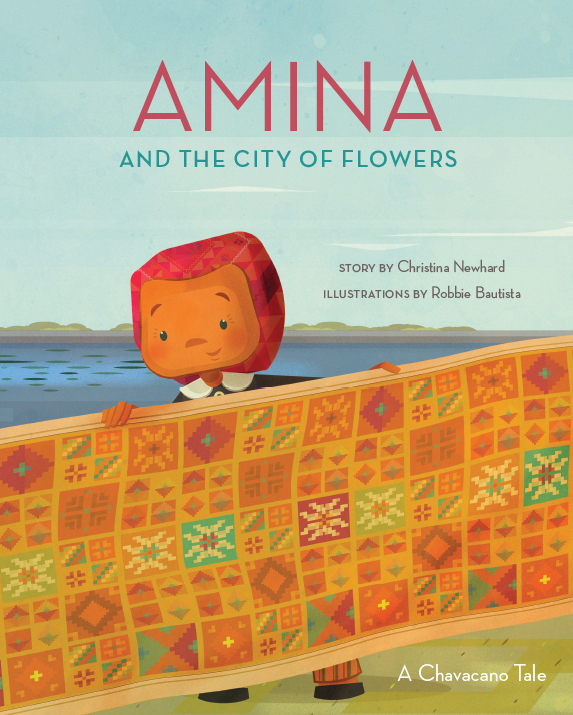
Written by Christina Newhard
Illustrated by Robbie Bautista
Bilingual English/Chavacano
Translated by Floraime Oliveros Pantaleta
Translated from English into Chavacano
Published by Sari-Sari Storybooks
Amina is a young weaver living in a Yakan village in Zamboanga City, far from her home of Lamitan. Upon a suggestion from her mother to counter her homesickness with weaving a story into cloth, she decides to travel through her new city.
In Newhard’s English and Pantaleta’s Chavacano (a Spanish creole), accompanied with Bautista’s cheerful illustrations, we meander with Amina through Zamboanga City’s cultural and religious diversity. As she observes and meets food sellers, dancers, teachers, and nomads, Amina eventually creates her own tapestry of her life in her new location.
Notably, the narrative does not mention the reason that Amina’s family has moved so many times, but cultural context in the beginning of the book mentions that “conflict displaced [the Yakan] from their homes on Basilan Island,” and the end offers discussion questions about why the family moved, opening conversation about sensitive topics about warfare and refugees without victimizing the fictional and real people involved.
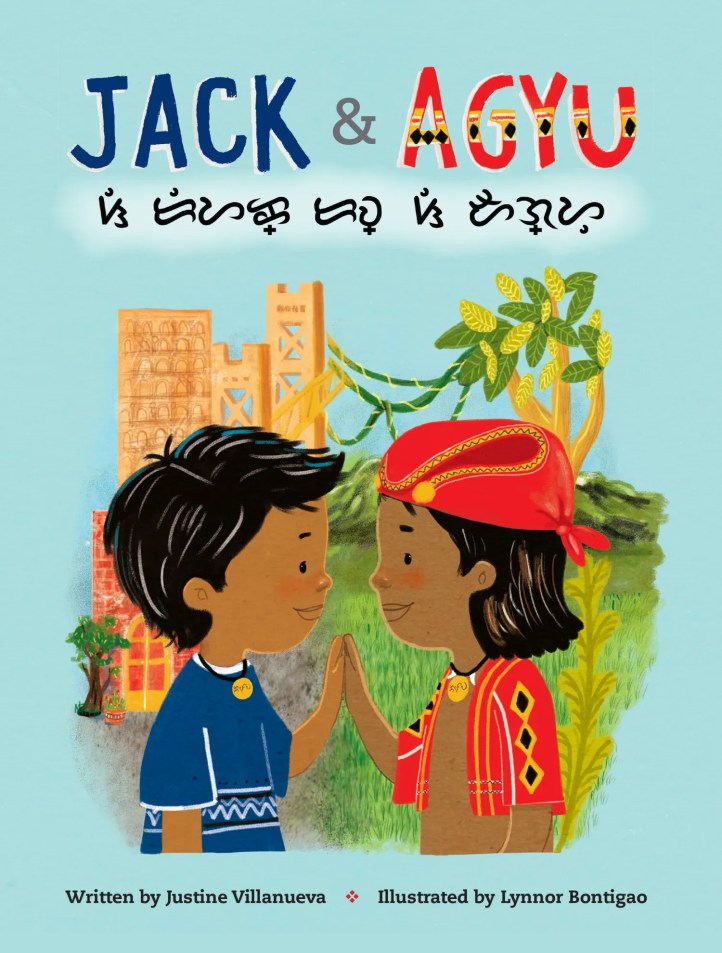
Written by Justine Villanueva
Illustrated by Lynnor Bontigao
Multilingual English/Binukid/Bisaya-Cebuano/Filipino
Translated by Bukidnon State University, facilitated by Rizza Ramos-Consad
Translated from English into Binukid, Bisaya-Cebuano, Filipino
Published by Sagawa River Press
When Jack, a young Filipino boy, notices that his favorite book characters are white, he decides to color his library books brown in an effort to relate to his heroes. When he gets in trouble with the library, his mother tells him a story about a child named Agyu (a Bukidnon hero from the Ulaging epic) and his mythic adventures.
While the other translations of the narrative are found in the back of the book, the English text is accompanied with translated keywords, and the story uses italicized Filipino words in the main text (such as kuya, kapwa, salimbal). It’s a tough balance, making sure the gorgeous illustrations aren’t crowded with too many words, but you find yourself flipping back and forth in the book instead of reading linearly. Children will also love the images of mythic Filipino creatures, and the use of baybayin in both pictures and acknowledgements is a lovely reminder of the ancient writing systems from the archipelago.
Pok Pok Alimpako: A Maranao Folk Song
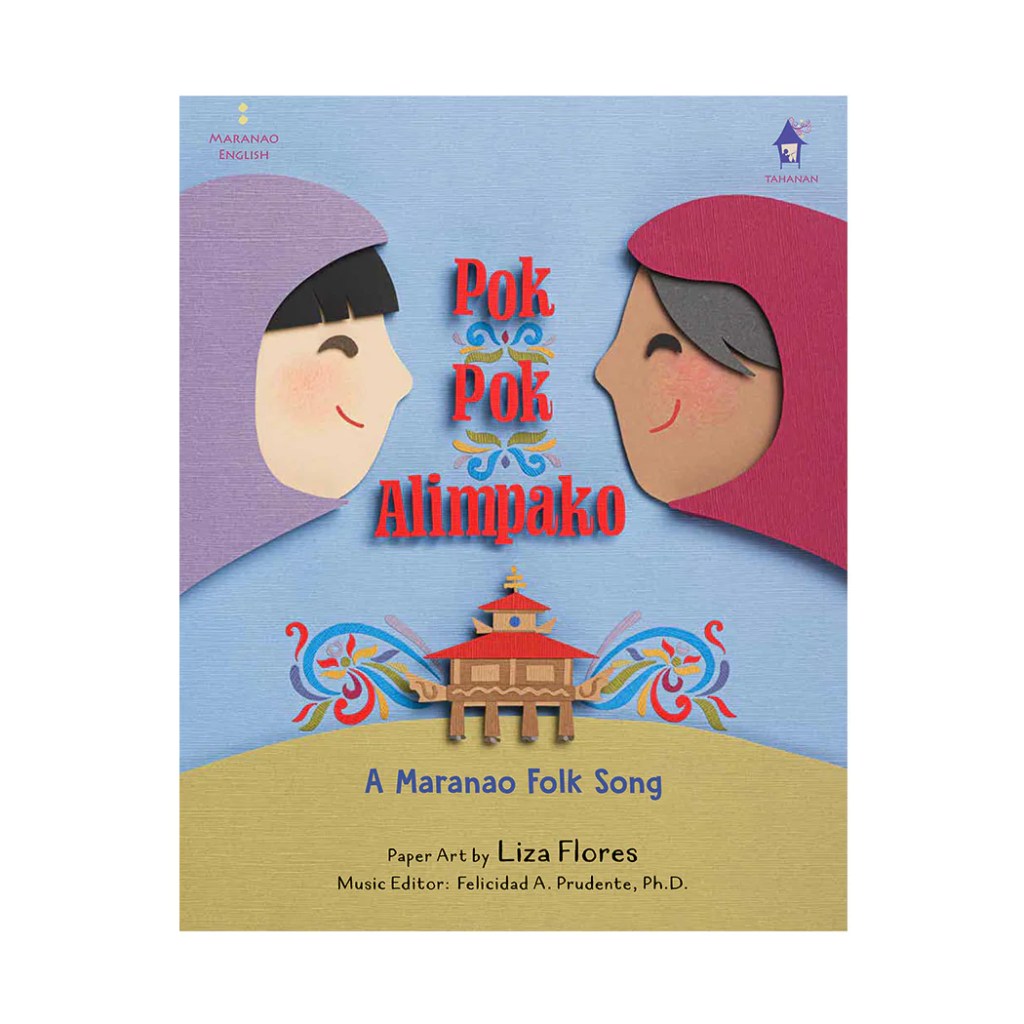
Traditional song illustrated by Liza Flores
Bilingual English/Maranao
Translated by Dr. Felicidad A. Prudente (musicologist) and Dr. Helen S. Tejero (cultural consultant)
Translated from Maranao to English
Published by Tanahan Books
The Maranao people are the largest Muslim cultural-linguistic group in the Philippines, tracing their ancestral homeland to Lake Lanao and its surrounding area in Mindanao. This book features the game song “Pok Pok Alimpako,” where children stack their fists to build an imaginary staircase to the moon and stars. Illustrated characters search for each other beneath tables and throughout the house, eventually taking their quest to the sky.
This book is delightfully simple enough to read to a toddler, while also opening up conversations with older children about music, games, and even the cosmos. Liza Flores’ paper cutout illustrations are inspired by okir motifs, beautifully curved plant-based designs considered to be pre-Islamic and often carved on animistic objects and houseboats. A musical score in the back is easy enough to play on a piano or instrument, so when you finish reading, you can sing or play the hand game.
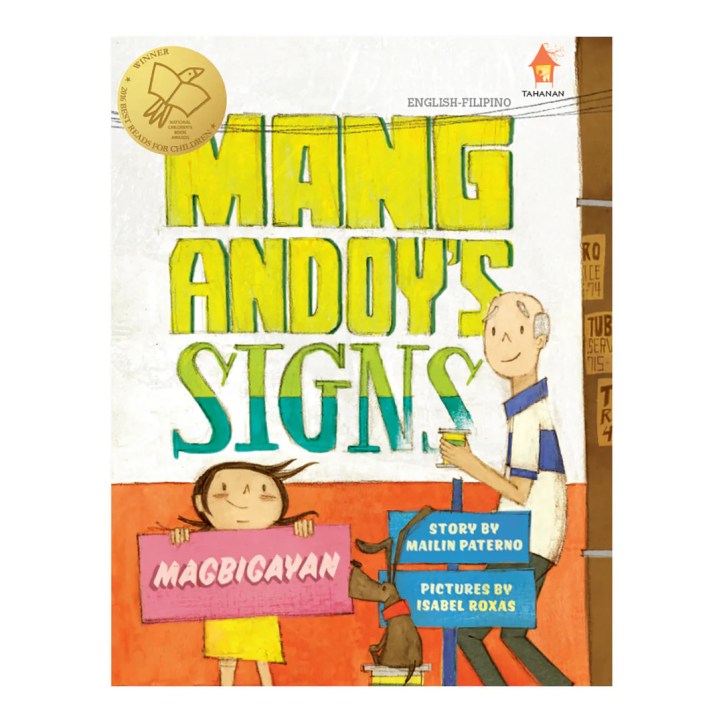
Written by Mailin Paterno
Illustrated by Isabel Roxas
Bilingual English/Filipino
Translated by Eugene Y. Evasco
Translated from English to Filipino
Published by Tanahan Books
Mang Andoy is a quiet sign-maker in a busy Philippine city who is tasked by the mayor to create signs that will improve the urban chaos: NO LITTERING! DO NOT CROSS THE STREET! GET IN LINE! But when Mang Andoy’s granddaughter points out how restrictive and angry the language seems, they think of ways to create language that is kinder and more persuasive.
It’s fantastic that this book shines a light on the art of sign painting and Philippine typography while demonstrating how inclusive and encouraging language can be crafted. I appreciate the choice to leave the Filipino signs in the illustrations unaccompanied with English translations, allowing readers to concentrate on the words themselves before diving into the meanings. Roxas’s images are created from “vintage ephemera,” paper scraps, watercolor, and digital collage, giving the book an earthy, warm feel alongside Paterno’s story and Evasco’s translation into Filipino.
Meet Amanda L. Andrei
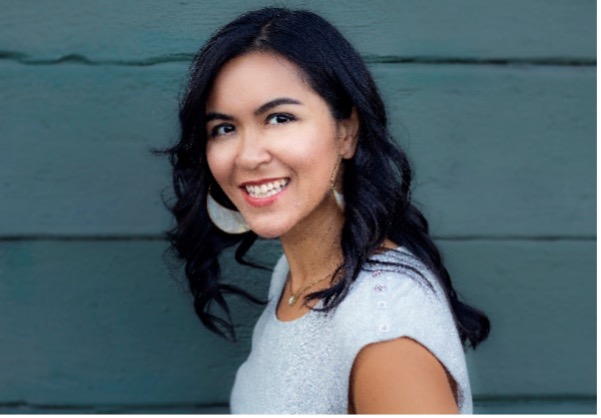
Amanda is a playwright, teaching artist, translator, and parent. She co-translates from Romanian to English with her father at their kitchen table. Her favorite animals are rabbits and dragons, and she loves a steaming pot of fresh rice. Check out more of her work and upcoming classes here and follow her on Instagram @theamandalandrei & Twitter @amandalandrei.
 World Kid Lit