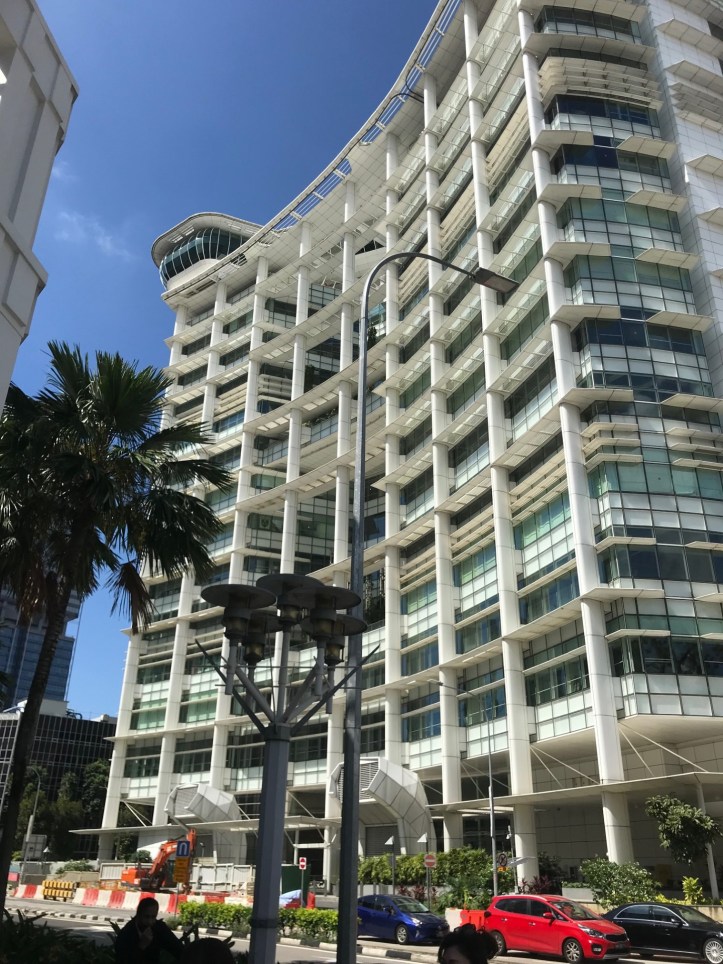
The 14th Asian Festival of Children’s Content (AFCC) took place in Singapore, 25-28 May 2023. Vietnam was the country of focus, and Play was the theme of the festival. We asked three friends to tell us about their experiences at this year’s AFCC.
by Johanna McCalmont
Helen Wang
This was my second real-life AFCC. I had been invited as a speaker in 2019, and enjoyed it so much I couldn’t wait to go back! Any worries that AFCC 2023 might not live up to my memories of the earlier AFCC soon vanished: the AFCC organisers were as organised and welcoming as before, the programme as inspiring, and the atmosphere as friendly as I had remembered. At this year’s AFCC over 100 speakers took part in over 70 events, with many speakers taking part in more than one event, and being in the audience of many more events. Every event I went to gave me something new to think about as writers, illustrators, translators, publishers, librarians, scriptwriters, film-makers, storytellers and audience of all ages and backgrounds shared their thoughts, works, experiences and plans for the future.
I was invited to take part in two panels. The first was titled “The Role of the Translator in the Age of AI”, with Nguyen Thanh Nam (publisher, in Vietnam), and Susan Xu Yun (Associate Professor of Translation, Singapore). We were each invited to give a ten-minute presentation, followed by a discussion. I had no idea what I could contribute to this until one of my authors (“my” in the sense that I have translated her work) shortly before the AFCC suddenly announced that she had just self-translated one of her novels using Chat GPT and self-published that translation – providing me with an opportunity to talk about our experiences of working together over the past decade. Nam followed with how he has to tackle the changes as a publisher, summing it up with “what doesn’t kill you makes you stronger”, and Susan showed us many examples of what AI translation tools can and cannot translate well (e.g. very good at technical/specialist terms that are used consistently, not so good at creative/imaginative writing by individual authors).
The second was “A Focus on the Bai Meigui: Promoting Translation Through Competitions”. The Bai Meigui Translation Competition is an initiative of the Leeds Centre for New Chinese Writing. This year’s competition was for Under-18s and was jointly organised with the Singapore Book Council. The event featured the winner (Hongyu Jasmine Zhu, USA), the highly commended runner-up (Joy Huang Si Xua, Singapore), one of three judges (Amanda Ruiqing Flynn, Singapore), mentor to the winner (myself, UK), the publisher of the winning entry (Roh-Suan Tung, Singapore), and writer, and moderated by Wong Kwang Han (translator and filmmaker, Singapore). The event also served as the launch of Hongyu Jasmine’s winning translation of Zhou Jianxin’s picture book Little Squirrel and Old Banyan.
Avery Udagawa
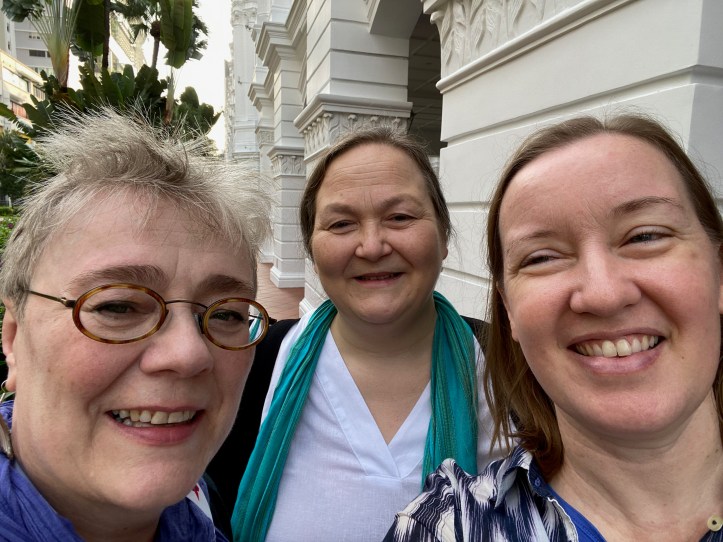
My two days at AFCC 2023 began with hugs and a delightful breakfast with Helen Wang, London-based translator from Chinese to English, and Lucia Obi, Chinese and Korean children’s literature specialist at the International Youth Library, Munich. Their efforts to promote World Kid Lit always inspire me, and it had been too long since last seeing them—four and five years ago, respectively, in Singapore at AFCC!
I stopped by Closetful of Books, the always-enticing festival bookstore run by Denise Tan and Kelvin Ng (online year-round!). I also connected with Singapore Book Council team members William Phuan, Vasantha Devi, Caroline Wan, Fransiska Chandra, and Carlo Peña, among others. I had interacted with these tireless humans at virtual editions of AFCC during the pandemic, but I was thrilled to greet them in-person again. At one point I basked in a conversation with R. Ramachandran, aka Mr. Rama, former Executive Director of AFCC and champion encourager.
My brain and heart found much to engage with in the Translation Forum – a range of events focusing on translation.
At a keynote on the many roles of the translator, English-to-Chinese translator 阿甲(Ajia) performed a version of “Tom, Tom the Piper’s Son” he had spent weeks refining for his rendering of the Peter Rabbit series. An active storyteller, he had insisted on making it singable for Chinese audiences. Polish-to-Korean translator Jiwone Lee then described curating exhibitions related to the author-illustrators she introduces in South Korea, such as Marianna Oklejak. Her remarks reminded me how much translators can, and do, add to PR efforts for the works they translate.
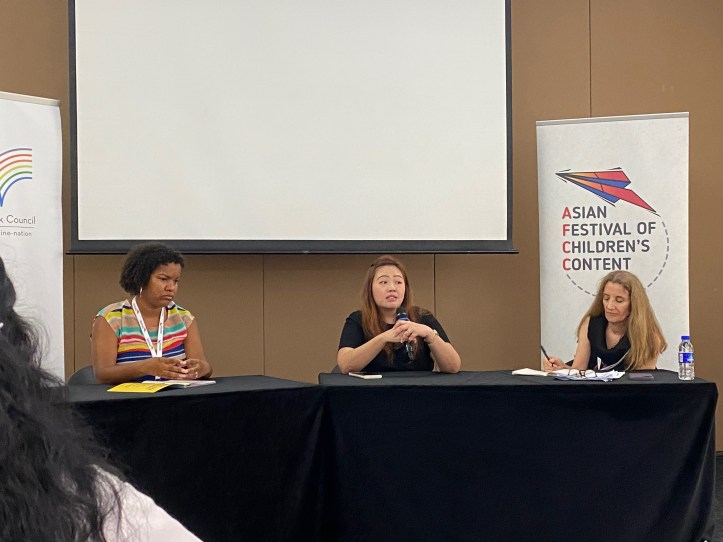
In a delightful session on the Bai Meigui Translation Competition, jury member Amanda Ruiqing Flynn remarked on how translators change the world by showing that “what we say matters.” Recent winner 朱弘昱 (Hongyu Jasmine Zhu) reflected on translation as the “art of cultivating attention toward the text.” Helen Wang, who mentors the winners, stressed how the competition improves “visibility of translation” among youth.
In a panel on the “why” of sharing World Kid Lit, Lucia Obi spoke soberingly of recent book banning movements in the U.S., comparing them to book burning in Nazi Germany. She pointed out that translating and publishing books in different countries is a practical way to keep them from being erased, and income flowing to their authors, as happened with the censored work of Erich Kästner.
In a panel on translation in classrooms, 梁郡夏 (Cassia Leong), Mohini Gupta, and Pham Thi Hoai Anh described activities they had led in schools in Singapore, India, and Vietnam, respectively. While the content of the activities had ranged from contests to conversations, the goal had always been to make students proud of their multilingualism. It was sobering, yet again, to hear that using Languages Other Than English is not a source of pride in many countries, which points to the global hegemony of English.
A panel featuring Helen Wang, Nguyen Thanh Nam, and Susan Xu Yun also explored ways in which AI may support and transform, but not replace, the artistry of literary translators.
Outside the Translation Forum, I enjoyed hearing from US editor Erika Turner about trends in middle grade, including graphic novels and science fiction. I soaked up lyrical remarks by US poet Nikki Grimes, who emphasized continuing to create amid the rampant book banning. I appreciated a panel about creating children’s content that explores dark topics, which featured Hanna Alkaf of Malaysia and Marie-Aude Murail of France, winner of the prestigious Hans Christian Andersen Award for Writing in 2022.
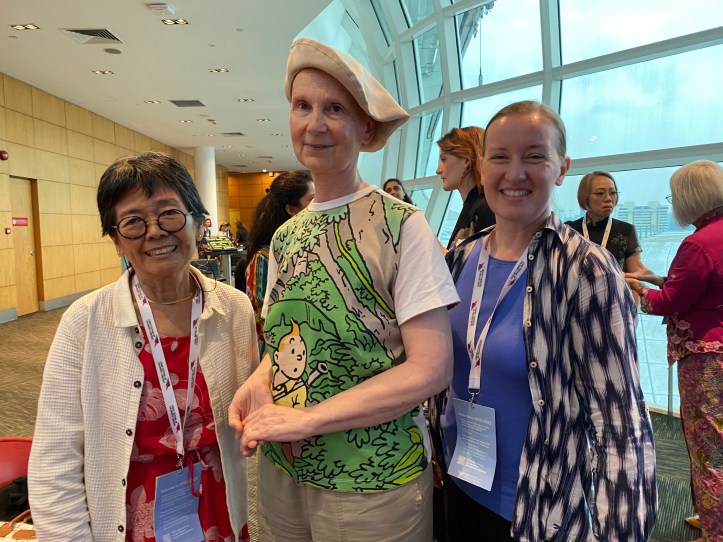
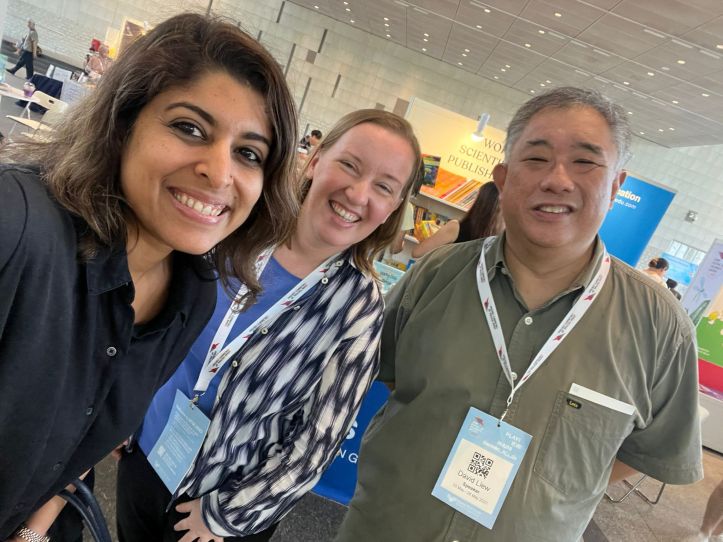
Finally, I enjoyed more socializing with members of the AFCC family, including authors Malavika Nataraj and Evelyn Wong, storyteller Rosemarie Somaiah, librarian Katie Day, illustrator and SCBWI Singapore leader David Liew, and the indefatigable Helen and Lucia. I missed them so much when I left after (it seemed) barely touching down in the Little Red Dot!
Until next time, everyone!!
Amanda Ruiqing Flynn
On the first day of the Asian Festival of Children’s Content (AFCC) 2023, I felt like an eager-faced child in a sweet shop with a five pound note. I had attended one panel discussion and participated in the Picture Book Hackathon in AFCC 2022. This year I was incredibly excited to have an all access pass which allowed me a feast of all the panels, lectures and workshops happening across four days.
In the foyer whilst getting my pass, it was so lovely to see Helen Wang; it had been seven years since we last met! There had been so many changes since the last time we met, and from when I had attended China Fiction Book Club with her in 2011. It was so comforting to feel that in the midst of all that change, some things don’t, and that was our love for books and for translation.
During the opening keynote I was inspired particularly by how French author Marie-Aude Murail interpreted the AFCC 2023 theme of Play! and its role in creating children’s stories. Marie said that two things developed her imagination; first, her parents had allowed her the time to play, and secondly, they had welcomed others to their home for her to play with. I thought it was so beautifully summarised and a reminder that in this day and age, we can overcomplicate childhood with attainment goals and enrichment classes, with little time for free play, especially in Singapore. Time to play is such an important necessity for a child.
Over the next couple of days, memorable highlights for me were attending a poetry workshop with poet Nicky Grimes, where we dived right into the practical and played with all sorts of engaging poetry styles, my favourite of which was a form called golden shovel poetry. It was exhilarating to feel the creative energy in the room bursting to be heard!
I also particularly enjoyed listening to award winning Taiwanese author-illustrator Lin Bo-Ting speak about his journey in crafting a picture book. His words and pictures tell separate parallel stories, and also blend together to create a third story as a whole. His beautiful and whimsical illustrations, which touch upon themes such as marine conservation and loss, made me reminisce about my time living in Taiwan and provided me with food for thought about what I want to achieve in my own work.

On Saturday morning, I moderated the Translation Forum keynote, Our Many Identities—Translator as Advocate and Bridge, where I had the pleasure of inviting on stage Ajia and Jiwone Lee, who are not only prolific translators, but also wear the hats of promoting the books they translate extensively. I was particularly fascinated by Ajia’s work in translating the Peter Rabbit series and how he helmed the Beatrix Potter exhibition in China, as well as organising tours to the Lake District. Jiwone translates from Polish to Korean and her dedication and role as an art historian and curator, as well as a promoter of Polish children’s books in South Korea impressed me so much. I was really in awe of and humbled by their passion, consistency and persistence in the field of children’s literature in translation.
On Sunday, I had the pleasure of speaking on the panel, A Focus on the Bai Meigui: Promoting Translation through Competitions. I had been one of the judges of the 8th Bai Meigui translation competition, and together with Helen Wang (mentor), Tung Roh Suan (Balestier Press), Jasmine Hongyu Zhu (winner) and Joy Huang (runner-up), we discussed the benefits of promoting translation through competitions, and of the translation environment we are trying to create. We then launched the English translation of the Squirrel and the Banyan Tree by Taiwanese author Zhou Jianxin, translated by Jasmine Hongyu Zhu. I hope that we will continue to remain curious about how powerful words can be when they can travel across languages and cultures.
What struck me overall about the AFCC was how well it was organised. The team at Singapore Book Council really paid fine attention to both the big picture and to the small details and went above and beyond to make the festival memorable for all. What a brilliant four days, I feel incredibly enriched and hopeful, as well as armed with more knowledge and ideas. I ended the festival feeling excited that there is so much more to learn and discover, and this environment where writers, illustrators, publishers, translators, librarians, teachers, parents and children meet is the perfect place for the best ideas to form. I can’t wait for AFCC 2024.
Amanda Ruiqing Flynn is a creative writing teacher, Chinese-English translator, writer and artist who has lived in the UK, Taiwan and Singapore. Her first children’s picture book, The Woof that went Weng! will be published by Balestier Press in 2024. Read more about her www.amandaruiqingflynn.com at and follow her on Instagram at @amandas.paint.and.pen.
Avery Udagawa is a Japanese-to-English translator based in Bangkok. She serves as SCBWI Global Translator Coordinator. Read more about her at www.averyfischerudagawa.com/.
Helen Wang is a UK-based Chinese-to-English translator of children’s books, and co-founder of Chinese Books for Young Readers. Follow her on Twitter @chinesebooksyoung and @helenwanglondon.
 World Kid Lit