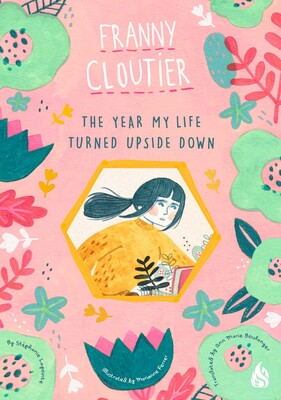
Today World Kid Lit Co-Editor Johanna McCalmont talks to translator Ann Marie Boulanger about how she brought Stéphanie Lapointe’s Franny Cloutier:The Year My Life Turned Upside Down to readers in English.
Johanna WKL: Thanks for joining us on the blog today. The Year My Life Turned Upside Down is such a fascinating book in so many colourful ways – literally! I can’t wait to find out more about how you translated the book from French into English but perhaps we can start by getting to know you first. How did you come to learn French? What made you want to become a translator?
Ann Marie Boulanger: Hi, Johanna! Thank you so much for inviting me.
I actually grew up speaking both French and English, as the happy product of a linguistically mixed marriage—a French-speaking father and an English-speaking mother—a situation that’s not uncommon here in Quebec.
Funny enough, I didn’t know that translation was a “thing” until I found out the older sister of my college boyfriend was enrolled in a translation program at university. That’s when the light bulb went off! I thought, what more perfect occupation for someone who loves languages? (Not to mention reading and writing!)
WKL: What drew you to literary translation? Would you say literary translation is different from other types of translation? And what do you enjoy most about translating kidlit?
I think a lot of translators harbour a not-so-secret desire to translate books, and I was no exception! However, like most translators, my path led me to commercial translation, which I did for close to 20 years before working up the confidence to tackle my first literary project.
I love the creativity involved in literary translation. It’s very different to the medical, legal and administrative texts I translate every day. I need to slip into a completely different mindset when I’m working on a literary or children’s book translation, and I love the euphoria that comes with finding the perfect word or rhyme. I also love the variety and the constant learning. On any given day, I could be translating a restaurant website, an autopsy report, or a book about dinosaurs. In what other job, I ask?! And if I’m being honest, I don’t hate seeing my name in the credits!
WKL: This book is pretty unique in how it’s formatted and illustrated like a diary. What else would you say makes this story stand out from other similar books?
It’s honestly unlike any other book I’ve ever seen. It’s colourful, eye-catching and engaging. And if the visual aspect doesn’t draw you in, you’ll quickly connect with quirky but loveable Franny! Hats off to Stéphanie Lapointe, who’s crafted a memorable series that I’m very proud be bringing to the English-speaking world.
WKL: What sort of reader is likely to enjoy the book? Just girls the same age as Fanny the narrator?
Definitely the middle school set, but I think adults who are fans of YA fiction will also get a kick out of it. After finishing my translation of book 2, I read the rest of the French series because I was so invested in Franny and her (mis)adventures that I had to know how things turned out!
WKL: I’m always curious about the background to fun projects. How did you get matched with this gorgeous book?
As it happens, my editor found me in the directory of the Canadian Literary Translators Association. So, take note, translators: It’s important to join associations and organizations. You never know who might stumble across your name!
WKL: And now a very practical question – how did you work on the translation? How long did it take you? Do you have a particular routine?
Since I work full time as a commercial translator, I don’t have the luxury of working on my literary projects in long, uninterrupted stretches. So, I incorporated the translation of Franny Cloutier into my workday as often as possible, doing a couple of hours here and there in between other deadlines. It did creep into my evenings and weekends toward the end, but I dictated much of my first draft, so that sped things up considerably.
WKL: Do you have any examples of sentences, words or chapters that were particularly challenging to translate? Are there any creative solutions you’re particularly proud of?
The book is presented as 14-year-old Franny’s diary, and I have to say, it’s gorgeous! It’s filled with drawings and doodles (by the talented Marianne Ferrer) and quirky margin notes added by Franny. So, I always had to be mindful of my translations fitting into the same physical space on the page, which was sometimes a challenge.
And, well . . . the main character’s name in French is “Fanny,” so as you can imagine, we needed to adapt that!
WKL: Were you guided by an editor or the publisher when finalising the English translation?
My editor was lovely to work with and mostly gave me free rein. The story takes place in a small town in Quebec, where the main characters all obviously interact in French. However, since the English version is aimed primarily at a U.S. audience, my editor kept me on track in terms of what would and wouldn’t work with an American readership. We may be neighbours, but what flies in Canada doesn’t necessarily pass muster in the United States. For example, we had to tone down Franny’s potty mouth a tad in the English version! But I felt very strongly about not erasing the “French-ness” of the book or Franny’s cultural identity, and while we made a few minor adaptations where nothing essential would be lost in translation, I’m happy to report that my campaign to leave “poutine” in the English version was a success!
WKL: What are you working on now? Any exciting projects you can tell us about?
As you read this, my translation of book 2 in the Franny Cloutier series is headed to print! I also just wrapped up a couple of picture books, one about a young squirrel and another about yoga, and an educational book for older kids about the history and origins of different spices and food ingredients (vanilla, cinnamon, pepper, salt, etc.).
That’s not to mention my more serious, everyday work in the medical and health science fields!
****

Ann Marie Boulanger is the owner of Traduction Proteus Inc., a part-time lecturer at McGill University, and co-founder of LION Translation Academy. When she’s not translating serious documents about serious things, she loves to translate books for kids and adults. Her translation The Woman in Valencia, by Annie Perreault, was named a Notable Translation of 2021 by World Literature Today. She loves to read and write, and she never leaves home without her e-reader, a notebook and a tube of lip balm! She lives in Montreal with her young son, doing work she adores and surrounded by family and friends. Read more about her work here.
 World Kid Lit