To continue our Reading Africa celebrations, Olatoun Gabi-Williams and WKL Co-editor Johanna McCalmont share a few of their favourites this year and one hot new release for your TBR out next year.
Middle Grade

Onyeka and the Rise of the Rebels
Reviewed by Johanna McCalmont
Written by Tolá Okogwu (Nigeria/UK)
Published by Simon & Schuster (2023)
Left with a nail-biting cliff-hanger at the end of the first book in the series, Onyeka and the Academy of the Sun, I couldn’t wait to find out how Onyeka and her friends would get out of the trap they had found themselves in.
It’s difficult to avoid spoilers (especially for anyone who hasn’t read the first book!), so I’ll try avoid giving away too much and simply say I breathed a hugh sigh of relief when I saw Onyeka and her friends regroup with help from Onyeka’s Aunt Naomi. Undeterred by their disappointment at the end of Book 1, they continue their quest find Onyeka’s father whilst also trying find a way to harness their special powers as Solarí so that they can use them without harming themselves or others, and also hopefully eventually serve their country Nigeria one day.
The tension is high in this real page-turner as the original group of friends learns to trust and cooperate with the new ‘rebels’. It’s a familiar format of a tight band of friends sticking together through thick and thin, love-hate relationships, lifted by plenty of jokes that’ll have readers laughing out loud. There is also a strong Nigerian flavour in every way (literally), from the mouth-watering food the characters seem to be forever eating, to the lilt of Hassan’s pidgin that admiring younger kids try to emulate in their own cute way. Readers who love a good adventure and the whirlwind tension added by fantasy superpowers that aren’t quite under control will definitely be kept on the edge of their seats with Tolá Okogwu’s series. How many months until Book 3 comes out next year?!
Young Adult

The Impatient
Reviewed by Johanna McCalmont
Written by Djaïli Amadou Amal
Translated by Emma Ramadan
Translated from French (Cameroon)
Published by HarperVia (2023)
While not specifically published as a YA novel, Djaïli Amadou Amal’s The Impatient has already caught the attention of teen readers in both France and Germany, winning the Goncourt des Lycéens in 2020 before being nominated by the Youth Jury for the German Children’s Literature Prize earlier this year.
Now available in Emma Ramadan’s English translation, The Impatient tells the story of three woman living in Northern Cameroon: Ramla, Hindou and Safira. Each character narrates one part of the novel, drawing readers into three different, yet intertwined, and ultimately similar experiences of women who are at the mercy of decisions taken by their fathers and husbands. 17-year-old Ramla dreams of going to university and marrying the young man she loves—one of her brother’s friends—but her father marries her off as the second wife to a rich 50-year-old. On the same day, Ramla’s half-sister Hindou is married off to her violent, drunken, womanising cousin. And, in the final part, 35-year-old Samira, the first wife of Ramla’s new husband, reveals her own tribulations, recounting how her father gave her as a wife to replace her sister who had died young. Samira’s jealousy of Ramla and her devious schemes to oust her co-wife ultimately have lasting ramifications for both women.
Amadou Amal’s novel is not an easy read by any means. The dialogue-rich text expresses the full force of the violence inflicted upon these women who are all being urged to forever remain patient, to demonstrate munyal. Nor does the story shy away from the tough themes of forced (child) marriage, domestic abuse, and sexual violence of the most brutal kind. Like Ananda Devi’s Eve Out of the Ruins (WKL review here), The Impatient is not for the faint-hearted, but there is no denying that Amadou Amal is an exciting new female voice from Africa worth watching.
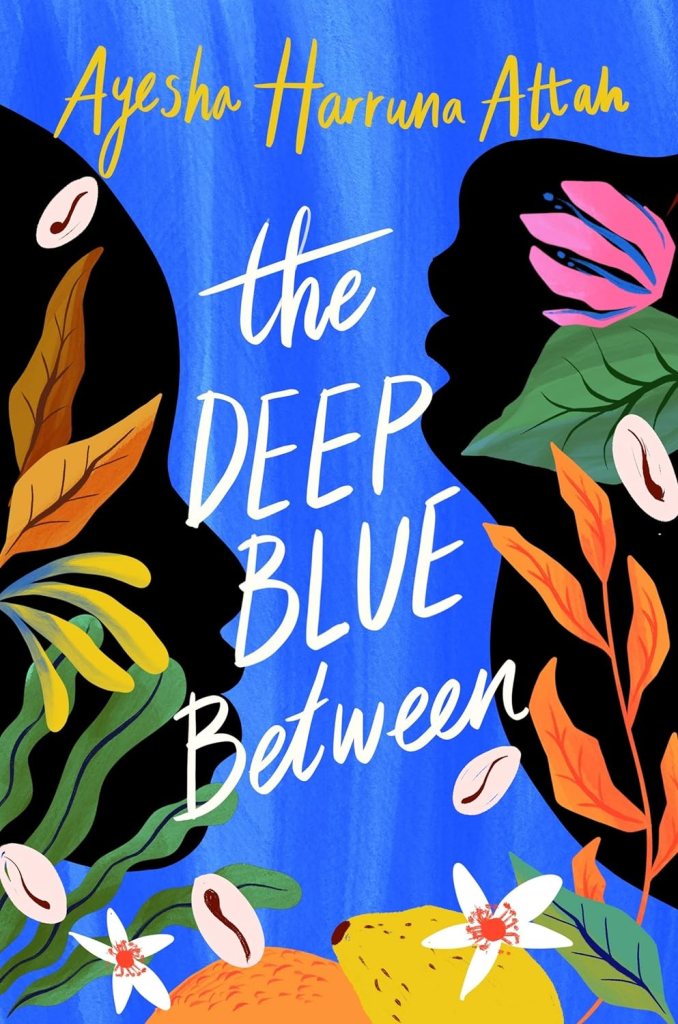
The Deep Blue Between
Reviewed by Johanna McCalmont
Written by Ayesha Harruna Attah (Ghana)
Published by Pushkin Children’s Books (2020)
Set in the 1890s, this historical fiction for young adults spans the Atlantic, the deep blue between of the title. Narrating alternate chapters, twins Hassana and Husseina become separated after their village is burned to a crisp during a raid. Yet the 10-year-old girls remain connected through their spirits and dreams. Hassana ends up living with Christian missionaries, but she is eventually urged by their daughter to follow the signs in her dreams. With help from the daughter, Hassana secretly runs away to Accra to be closer to the water that she keeps seeing in her dreams. Husseina, meanwhile, is rescued from abusive Baba Kaseko by Yaya who initiates her into a new religion, Candomblé, and soon whisks her away to greater safety in Brazil. The years pass, but the twins continue to miss each other. “Keep listening. She may be looking out for you is what your dream tells me,” wise Baba Sule advises 15-year-old Husseina, who now goes by the name of Vitória. So she boards a ship back to Lagos, leaving behind the terreiro she helped save, along with her young love Joaquim.
Without wanting to give away the end, I will say that Ayesha Harruna Attah has masterfully woven together a story full of hope, despite the stark historical context she has carefully recreated. Slavery, for example, may have been officially abolished, yet its spectre is still tangible, seen in both the locations in the story and the lasting imbalance in relations in the societies in which the twins live. The mix of religions and languages in which Hassana and Husseina live, such as English, Portuguese, Hausa, Gourmanchéma or Yoruba, not only reflect the multilingual reality of their daily lives, but also highlight the influence of colonisation in the region. And the effects of the British war against the Asante are also hauntingly echoed in the psychological trauma that Hassana sees it inflicts on Private Osman who she ultimately tries to rescue from an asylum. So much history in just 252 pages, all tied together with the page-turning tale of a bond between two twin sisters that will not be destroyed. The Deep Blue Between is a story that I won’t forget quickly!

The Djinn’s Apple
Selected by Johanna McCalmont
Written by Djamila Morani
Translated by Sawad Hussain
Translated from Arabic (Algeria)
Published by Neem Tree Press (Feb 2024)
I haven’t had a chance to read this one yet, but I’m looking forward to its release next year, so I’ll just leave you with the publisher’s blurb.
Historical fiction meets crime fiction in The Djinn’s Apple, an award-winning YA murder mystery set in the Abbasid period—the golden age of Baghdad.
A ruthless murder. A magical herb. A mysterious manuscript.
When Nardeen’s home is stormed by angry men frantically in search of something—or someone—she is the only one who manages to escape. And after the rest of her family is left behind and murdered, Nardeen sets out on an unyielding mission to bring her family’s killers to justice, regardless of the cost…
Full of mystery and mayhem, The Djinn’s Apple is perfect for fans of Arabian Nights, City of Brass, and The Wrath and the Dawn.

Sacred Nile
Reviewed by Olatoun Gabi-Williams
Photos by Chester Higgins (USA)
Text by Betsy Kissam (USA)
Published by March Forth Imprint (2021)
Chester Higgins is a renowned African-American photographer who spent 50 years in a passionate exploration of the Nile Region. His aim was to bring fresh perspectives on Ancient Egypt (Kemet – the Black Land), Ethiopia (Kush) and Sudan (Nubia). With Betsy Kissam, he has documented what he found in a 229-page book called Sacred Nile.
It is an epic work of beauty in which you will find luminous prose and extensive research. Absorbing and well-paced, through Sacred Nile, Higgins has gifted us not only stirring perspectives about a place known as the cradle of civilization, but a vast trove of images, each exuding the ineffable quality for which his photographs are known.
I encourage parents of young adults to explore the Nile Region alongside their teens guided by Chester Higgins. Enjoy the images—of course—but try also to read the introductory Notes on Ancient Names. Here you will find a clear, analytical chart of the fascinating system of writing known as hieroglyphics—the Sacred Language of Priests. There is brief but valuable context about the history and political culture of Kemet—the Black Land. In the Notes, the authors throw open a window onto one of the most epochal moments in the history not only of the African continent, but of the world: the conquest of Egypt by General Napoleon Bonaparte in 1798 followed by the 4-year occupation of Egypt by France and during that period, the discovery of the Rosetta Stone.
What is the Rosetta Stone? It’s a 196 BCE royal decree written in demotic and hieroglyphic scripts and ancient Greek. It was the decoding of the Rosetta Stone in 1822 by a team of French scholars led by the linguist, Jean-Francois Champollion, which made it possible for scholars—who would become known as Egyptologists—to unlock voices hidden inside theological documents of Kemet. By unlocking those voices, they were able to begin the unveiling of the extraordinary culture of Ancient Egypt.

Olatoun Gabi-Williams is a Nigeria-based journalist, publicist, child welfare advocate, elder care and dementia advocate, public speaker, administrator, and non-profit founder. In 2015, she founded Borders Literature for all Nations which in 2021 joined United Nations Namibia and 5 pan-African Book industry institutions to establish the UN SDG Book Club African Chapter.

Johanna McCalmont was born in Northern Ireland and now lives in Brussels, Belgium where she works from French, German, Dutch and Italian. Her work has been published by Indiana University Press, Blue Dot Kids Press, and Arctis. She loves connecting writers with audiences when interpreting at literary festivals and has a particular interest in African literature.
 World Kid Lit