It’s #WorldKidLitMonth! Today, author, translator and teacher Holly Thompson whisks us off to East Asia with two great reviews – a YA fantasy from Japan and a graphic novel biography from Taiwan.
By Holly Thompson

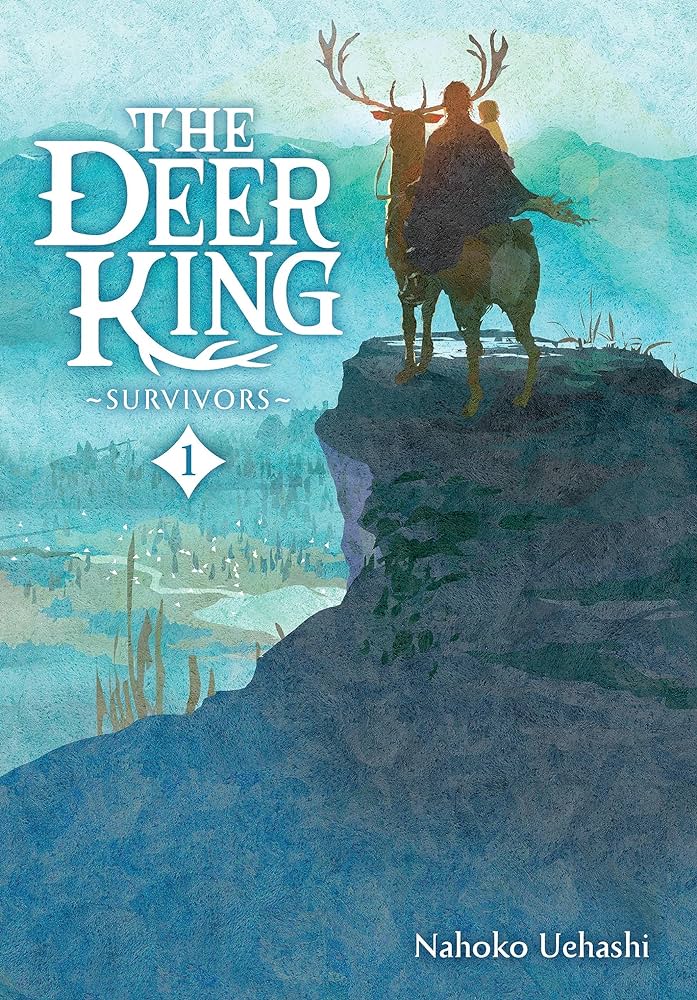
The Deer King Vol. 1 Survivors, Vol. 2 Returners by Nahoko Uehashi
Translated by Cathy Hirano, Cover art by Masaaki Yamamoto, Map art by Yui Ohara
English Translation published by Yen Press (2023 & 2024); originally published by Kadokawa Corporation, Japan
Author Nahoko Uehashi is a giant in Japanese young adult fantasy literature. Uehashi, a former professor of anthropology, crafts intricate, vivid worlds with stories set in complex societies. Uehashi’s books previously translated into English by Cathy Hirano include books 1 and 2 of the Moribito series, and the duology The Beast Player and The Beast Warrior.
The Deer King duology opens in Volume 1 with a harrowing scene deep in a salt mine where chained and enslaved people are being attacked by wolf-like beasts that infect victims with a fatal disease. Van, an enslaved former warrior, originally from a herding community in a mountainous region, is the only one to survive, or so he thinks, until he finds his way out of the mine and discovers the toddler girl of a dead servant. He flees the abandoned mine with the girl he names Yuna and sets off into the forestto elude authorities. On encountering an injured man with a reindeer-like flying pyuika he can’t control, Van—a former pyuika herder—helps him, and with Yuna, takes shelter in the man’s remote community. Van begins to notice strange sensations, plus a voice within him, perhaps related to the beast bite he suffered in the salt mine.
The world of the story expands to the lands that Van and his Lone Antler warriors had fought in, domains that clash, and a young medical researcher Hosalle investigating the attack at the salt mine with a team trying to determine what or who had attacked the enslaved laborers. Hosalle suspects victims died of black wolf fever, and aims to find the person they believe is the sole survivor. He convinces Sae, a skilled female tracker, to assist in locating Van, but beasts attack them and Sae disappears, presumed dead.
The story shifts between the mystery of the salt mine attack and the medical implications for future clans and kingdoms. Differing clan views regarding illness and medicine, opposing approaches to land and resource use, plus undercurrents of distrust and animosity between warring factions result in layered social conflicts. Efforts to understand the mysterious attacking “beasts,” as well as how to treat those bitten by them and whether or not people can be immunized against the disease the beasts carry, add layer after layer to the story. Interpersonal conflicts and efforts to outwit both the beasts and those who might be controlling the beasts drive the story forward in unpredictable and intriguing ways.
Nahoko Uehashi’s tales are always richly-crafted, circuitous journeys through well-honed societies set in detailed natural worlds; readers are led to mull over plots and characters in scenes that reverberate long after the final pages. Cathy Hirano again produces stellar translations from the Japanese in these two volumes of The Deer King.
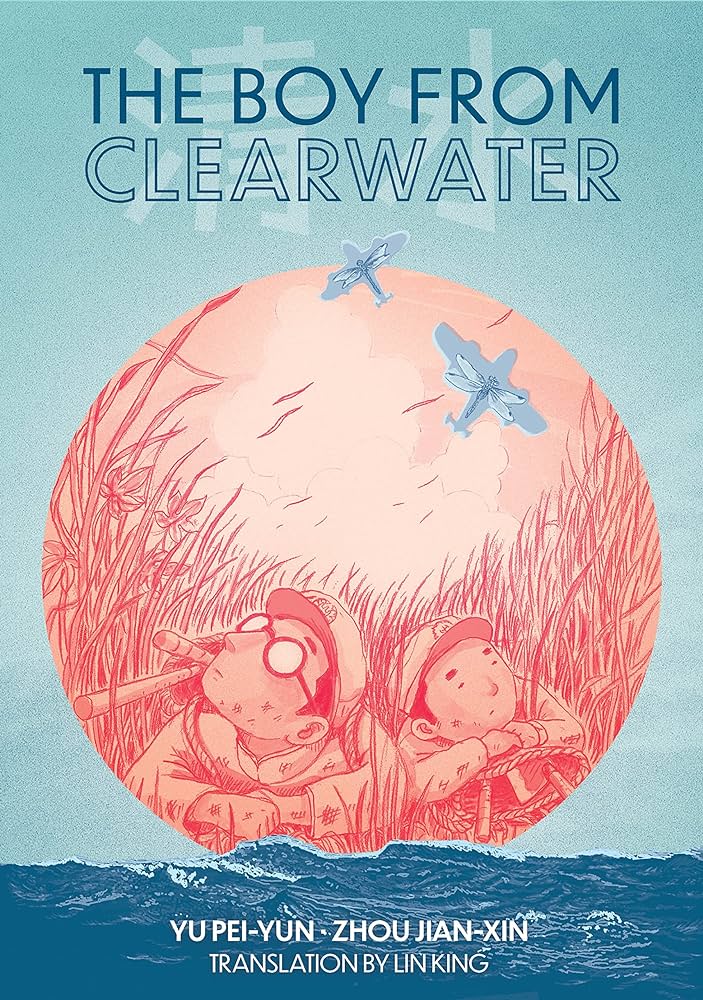

The Boy from Clearwater, Book 1 and Book 2
Written by Yu Pei-Yun, illustrated by Zhou Jian-Xin, translated by Lin King
English translation published by Levine Querido (2023 & 2024); originally published by Slowork Publishing, Taiwan
Translating The Boy from Clearwater, the graphic duology biography of Tsai Kun-lin into English, was an ambitious feat. Taiwan’s diversity of languages from the 1930s to 2020s means that Hoklo Taiwanese, Mandarin Chinese, and Japanese are spoken by the many individuals that appear in Books 1 and 2; some have names in three languages. Color coding of text in speech balloons makes for smooth reading in English, while also enabling readers to visually grasp linguistic shifts. Here and there informative captions offer historical context and background; helpful in-depth timelines appear at the end of each book. Dynamic shifts in color and illustration styles accentuate the upheavals in Tsai Kun-lin life.
The biography of Tsai Kun-lin—referred often throughout the duology as Khun-lim—opens in 1935 midway through Japan’s control of Taiwan when he was an elementary school student. Intricate illustrations draw readers into the relatively peaceful daily life of this period of his childhood in expressive panels that feature delicate lines of black, white, pink and red.
But after Khun-lim’s family celebrates the Imperial Japanese Army’s occupation of Nanjing, Japan’s Navy attacks Pearl Harbor, and life takes a turn. School involves military training and sounds of war, a sibling is called up to fight, jobs are lost, then the unthinkable happens—Khun-lim is drafted as a student soldier at age 15.
When at last the war ends, and Japan surrenders with Taiwan returned to the Republic of China led by the Kuomintang in the fall of 1945, Khun-lim can again return to school, though now learning in Mandarin Chinese. Khun-lim is indoctrinated with new patriotic principles, and a purge to suppress Taiwanese civilian unrest interrupts his education. Then, when the communist People’s Republic of China is established, a stand-off begins with the Taiwan-based Republic of China, and leader Chiang Kai-shek establishes a military dictatorship.
One day in the fall of 1950, tricked into entering a police station, Khun-lim is arrested, and so begins Part 2, and ten years of imprisonment, starvation, abuse and isolation in detention centers, a concentration camp for reeducation, then a correction center on a small island off Taiwan. Illustrations shift into heavy blacks, and misery is lightened by moments of kindness among prisoners, a vegetable garden, songs, memories, and even the brutal labor that helps them forget about fellow prisoners they’ve lost. Restrictions are eventually eased a bit, a nephew sends books, and Khun-lim, over time, writes his thoughts and experiences to his nephew, until at last he is released. Color returns to the panels—blue water, skies, trains—and Khun-lim returns to his family in 1960.
Part 3, the first half of Book 2, sees Khun-lim reunited with family, rebuilding his life, struggling to find a job and stay employed. Yellow panels build warmth as he reconnects with his childhood crush, Kimiko/Pik-ju, now a teacher, and he finds work in translation, then as an editor of a monthly children’s magazine, then co-founding a subscription children’s manhua (Taiwanese manga) press. Hope has returned, Khun-lim and Pik-ju marry, but life is full of complications, and Khun-lim’s past “criminal record” seems like it might shatter his fragile new life. Upheavals occur again and again, with stability, financial gains, and opportunities followed by huge losses, then bankruptcy.
In Part 4, the illustration style returns to fine black line work, with touches of gray, pink and red as Khun-lim manages to reinvent himself again in the 1970s, but the storytelling mode shifts yet again, now with the duology’s author Yu Pei-Yun entering the story having met Khun-lim at a human rights exhibition focused on victims of Taiwan’s White Terror Era (1949-1992). Yu interviews Khun-lim about his life and his choices, work opportunities he grabbed when they came along, social unrest and political change in Taiwan. Graphic styles shift for past events recalled and the later years of Khun-lim’s life, when he starts telling his life story to his children, revisits the island where he’d been a prisoner for so long, and publishes an essay of his experiences.
Author Yu’s dedication to understanding Taiwan’s hidden history and learning about peaceful reform are woven together with Khun-lim’s quest to share the stories of other prisoners with their surviving family members, and his chance to speak at the opening of a Human Rights Museum on the very island where he and so many others had suffered at the hands of their own government.
These two volumes about the spirit and determination of Tshua Kun-lim are vital works in the pantheon of human rights literature. The collective artistry by author, illustrator and translator will inspire thinkers and peacemakers of all ages.
About Holly

Holly Thompson (www.hatbooks.com) is the author of the verse novels Falling into the Dragon’s Mouth, The Language Inside and Orchards, the novel Ash and picture books Listening to Trees: George Nakashima, Woodworker; Twilight Chant; One Wave at a Time; and The Wakame Gatherers. A graduate of the NYU Creative Writing Program, and a long-time resident of Japan, she writes poetry, fiction and nonfiction for children, teens and adults, and teaches creative writing in Japan, the U.S., and places in between.
 World Kid Lit