By Paula Holmes
I always love learning what people are reading or what’s on their TBR (to be read) pile. When asking about a book, the answers are usually divided into two categories: good (it’s a good book), or different (I really like it, but it is different, and you might not think it’s good). I have been collecting children’s books for over 30 years. I’ve learned you can’t keep everything, so over the years I have been refining my collection to focus on translations. I love my collection and my literary diet, but it means I probably haven’t read the latest bestseller, or celebrity book written for children, or popular series for kids. I am known to purchase extra copies, and as a librarian, I do weed my collection. It’s a joy to find a happy educator looking to share diverse and global books with their students. On the rare occasion, the response to my collection is unsettling. A friend once described the books I love as a bit strange and different. I would say that every book in my collection is a good book, and that reading translations and reading globally has enabled me to embrace the different, (slightly) strange, and unruly. What a gift to allow my mind to have flexibility. My suggestions for your collection:
STORY OF THE EVERYTHING, THE NOTHING, AND OTHER STRANGE STORIES

Written by Gyula Gábor Tóth
Illustrated by Norbert Nagy
Translated from Hungarian by Adam Z. Levy
Published by Transit Children’s Editions
Well, the title says it all, “other strange stories”. Seeing the title I knew there is a high probability that I was going want this book in my collection. Cats on the cover floating in frog-like hot air balloons that blow bubbles made it a definite. The book is composed of very short stories including “Story of the Little Boy Whose Pajamas Wouldn’t Let Him Go to Sleep”. I had sheets like that. I took storytelling in college, where we were given a few “ingredients” and had to tell a story in that moment. It’s a gift to be able to tell a story well, capture your audience, make it short, and have the audience always wanting more. This book demands to be read aloud; the illustrations beg to be examined closely and multiple times. I love the use of questions in the stories that allows interaction with readers (and listeners): “What else do you think wasn’t in this nothing?” Are the stories strange, yes, but isn’t that what curious and imaginative kids want? Isn’t it what we want them to have, to become the next generation of storytellers?
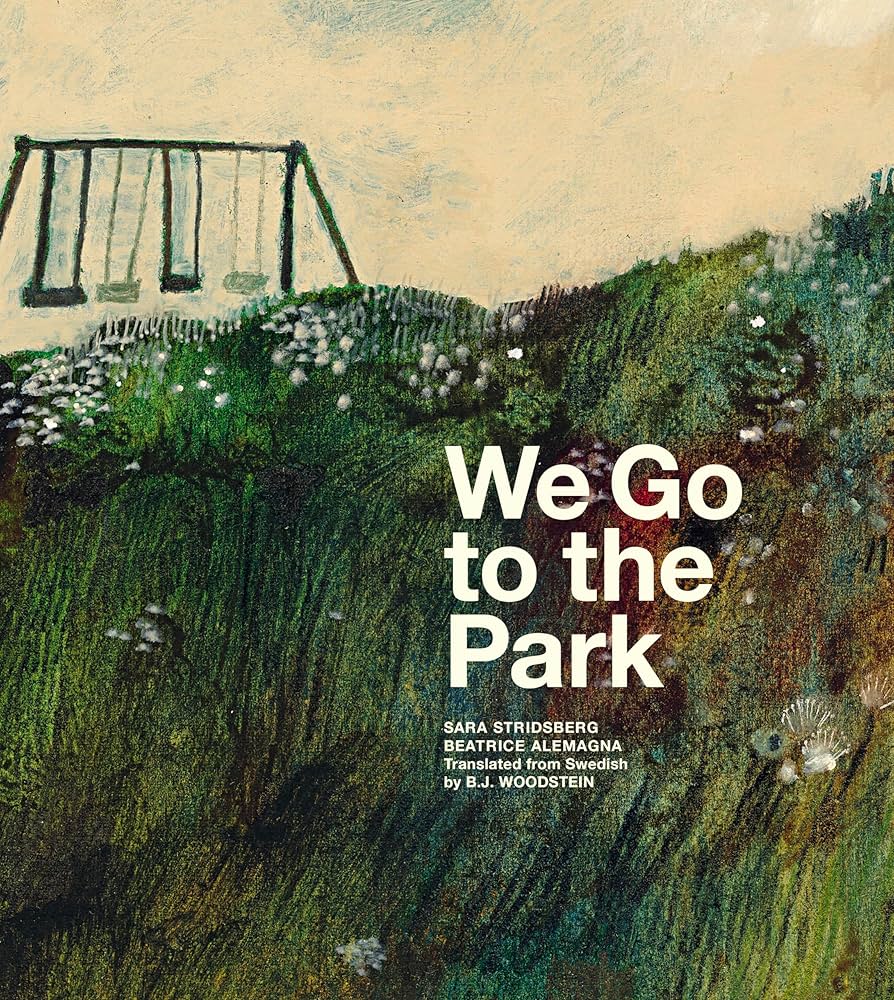
Written by Sara Stridsberg
Illustrated by Beatrice Alemagna
Translated from Swedish by B.J. Woodstein
Published by Unruly an Imprint of Enchanted Lion Books
Originally published in Sweden
I don’t know if it started with Heinrich Hoffmann’s 1845 picture book Der Struwwelpeter which stated the book was for children 3-6 years old, but this seems to be an ongoing assumption in the US that picture books are for children 3 to 6. I so appreciate that Unruly (an imprint of Enchanted Lion) is challenging that notion. Since 2020, Unruly is defying norms, with titles such as The True Story of a Mouse Who Never Asked for It, You Can’t Kill Snow White, and The Book of Denial. If not for Unruly, we would not have the access to these picture book translations for teens and adult. Unruly’s latest title is WE GO TO THE PARK. Unruly, just like Enchanted Lion, creates books with beautiful printing, binding, and thick creamy paper that make the Beatrice Alemagna illustrations feel like each page is an original.
My underwhelming high school academic career made me think that poetry was not for me. Any joy had been beaten out of it by overanalysis. So, what a gift to read B.J. Woodstein translate Sara Stridsberg’s poetic voice with Beatrice Alemagna’s images of playgrounds of Paris. I’m transported, not only to Paris, but to the parks and woods of my childhood. The green spaces, the smells, the flying freedom of the swings, the unnerving feeling of ants crawling on flesh, poetry that allows you to feel, remember, breathe. Sparse words paint a huge picture, and the pictures create a huge dialog. The book has taken on a larger format as exhibition, reminding us of all that picture books are accessible art and poetry to enjoyed by all ages. This is a great book for discussion. My favorite comment coming from my discussion with the book was “For an adult the park is a time out of their day, but to a child the park is their entire day”. If you want to do a book group, I suggest pairing this book with Unruly’s You Can’t Kill Snow White, also from Beatrice Alemagna, translated by Karin Snelson and Emilie Robert Wong. May we all be unruly in our reading!
MARCELO, MARTELLO, MARSHMALLOW

Ruth Rocha and Ana Matsusaki
Translated from Portuguese by Tal Goldfajn
Published by Tapioca Stories
Originally published in Brazil in 1976 as Marcelo, Marcelo, Marmelo
For the last several years, I have been following what’s coming out from Tapioca Stories, a New York-based publisher with a focus on translations. I have found the best way for me to discover high quality #worldkidlit in the US is to follow the handful of small independent publishers printing high quality translations. I find authors, illustrators, and translators to follow this way. Last year, Tapioca Stories published The Collector of Heads by Ana Matsusaki, an absolute original, illustrations not typical of US books. I couldn’t wait to see what would come next from Ana Matsusaki, and I didn’t have to wait long. This year, Ana Matsusaki is the illustrator of Marcelo Martello Marshmallow written by Ruth Rocha and translated by Tal Goldfajn. I’m a huge fan of collage as a medium for illustrations. The illustrations and word play in this book do not disappoint. Kudos on the translation decision of changing marmelo to marshmallow. That word change created such fun pages, a bathtub collage with marshmallows as bubbles and Marcelo’s reflection in the bathroom mirror becoming a marshmallow head wearing glasses. Don’t forget to look under the book jacket. The illustrations will have you reading this over and over. I loved spying the toolbox on different pages and the unexpected use of Jello. The text is equally delightful, with Marcelo questioning language and reinventing language to better fit the meaning. The only question is, will we start the morning with greetings of “Good sunning!” now?
A note about my love for collage–for that I must thank Canadian author and illustrator Irene Luxbacher. In 2019, at the USBBY regional conference, as part of a book tour from Deep Underwater, Irene taught a mini workshop on making tiny collages. I haven’t stopped collaging since.
About Paula

Paula Holmes has served in a variety of volunteer capacities for the Association for Library Service to Children (a division of the American Library Association), USBBY (The United States Board on Books for Young People) and currently as a University of Alabama MLIS National Advisory Board Member and Consultant. Paula is known to create tiny collage art, support translations of children’s literature, practice ballet, and is on a quest to learn Finnish.
 World Kid Lit