
by Ruth Ahmedzai Kemp
It’s Black History Month in the UK: the perfect time to explore the lives of strong Black women who have changed the world.
From the unwritten histories of women in 18th century Colombia, silently braiding messages in others’ hair to help them escape enslavement and seek refuge in free communities, or ‘palenques’ … to Rosa Parks’ quiet act of defiance that boosted the civil rights movement in 1950s USA … to Kenya’s Wangari Maathai and her transformative act of sharing seedlings and helping others, tree by tree, to reforest a struggling landscape … these are stories of bold and brave Black women challenging the status quo and – with each individual who stands alongside them – gradually changing the world around them.
Freedom Braids
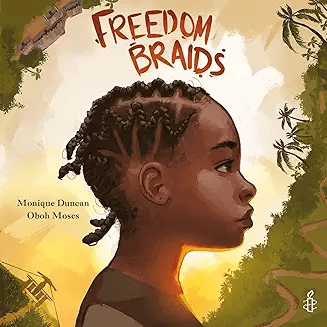
Written by Monique Duncan
Illustrated by Oboh Moses
Published by Lantana Publishing, 2024
Buy from Bookshop.org / Lantana Publishing
“Beyond slaveholders and sugarfields – freedom braids led the way.”
As Nemy braids her cousins’ and aunties’ hair in the dim twilight, she learns to weave in messages and maps to freedom in this beautiful, hopeful picture book telling an imagined version of a true story.
Nemy is an enslaved girl of African descent in 18th century Colombia, when many people risked their lives to escape and set up free communities, palenques. Without access to writing or maps, hair braiding was the means of communicating secret messages and enabling others to find the route to freedom.
“Some braids were thick and tight, delivering messages to flee. Others were skinny and curved, showing roads to travel.” As the sun rises in one spread, the woodlands and paths on the hill ahead are reflected in the twisting, zigzagging braids in Nemy’s hair.
This book is a stunning introduction to an important part of African American history: a creative expression of determination and resilience in the face of oppression.
Rosa’s Bus

Written in Italian (Italy) by Fabrizio Silei
Illustrated by Maurizio A. C. Quarello
Translated into English by Siân Williams
Published by Darf Publishers, 2022
Buy from Bookshop.org / Darf Publishers
When Ben’s grandpa takes him to Detroit, to the Henry Ford Museum, to see something important, Ben is disappointed and confused when the ‘surprise’ turns out to be some boring old bus. “Poor me, thought Ben, he’s really gone off his rocker. It must be the prostate.” But then when they take their seats on this mysterious bus, Grandpa tells of how he was in this seat in 1955 the day that a Black lady refused to give up her seat to a white person. The day that Rosa Parks said “No”.
Illustrated in an edgy painted style, the images switch to monochrome and the narrative adopts a different typefont when we step into the past with Grandpa’s story. Not shying from conveying the violence and fear of the time, this is an emotionally involving version of Rosa Parks’ story, perhaps ideal for children of 8 or older.
Particularly moving is the way Grandpa passes on the challenge to Ben, to hold his head up high and not be afraid to say “No”. “We thought she was mad, but it was we who were mad, so used to hanging our heads and always saying ‘yes’. That’s why I’ve brought you here today, to remind you that there’s always a bus which goes by in everyone’s life.”
With their little journey into the past, Grandpa urges his grandson Ben not to be afraid as he was back then, and not to miss the bus when his chance comes along to make a difference.
Mama Miti: Wangari Maathai and the Trees of Kenya

Written by Donna Jo Napoli
Illustrated by Kadir Nelson
Published by Paula Wiseman Books/Simon and Schuster, 2017
Buy from Bookshop.org
As Wangari Maathai, or Mama Miti, becomes known and respected for her knowledge of nature and ecology, women come to her asking for her advice. “I have too little food to feed my family,” says one woman seeking her help. “What can I do?” Wangari places some seedlings of the mubiru muiru tree in the woman’s hands. “Plant as many as you can. Eat the berries. Thayu nyumba – peace, my people.”
To every woman who seeks her help, she gives a seedling: mukinduri trees for firewood, muheregendi for animal fodder, muthakwa wa athi for medicinal leaves to treat sick cattle. And for each woman, a message of strength, of hope: “Thayu nyumba – peace, my people.”
One by one, village by village, a movement starts, as women teach each other and share the trees to plant for sustainable development, for resilience, and for biodiversity to return where it was struggling. As the Greenbelt Movement spread, Kenya’s capital city, Nairobi, once known as Kiinuini —”the place where there are many miinu trees”— became lush with trees again.
Kadir Nelson’s striking illustrations combine almost photographic painted individuals layered over with a collage of fabrics, a celebration of the rich colours and patterns of African textiles. The back matter includes a full glossary of the Kikuyu words used in the book, together with the scientific names for the trees described.
A remarkable academic, ecologist and politician, who was imprisoned for her activism, and whose impact on her country and on the world was fêted with the Nobel Prize in 2004, Wangari Maathai’s life story, as told here, is an inspiring embodiment of the Kenyan notion of harambee: a Swahili word meaning the spirit of pulling together for the common good.
About Ruth
Ruth Ahmedzai Kemp is a translator and teacher of Arabic, German and Russian. She’s a passionate advocate of world literature for young people and diversity in children’s publishing and education, and is managing director of World Kid Lit CIC.

Support World Kid Lit!

World Kid Lit CIC is a non-profit company that aims to bring diverse, inclusive, global literature into the hands and onto the bookshelves of young people. We rely on grants and donations to support our work. If you can, please support us at Ko-fi. Thanks!

We earn a small commission every time you buy books via the Bookshop.org links on our site. This is a much appreciated donation towards our work. Thank you!
 World Kid Lit