By Ekram Abdelgawad and Ruth Ahmedzai Kemp
For Read Palestine Week, we share five books for young people by Palestinians of the West Bank and the diaspora: stories of historic Palestinian cities, of families forced to flee violence and losing the right to return to their homes, and of a culture, a heritage, and a memory of Palestine that lives on in Palestinian communities around the world.
Picture books
A Map for Falasteen
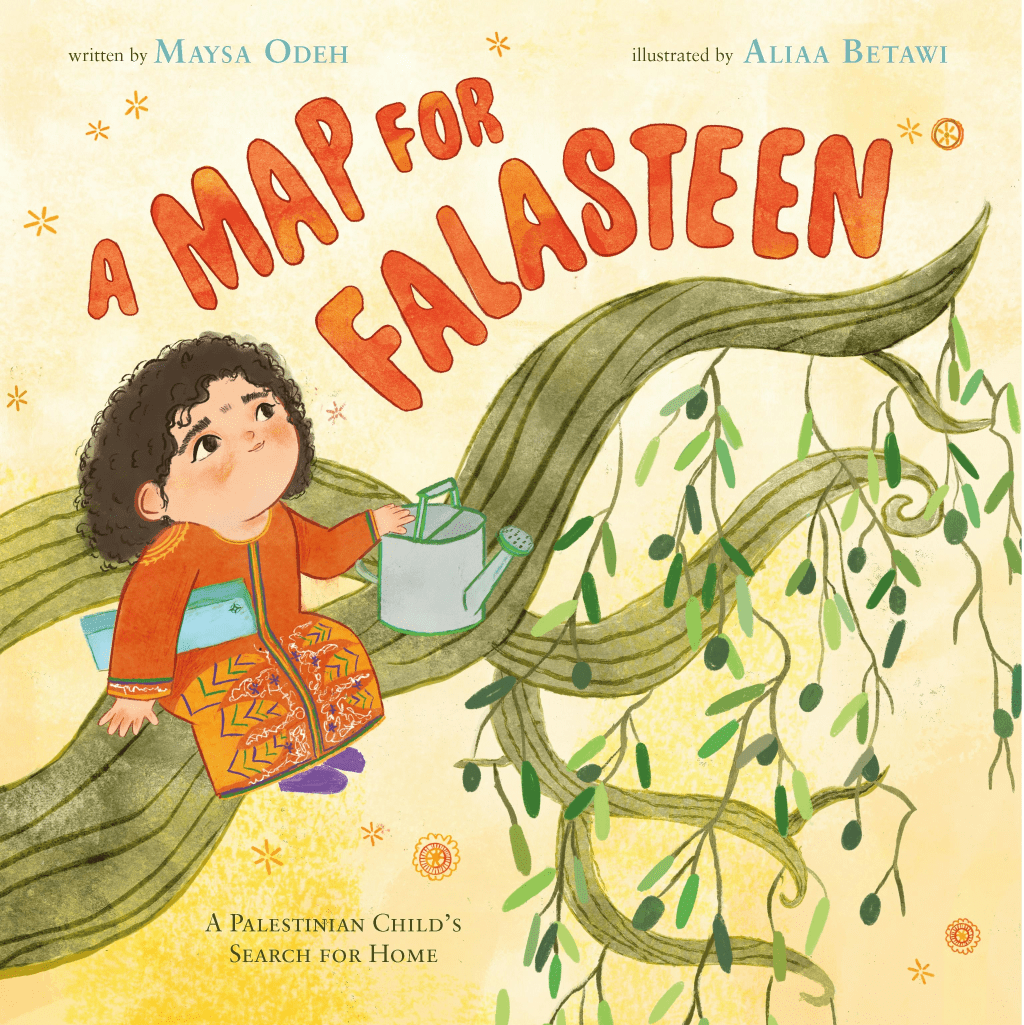
Written by Maysa Odeh, illustrated by Aliaa Betawi. Published by O’Brien Press (Ireland)/Henry Holt BYR (US), 2024. Reviewed by Ruth. Buy at Bookshop.org
Can a place exist if it’s not on a map? When Falasteen’s classmates in the USA look on a map of the world to find the countries where their families are from, she is confused to find that Palestine isn’t there. She asks first her teacher, then her grandpa, Jido, her grandma, Teta, then her mother: “Why isn’t Palestine on the map?” Their wide-ranging answers reassure her that Palestine very much exists, even if it isn’t included on most maps. Palestine is in her name (Falasteen is the Arabic pronunciation of Palestine), in the spinach pies she makes with Teta, in the key from their family home, in the embroidery of the thobe she wears at Eid, and in the map that Jido can draw from memory. But as Mama points out, “Sometimes people live in countries. Sometimes countries live in people.”
Emotive illustrations combine the abstract and figurative (Teta fleeing the violence of 1948, carrying their family home on her back) with cosy details of a Muslim Arab-American family home (an ‘oud leaning against the bedroom wall, a prayer mat on the floor, and a copy of picture book classic The Proudest Blue on her bedroom table) in this very relatable story of a second generation family keeping their connection to their roots. As Falasteen echoes her question four times, so too does her Mama echo her reply: “Palestine lives in you and me.”
Homeland: My Father Dreams of Palestine
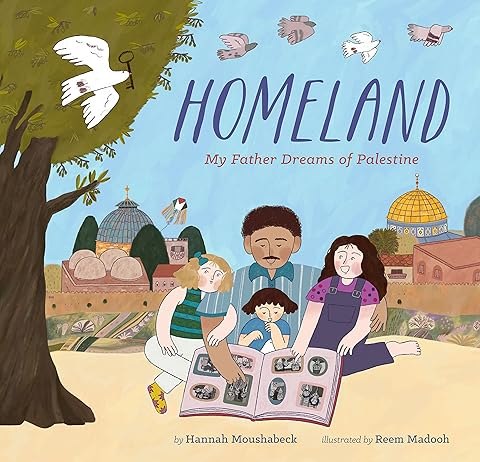
Written by Hannah Moushabeck, illustrated by Reem Madooh. Published by Chronicle Books, 2023. Reviewed by Ruth. Buy at Bookshop.org
Inspired by the bedtime stories her father Michel shared with her and her sisters about his memories of East Jerusalem, Hannah Moushabeck brings a multicultural city and community to life. We meet the juice vendor who roamed the streets carrying a huge tank of delicious jellab on his back, tapping out rhythms on his brass cups that Michel mimicked in his Teta’s kitchen, using her best china! And we meet Michel’s Sido (as the guide to key Arabic phrases in the backmatter explains, both jido and sido are local words for grandfather), a pillar of the community and owner of the local cafe where intellectuals and poets meet to exchange ideas over a coffee.
Michel remembers the last day he saw his grandfather before he had to leave Palestine: the day Sido showed young Michel his homing pigeons, skillfully guiding them into a circle in the sky with only a swish of a stick with a black cloth on the end. As bedtime stories morph into hopeful dreams of peace and return, the white peace doves hanging from the girls’ bedroom merge into a dream of those homing pigeons flying back to their homeland with keys in their beaks.
Illustrated chapter books
The Little Green Drum
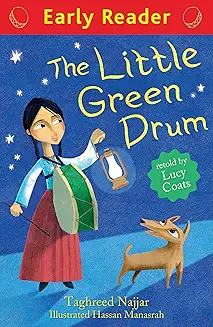
Written by Tagreed Najjar, translated from Arabic by Tagreed Najjar and Lucy Coats. Illustrated by Hassan Manasrah. Published in the UK by Orion Children’s Books, 2015. Reviewed by Ekram. Buy at World of Books
A Dawn Waker-Upper called Yaba used to live in a village named Lifta in Palestine. “Wake up, sleepyheads. It’s time to eat!” These are the words Yaba shouted every night in the holy month of Ramadan marching around the village banging his drum. The villagers used to wake up to eat their early morning meal (Suhoor) to get ready for fasting the whole day till sunset. Yaba had a daughter named Samia. One day just before the first day of Ramadan, Yaba got very sick. Samia decided to do his job instead of him and wake the whole village. She took her green drum, a lamp and her dog Barkie and went to the village to wake people for the first Suhoor. Despite the danger she faced, Samia managed to get to the village. BOOM-A-BOOM. “Wake up, wake up sleepyheads! It’s time to eat!” she cried at the top of her voice. What happened when Samia marched around the village made it a memorable night for all the villagers young and old. The incidents of this story took place in the 1930s. The village of Lifta is still there, though now it is “empty and unlived in”. But in other parts of Palestine, the Dawn Waker-Upper still wakes people up for their Suhoor every day in Ramadan.
We Are Palestinian: A Celebration of Culture and Tradition
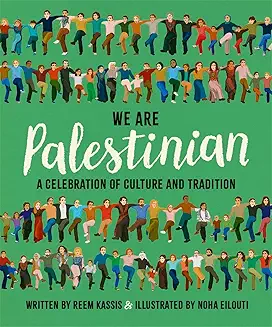
Written by Reem Kassis, illustrated by Noha Eilouti. Published in the UK by Studio Press (imprint of Bonnier Books UK) and in the USA by Crocodile Books (imprint of Interlink Publishing), 2023. Reviewed by Ruth. Buy at Bookshop.org
Published by Interlink (the publishing house founded by Michel Moushabeck, star of the above picture book, and now run by his daughter, Hannah Moushabeck), this is a colourful and joyful celebration of Palestinian history, food, art and culture. We’re taken on a tour of the fascinating nooks and crannies (and churches and caves, bakeries and local crafts) of places within what is now Israel, as well as Gaza and West Bank cities such as Bethlehem and Ramallah. We discover Palestinian embroidery, traditional dress, the famous keffiya scarf, and the Handala cartoon meme. We’re treated to delicious nuggets of food from knafeh, to maqlubeh and za’atar; we hear of the many uses of olives, and we meet iconic writers, artists and cultural figures from poet Mahmoud Darwish, to feminist author Sahar Khalifeh, to 23-year-old Gazan artist Malak Mattar, to the much-loved journalist Shireen Abu Akleh.
Young adult
Trees for the Absentees
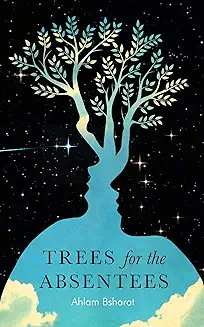
Written by Ahlam Bsharat, translated from Arabic by Ruth Ahmedzai Kemp and Sue Copeland. Published by Neem Tree Press, 2019. Reviewed by Ekram. Buy at Bookshop.org
“My dad loved Palestine so much that he called me Philistia, after the first people who lived in this land”. Philistia is a university student who lives in Deir Sabra village just outside of Nablus, West Bank. She earns her living by working at the bath house (hammam) in Nablus. Her grandmother Zahia has passed away, yet remains her guardian angel and a comfort to her soul. Whenever she comes across a difficult situation, Philistia imagines that she is present and asks her: “Grandma, where is the light in this darkness?”. Grandma Zahia is both present and absent in Philistia’s life.
Her father is a political prisoner held in an Israeli jail. Yet, he too is present in the letters she keeps writing to him telling him about everything that happens in her and her family’s lives. And then there is a young man: “the guy who had begun to visit me in my dreams since I started working at the hammam.” He is present in her dreams and absent from her real world. Philistia herself is present in this world yet she is totally lost in her dreams. In these dreams, she sees all those she can’t meet in the real world. The absentees in Philistia’s story are not totally absent; they are present in some way. They live in a garden deep inside her soul. They are all planted in Palestine: the present/the absent.
Ekram Abdelgawad holds a PhD in translation of children’s literature with first honours, English Department, Faculty of Arts, Sohag University, Egypt, 2018. She had taught English as a foreign language to children in Egypt for 16 years. She was an English lecturer at King Khalid University, Saudi Arabia for five years. She taught translation at the Faculty of Languages and Translation, Pharos University in Alexandria, Egypt for more than two years. She is currently an independent researcher in translation of children’s literature and freelance translator of children’s literature (English/Arabic). Her fields of interest are translation of children’s literature, translation studies, translation theories, and Arabic language.
Ruth Ahmedzai Kemp translates books for adults and children into English from Arabic, Russian and German. Her many translations include books by authors from or based in Croatia, Finland, Germany, Jordan, Morocco, Norway, Palestine, Russia, Switzerland, and Syria. Her latest translation for young people is The Invisible Elephant by Anna Anisimova and Yulia Sidneva, which was included in the 2024 USBBY list of Outstanding International Books. Ruth is managing director of World Kid Lit CIC, and reviews international children’s books for World Kid Lit, Words Without Borders, and World Literature Today.
 World Kid Lit