By Katy Dycus
Two bilingual picture books highlighting the Cree and Tla’amin Nations in Canada and one trilingual picture book honoring Aztec culture and language in Mexico give readers special introductions into Indigenous ways of life, the natural world, imagination and legend.
ɬagət̓hiyt t̓oxwʊm / Herring to Huckleberries

Written by Ošil (Betty Wilson)
Illustrated by Prashant Miranda
Translated into Tla’amin by Ošil (Betty Wilson)
Published by HighWater Press, 2025
Buy from HighWater Press / Bookshop.org US
Herring to Huckleberries brings us close to the land – and language (ʔayʔajuθəm) – of the Tla’amin Nation. It is a rich celebration of seasonal living. As ɬagət̓ (herring) return to warmer waters in ƛɛkʷanom (Scuttle Bay), on the Sunshine Coast of British Columbia, Ošil and her grandparents gather foods such as herring, berries and clams.
They are part of a larger, close-knit community who work together. Elders pass on their traditional knowledge to the young. As the weather continues to warm, Ošil’s kʷʊkʷpa (grandpa) takes the kids to pick salmonberries and thimbleberries when they ripen, plenty for everyone to share. Ošil goes with her čičyɛ (grandma) to pick huckleberries, who “uses her hands to sweep away whatever is bothering her, letting go of any bad things that happened the day before.”
When autumn approaches, chum salmon swim upriver to spawn. čičyɛ gets the smokehouse ready while the aunties prepare cedar sticks to hang the salmon. Ošil and her cousins gather dried ferns on which to lay the fish. Everyone knows their job and for two weeks the family works together to prepare the salmon they will eat all winter. “Here in ɬaʔəmɩn (Tla’amin), I have everything I need,” Ošil says. “I have food from the land and sea, and family and friends to gather close and share it with. All is well.” Spending a year with Ošil helps us appreciate the rich wonders of the land. Readers can also appreciate, at the book’s end, a glossary and pronunciation guide, map, and descriptions of the traditional foods mentioned in the story.
ê-pawâtamahk / Dreaming Alongside

Written by Monique Gray Smith
Illustrated by Nicole Neidhardt
Translated into Plains Cree by Dorothy Thunder
Published by Orca Book Publishers, 2025
Buy from Orca Book Publishers / Bookshop.org US
ê-pawâtamahk / Dreaming Alongside celebrates the power of the imagination to awaken dreams within us. These dreams can come at any moment, no matter how ordinary: while at the dentist’s office, on the soccer field, staring out the window of a bus – imagining all the places we’ll go – and standing next to our bookshelf, imagining all the stories we’ll share. In this book is the idea that we can daydream alongside someone and be inspired – together – by any place, person or object in the world, opening ourselves to new worlds and imaginative possibilities.
Where ê-pawâtamahk / Dreaming Alongside truly soars – and Neidhardt’s illustrations reflect this radiance – is in Smith’s exploration of the natural beauty around us, which resonates in the hearts of those lucky enough to not only look but see. ê-pawâtamahk / Dreaming alongside “the ocean, we see all the ways she provides for us and how we can care for her.” ê-pawâtamahk / Dreaming alongside “Grandfather cedars, we feel their roots give us strength.” ê-pawâtamahk / Dreaming alongside the “blanket of moss, we feel nurtured and peaceful.”
Neidhardt’s illustrations offer a vision of nature personified. The cedars and sunflowers and ocean waves tower above us. Smith’s book suggests that some dreams can be shared but other dreams – those held most sacred – are meant to be internalized.
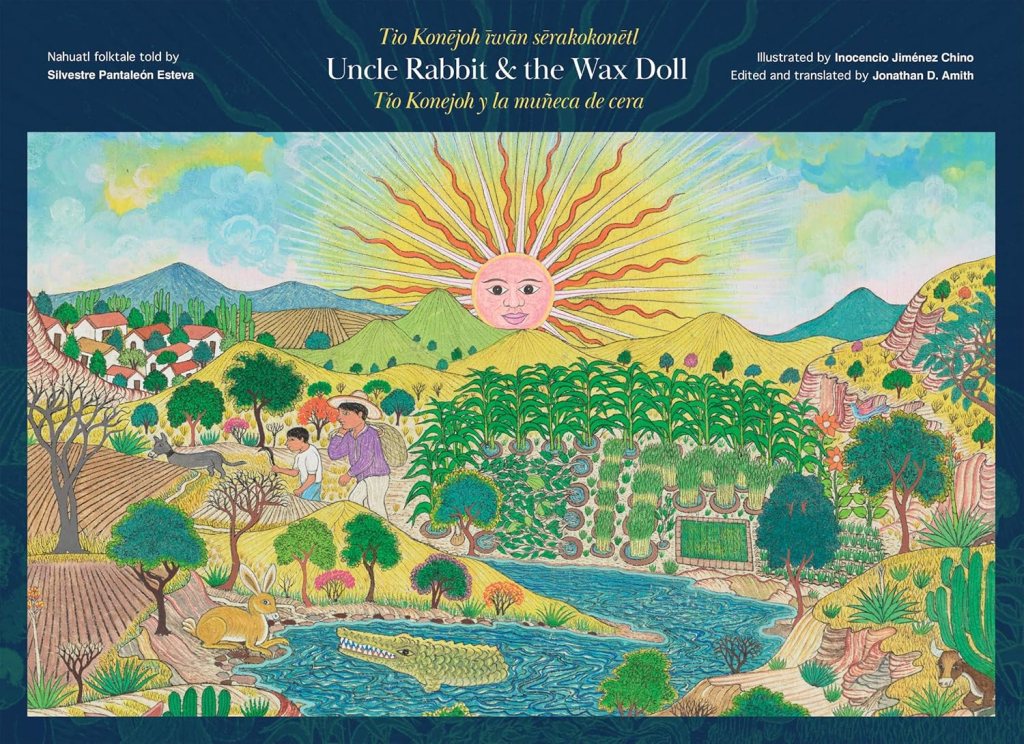
Tio Konējo īwan sērākokonētl / Tío conejo y la muñeca de cera / Uncle Rabbit and the Wax Doll
Narrated by Silvestre Pantaleón Esteva
Illustrated by Inocencio Jiménez Chino
Recorded, transcribed, and translated by Jonathan D. Amith
Published by Deep Vellum, 2024
Buy from Deep Vellum / Bookshop.org US
A picture book written in Nahuatl – the language of the Aztecs – Spanish and English, Uncle Rabbit tells the Nahuatl version of Brer Rabbit, one of the most beloved tales of both the Old and New Worlds. This rare trilingual edition presents three different languages as vertical columns in three distinct colors.
Luminous illustrations by Inocencio Jiménez Chino on amate bark paper represent the rich and vibrant culture and language of the Aztecs, a language still spoken by nearly a million people in Mexico today. Silvestre Pantaleón Esteva, the narrator of this story, was from the Nahuatl-speaking village of San Augustín Oapan, state of Guerrero, Mexico, and Uncle Rabbit is one of many stories he recorded for anthropologist Jonathan Amith, who put this book together and even included a Nahuatl-English glossary, grammar lesson and translation exercise at the end of the book.
Readers of all ages will enjoy this classic story about trickster Uncle Rabbit who repeatedly and humorously outwits Old Man Crocodile, Uncle Coyote, and the farmer whose wax doll does nothing to stop Uncle Rabbit from feasting on his sweet potato vines. The tale ends simply: “That’s it. That’s it, it’s just a short little story. Not very long.” One can imagine the journey this story has taken across languages and cultures and appreciate the book itself as a beautiful physical object – one that emerged as a result of rich oral tradition.
About Katy Dycus
Katy writes for the Department of Anthropology at Texas A&M University. Her essays and reviews appear in Harvard Review, The Wild Detectives, Appalachia and Necessary Fiction, among others.

Support World Kid Lit!

World Kid Lit is a nonprofit that aims to bring diverse, inclusive, global literature into the hands and onto the bookshelves of young people. We rely on grants and donations to support our work. If you can, please support us at Ko-fi. Thanks!

We earn a small commission every time you buy books via the UK Bookshop.org links on our site. This is a much appreciated donation towards our work. Thank you!
 World Kid Lit