
by Hongyu Jasmine Zhu
Weather is with us all the time, but perhaps we’re only made aware of it when we put on a change of clothes, take out our umbrella, or check the weather forecast. Four new picture books from China, Korea, and Japan play with ways of noticing some of the most abundant things we have in life—like the water, falling as rain, and frosting to fluttering snow; like the air, turning cold, warming up, and moving everything along.
When we’re sleepy, busy, sad, or in a hurry, we tend to occupy our attention entirely with our most pressing needs, or a destination, and the weather becomes a background—sometimes a really inconvenient one. But each of these stories paints a possibility, where a chance encounter and a turning of our gaze could make us feel so small, as the world of wind, rain, and snow, in turn and indeed, becomes everything.
Take A Walk with the Wind 和风一起散步

Written and illustrated by Xiong Liang 熊亮
Translated from Chinese by Chloe Garcia Roberts
Published by Elsewhere Editions, September 2025
Buy from Bookshop.org US / Bookshop.org UK
You’ve felt the wind before—caressing your face, tousling your hair, reminding you to put on an extra layer, or bringing sudden relief on a scorching summer day. You’ve heard the wind—rustling the treetops, making the chimes sing, whizzing past like a runaway train, hurling drops of rain at umbrellas and window panes. And you’ve seen the wind too—in the swaying reflections on a dewy blade of grass, in the dancing tail of a kite flying high in the sky, in leisurely clouds as they transform into a dog one second, a jellyfish the next.
But have you ever taken a walk with the wind?
This may sound like a strange idea—at least, the tiny, sleeping Treeling thinks so. When the wind, mischievous as ever, turns up in the room uninvited, reaches out with the tip of the curtain to tickle the Treeling, and teases the corner of the wall poster, making the painted leaves lift, as if they too have felt the breeze, the Treeling doesn’t really feel like going on a walk:
“There’s no need to yell. I’m not awake yet.”
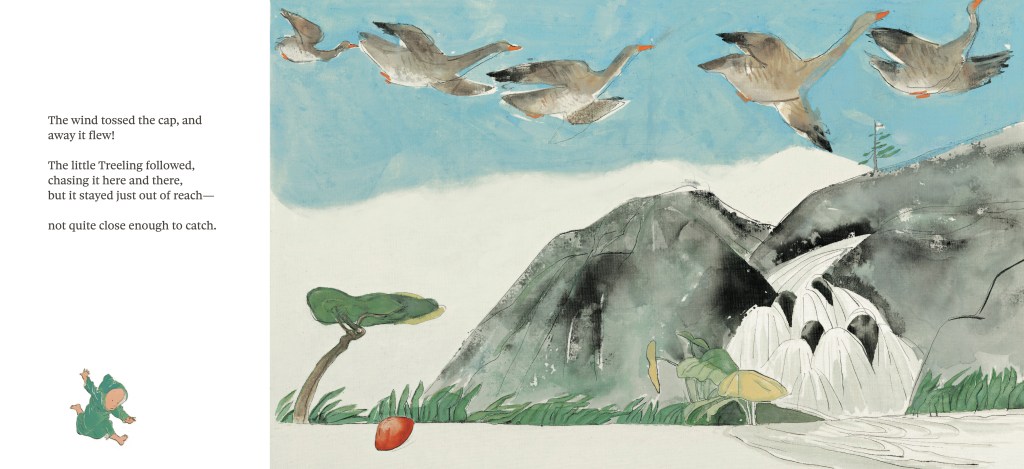
But the wind isn’t giving up that easily—it has plenty of tricks! With a playful whoosh, the wind whisks away the Treeling’s little tangerine hat. And off the Treeling goes, chasing behind, pattering with tiny feet. Together they wander, through valleys and past a dark cave, meeting a great bear, a large crane, some mushroom people, a troop of monkeys, a flock of birds, and an old lonely eagle…
“It leaves, it wrecks, it turns, it shifts.
It’s this fresh cool hero wind that blows everything.”
Inspired by Chinese ancient poet Song Yu 宋玉’s Ode to the Wind《风赋》, Xiong Liang’s story gives the wind a voice of its own—as the wind “gusted” and “blasted” playful commands and impatient invitations at the reluctant Treeling, urging them to wake up, keep up, and come along for the ride. Even the textures of the story speak of wind: soft washes of ink on rustling silk paper that ripples, ruffles, and wrinkles just as when water meets the wind.
Having journeyed all around and fallen soundly back to sleep once again, the little one is nestled in place just as before—but now with the wind as a new friend.
This is a book that will leave kids wanting to take a walk with the wind, and maybe keep an eye out for the Treelings hiding nearby…
Late Today 지각

Written by Jungyoon Huh 허정윤,
Illustrated by Myungae Lee 이명애
Translated from Korean by Aerin Park
Published by Eerdmans Books for Young Readers, September 2025
Buy from Bookshop.org US
Do you ever worry about being late?
Have you ever had one of those days when you’re rushing to get somewhere—school, work, meeting up with friends—and suddenly, it starts to rain? The kind of rain that doesn’t care whether you brought an umbrella, and just keeps falling, heavier by the second. So you thread your way through puddled and muddy roads, through bumper-to-bumper traffic, rehearsing how you’ll explain arriving later than you should.
That’s what it’s like for the people on the Seogang Bridge one weekday, as the news broadcast announces: “Morning rush hour traffic is congested all over Seoul.” Under a sky thick with gloomy clouds, the city becomes a blur of honking horns, screeching brakes, and flashing headlights. Cars of all sizes inch forward in fits and starts. And in between it all—a kitten, just two weeks old, tries to cross the road.
Her little body leaps between tires, darts through puddles, and skitters past the pelting raindrops and the flurry of startled feet. Where should she go next? Will anyone stop to help?
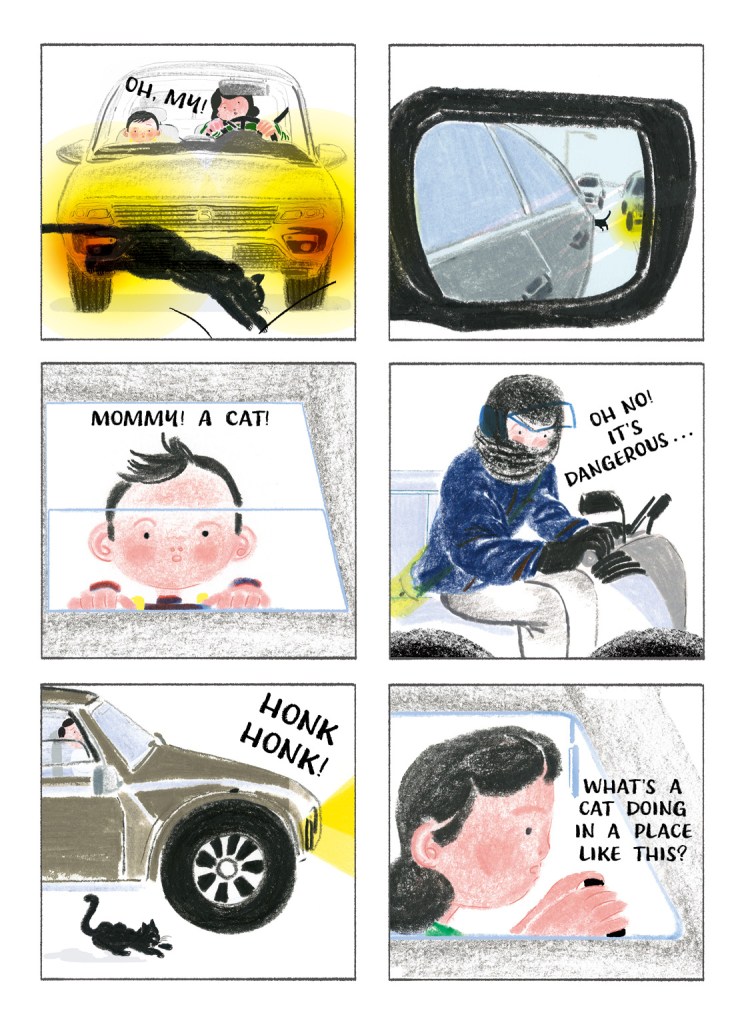
Pedestrians and passengers in Late Today are often depicted in storyboard-style sequences. These small, rectangular panels resemble windows, like those of a car, a bus, or even a smartphone screen. From there, people look out into the rain, into traffic, and into the path of a kitten, if only for a flicker. Perhaps these windows hint at how we move through the world: boxed in, in transit, barely noticing what—or who—lies just outside.
But when the layout shifts to full-spread scenes, the boxed-in perspectives open up. We see the rain in sweeping sheets, the glistening road, and how, from above, the traffic jam is but a palette of red, blue, and yellow.
These panoramas present not just a change in scale, but a shift in awareness—one that visually echoes the book’s Korean title, 지각 (jigak), meaning both “arriving late” and “perception.” In these moments of pause, people’s vision extends beyond themselves and their immediate destinations ahead, reminding us that to be late is also to take the time to stop, notice, and help a kitten find her way.
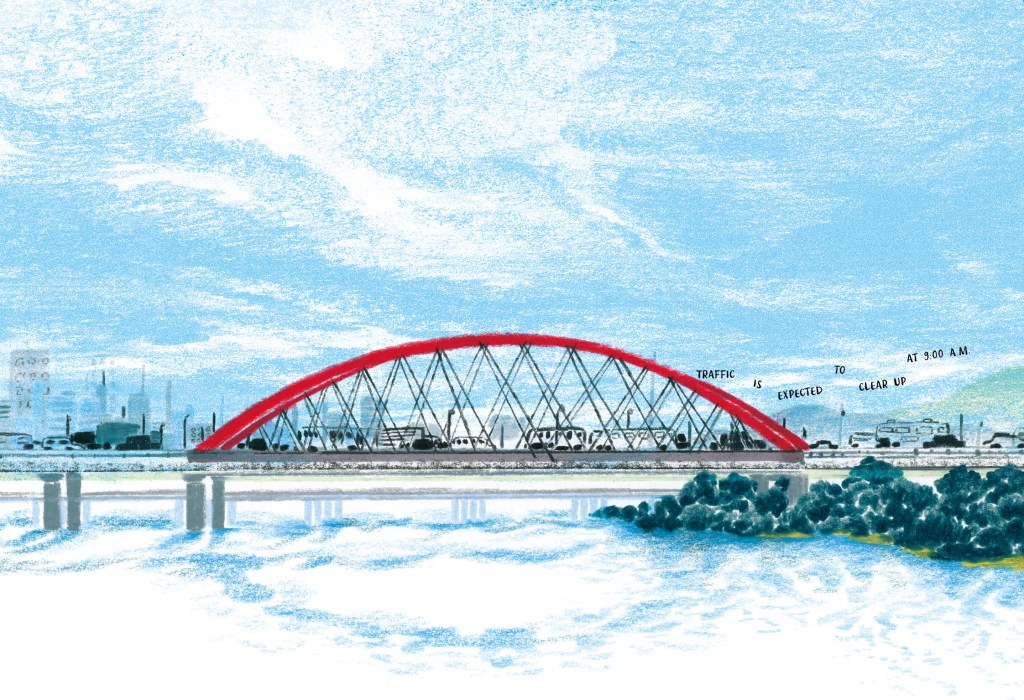
The story closes with a radio update: “Traffic is expected to clear up at 9:00 am.” We return to the same side view of the Seogang Bridge shown on the first page—but now the sky is no longer overcast. It’s all sunny blue. Before the traffic clears, the sky has already lifted, and so have the furrowed brows and worried looks—still stuck in traffic, they’re late, but “today [is] a good day to be late.”
Because whether it’s a late day or a good day might just depend on how we choose to look at it.
Downpour どしゃぶり

Written by Yuko Ohnari
Illustrated by Koshiro Hata
Translated from Japanese by Emily Balistrieri
Published by Red Comet Press, 2025
Buy from Bookshop.org US / Bookshop.org UK
“It’s sooo hot! The ground’s burning hot! Hot, hot!”
The heat begins to wield its bossy power as soon as the story opens. And the vibrant strokes of color, in lush green bushes and their densely dark shades, are complaining the same thing. Even the house’s sandpapery wall looks hot enough to fry an egg. Rendered in flat, saturated tones, the bright blue sky and puffy clouds don’t offer any relief either—the blue almost too blue, the white too thick, as if the air has stopped moving entirely.
This is a headache we all know too well: on summer days, when all we want to do is go out and play, the rising temperature refuses to play along. But the boy isn’t about to give up. He marches outside anyway, stomping his little feet in protest. The sky, as if it has heard the boy’s mini tantrum, summons its dark clouds, and soon—PLIP! PLIP! PLIP!—raindrops begin to fall.
“It smells like the sky. It smells like the ground, too.”

The Japanese title of the book, the word for “downpour,” is どしゃぶり (doshaburi)—a blend of 土砂 (dosha, “soil and sand”) and “降り” (furi, “falling”). Perhaps this is the husband-and-wife creative team’s beautiful offering, that the rain is as much a child of the sky as a child of the ground—it’s a messenger between above and below, calling us to look up wonder-filled, and stay grounded with our bare feet in the mud, as it rains.
The rich onomatopoeia of the Japanese language gives expression to the full range of music that the rain makes. Jump barefoot in a puddle—KER-SPLASH! Run and kick the rain—PWISH!—the dancing, thickening water is given a sonorous, crescent shape. Hold up an umbrella against the pelting rain—B-DADADADA PLOPOPOP”—the umbrella turns into a drum. In this song, we may notice that even sounds have all sizes, directions, and they ricochet off all other senses!
Gradually, what could feel so small and unnoticeable, like a drop of rain, becomes the foreground. Raindrops, when they hit the ground, splatter into many flower petals. And each rain crystal holds all the colors of the world.
As the rain comes more and more, the distinct contours of sky and trees dissolve into a misty wash of green and blue. A palette of overflowing watercolors, soft and swirly like a dream, feels like a gentle embrace for the boy, who has tossed away his umbrella, kicked off his shoes, and become fully together with the rain, his new best friend.
After the rain, the world doubles. The sky, the trees, the rooftops, and the boy’s golden joy—they all shimmer in reflection on the wet ground, making the world feel twice as big.
Come along on this rainy ride! Maybe, like the boy, you’ll come up with your own ways to play in the rain—even on a hot sunny day.
The Snow Theater ゆきのげきじょう

Written and illustrated by Ryoki Arai
Translated from Japanese by David Boyd
Published by Enchanted Lion Books, November 2025
Buy from Bookshop.org US / Bookshop.org UK
In the coldest season of the year, when everything is blanketed in snow, one house glows in golden light. Inside, the boy and his friend pore over a book of butterflies, his dad’s favorite. But their play is interrupted when—oops!—they accidentally rip a page apart.
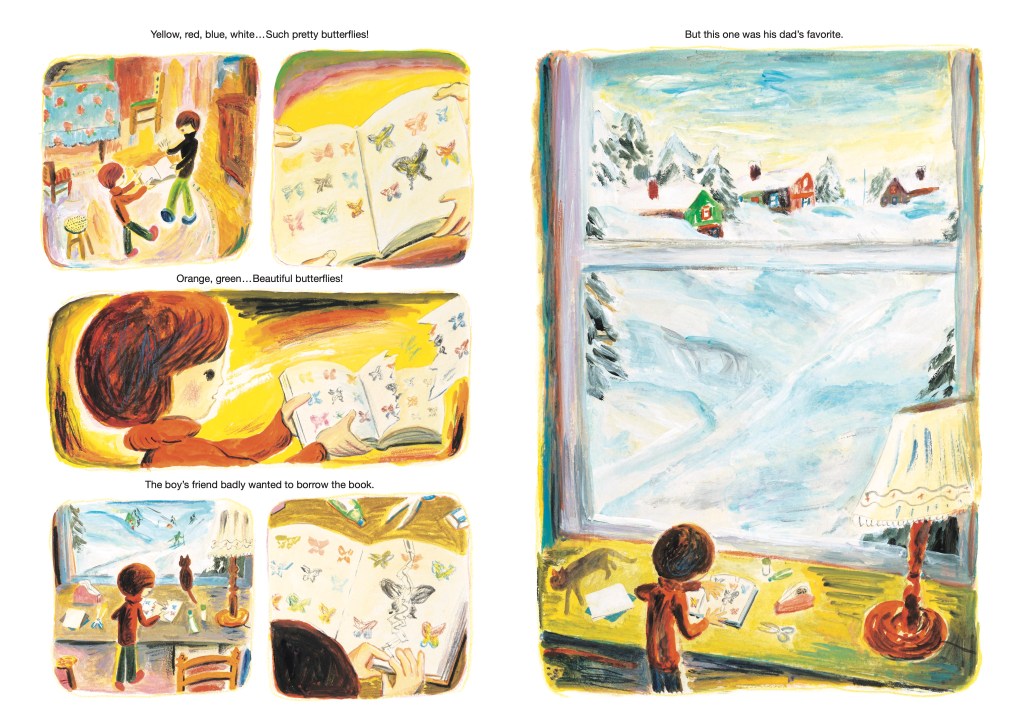
The boy puts on his winter hat and coat, straps on his skis, and heads out into the snow. Where is he going, and what’s on his mind? What does this boundless white hold, and what does it hide? Let’s follow the boy’s ski tracks—left-right, left-right—and see what we find.
Snow is white—perhaps. Can snow also be the coming-together of every color of light? “Yellow, red, blue, white…” The sky streaks with tangerine, the fir trees glint emerald, the distant mountains shimmer silver-blue, and the neighbor houses sparkle in a kaleidoscope. Together, they give snow the color of butterflies—“[o]range, green, purple…pink…”—fluttering colors caught mid-flight.
Snow has shades too, and folds into soft hills and steep slopes. Thicker here, thinner there, it’s telling the shape of the land, like paper sculpted by wind, drawn in crayon-like dreamy strokes, and set to the the sound of the boy’s own swooshing journey.
Snow is also a hot breath exhaled into cold air. And—OOPS!—perhaps too absorbed in snow’s many colors and moods, just as we are, the boy slips into a gap. And there, before his eyes, a tiny snow person has tumbled off a tiny stage. The boy helps them back up, and in return, the snow people invite him to the day’s performance.
As the curtain rises and the tiny snow people take center stage, the boy suddenly shrinks, so small that the sweeping white behind him blooms into fine-point detail. Snow begins to dance, the snow people whirl and bustle, and all the other colors—swirling, singing, spilling—become the world.
Snow is a flower petal. A fluttering bird. A miracle made possible by all the other colors. A spinning top that won’t stop rising—“higher and higher in[to] the sky.”
In Ryoji Arai’s story, words and pictures don’t always walk side by side; often, the pictures go first. Maybe this too is The Snow Theater’s invitation: to walk deeper into the snow, look closer into every shifting shade of light, and to feel before we try to speak.
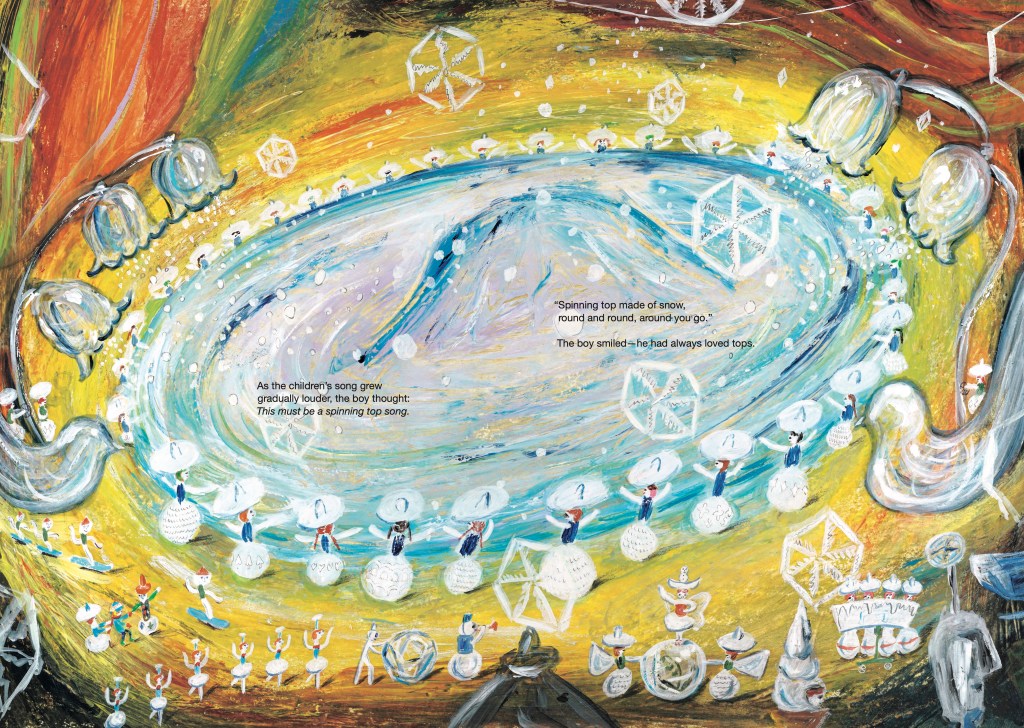
What else is snow?
The boy’s adventure begins with a torn page and a slip into the gap. Perhaps your trip to the snow theater is just around the corner!
About Hongyu Jasmine Zhu
Hongyu Jasmine Zhu 朱弘昱, from Chengdu, China, is a third-year undergraduate at Brown University and Editor-at-Large for China at Asymptote Journal. Her translation of Zhou Jianxin’s picture book Little Squirrel and Old Banyan will be out with Balestier Press this autumn. When she’s not lost in words, Jasmine sings, dances, walks, mails letters, and leads an entourage of plushies. She dreams of opening a reading room where no one is too young or too old to huddle, read, and play, and is busy collecting picture books from around the world. Say hi on Instagram / X @jasmine_hongyu or on Bluesky @jasmine-hongyu!

Support World Kid Lit!

World Kid Lit is a nonprofit that aims to bring diverse, inclusive, global literature into the hands and onto the bookshelves of young people. We rely on grants and donations to support our work. If you can, please support us at Ko-fi. Thanks!

We earn a small commission every time you buy books via the affiliate links on our site, or via our booklists at UK Bookshop.org. This is a much appreciated donation towards our work. Thank you!
 World Kid Lit