by Ella Plaisted
As I contemplate what to do about my sons’ bulging bookshelves – the towers teetering after each addition – I spot a clear pattern in their favourites. Like many young readers, they’re drawn to stories that take them to far-off places, imaginary worlds and into the lives of children whose experiences differ from their own.
But what if my 10- and 12-year-old boys were dyslexic? Would their bookshelves still be bursting? I would hope so. But the reality is possibly not.
I say that because for young dyslexic readers, the challenge isn’t just having the right tools and support to read – it’s fuelling their desire to keep reading until lights out.
Roughly ten percent of the UK population has some form of dyslexia. Apply that statistic to the classroom and it means that up to three children per class process written language differently.
The problem: accessible formats are mostly English originals
Dyslexia-friendly publishing has transformed access to books for many struggling readers. But there’s one issue: almost all the dyslexia-friendly books available in the UK are written by native English-speaking authors.
As a parent and translator, I find this gap striking. While we rightly celebrate and promote world literature for young readers, we mustn’t forget children who read differently. If the narrative is that all young readers can benefit from the curiosity and empathy that global stories inspire, shouldn’t young dyslexic readers have access to these stories too?
The gap: translation and accessibility rarely meet
Despite sharing common goals, translation and accessible publishing tend to operate as two separate worlds. Translators work to bring international voices into English; accessibility specialists focus on making texts easier to process visually and linguistically. The overlap between the two is surprisingly small.
People often ask me what ‘dyslexia-friendly’ means. In the UK, a handful of publishers specialize in adapted children’s books, such as Barrington Stoke, Badger Learning, Ransom Publishing, Books on the Hill Press and Sweet Cherry Publishing. Their editions typically include:
- a clear sans-serif font
- wider line spacing
- off-white paper to reduce glare
- layouts that prevent visual crowding
- language adaptation, where necessary – shorter sentences, familiar vocabulary, an active voice and clear dialogue tags
What’s interesting is that most of these specialist publishers distinguish between interest age and reading age (their “hi-lo” collections: high interest, low reading age). The key is to match content to a child’s interest age, because if the story doesn’t engage them, not even the most dyslexia-friendly text will encourage them to read regularly.
These easy-to-read designs have been transformative for many parents trying to motivate their dyslexic children to read more. But only a tiny fraction of these accessible books are translations from another language into English. In the UK, estimates suggest that only around 3-4% of children’s books published each year are translations, and under 1% of Barrington Stoke’s collection is translated work.
Why does this matter?
Put simply, if children don’t read often, they can lose some of their word-sound awareness, which then makes reading even harder for them.
And if engaging, new and diverse content remains inaccessible to dyslexic readers, we not only limit their motivation to read but the breadth of cultural perspectives available to them too.
Across the Channel, I found the same situation. As part of my MA research, I compared dyslexia-friendly children’s books in France and the UK. I found that France has at least fifteen publishers producing adapted collections, yet just one includes a small number of foreign titles translated into French.
The US shows a similar pattern. Bloomsbury’s High/Low series, Union Square & Co.’s Everyone Can Be a Reader, and High Noon Books support struggling readers with accessible formats – but translated titles are scarce.
Inclusive publishing is gaining momentum, which is encouraging, but translation is still missing from the conversation.
Translation’s role in inclusive reading
Translation broadens the range of stories children can access; it brings them into contact with diverse voices and cultures they might never otherwise encounter. In this way, translation can be seen as a form of inclusion.
Translators of children’s fiction constantly make decisions about sentence rhythm, syntax, vocabulary and tone. Accessibility specialists consider many of the same decisions when making a text easier to read. When guided by accessibility principles, translation can improve a text’s readability while being careful not to oversimplify.
Translating foreign stories into English can also motivate and build confidence in young readers. Easy-to-read books that introduce new landscapes, traditions and perspectives could help struggling readers to develop stronger reading habits. Engaging content feeds fluency.
During my MA, I looked at how translation and accessible language fit together. As part of that work, I created a dyslexia-friendly English version of a classic French fairytale. The case study showed the many ways in which translation choices – guided by research on how dyslexic readers process written language – can improve a story’s readability. By choosing words that are easy to sound out and understand, keeping letter-to-sound patterns consistent and making sure sentences flow logically, translators can make a text accessible and still engage readers.
If more foreign-language children’s books were adapted into dyslexia-friendly English, those bookshelves I mentioned might have more chance to bulge.
Positive examples
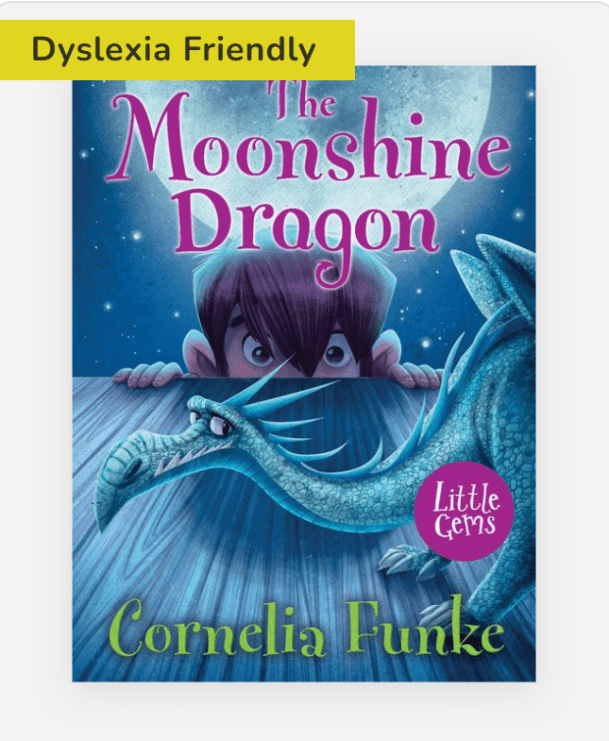
During my dissertation research, I found a few encouraging examples of translated works in easy-to-read English. As the leading specialist dyslexia-friendly publisher in the UK, Barrington Stoke gives us a snapshot of the translated titles currently available in their 500+ collection.
Cornelia Funke, the best-selling German children’s author, is one of the very few international writers whose stories appear in dyslexia-friendly editions in the UK. Barrington Stoke has published four of her short adventure and fantasy titles – two for interest age 5+ and two for 7+ – all well-illustrated and adapted to support reading fluency (e.g. Gawain Greytail and the Terrible Tab and The Moonshine Dragon). These books have served dyslexic readers well and, crucially, mean they can access the same authors their peers enjoy.
However, beyond interest age 9+, there are currently no translated dyslexia-friendly books available from Barrington Stoke. That leaves the 9 to 12 age group with virtually no international authors to choose from.
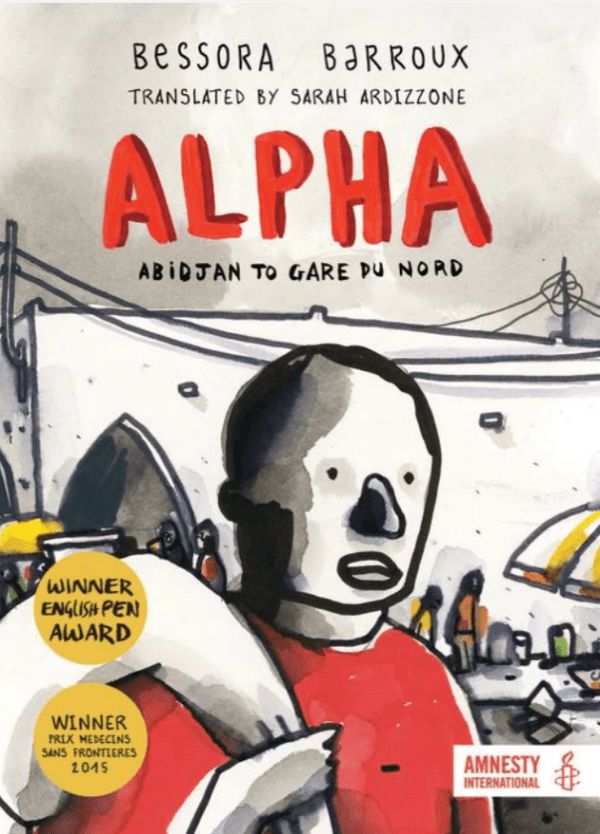
The only other translated title in Barrington Stoke’s collection is Alpha: Abidjan–Gare du Nord, one of just four translated books to receive a PEN Promotes award. Written by Sandrine Bessora, illustrated by Stéphane Barroux and translated by Sarah Ardizzone, it follows one man’s long, uncertain journey from Côte d’Ivoire to France in search of his family. Alpha, listed as interest age 5+ and reading age 8, is currently out of stock as its license is coming to an end. (It may be available at used bookstores.)
Despite the lack of translated editions of English originals, Barrington Stoke licenses almost all its titles for translation into other languages and works with partners from Korea to Sweden. To me, that shows the demand for accessible stories has global reach, even if we’re still falling short when it comes to bringing more foreign stories into English.
Publishers with substantial easy-to-read collections often don’t look beyond national borders. Not from lack of interest, but because accessibility specialists, translators and educators tend to work in isolation. Translators rarely receive dyslexia-specific training; accessibility experts rarely engage with translation, and publishers may find it costly to license foreign titles. But with 10% of children as a potential readership, the case for these specialists to come together is compelling.
The world on every child’s shelf
What we need now are collaborative experiments. A pilot project between a children’s publisher and a dyslexia-specialist translator could show just how feasible and rewarding this work could be. Imagine a global reading list of short, illustrated stories from around the world, all produced in dyslexia-friendly English.
We often talk about how important world literature is for young readers and increasingly about inclusion in children’s books. But inclusion must also apply to how stories are presented, not just the characters they feature. A diverse bookshelf doesn’t mean much if the books aren’t presented in a way that makes reading manageable for every child.
More collaboration between translators, publishers and accessibility experts could change that. Making foreign-language stories accessible in dyslexia-friendly English could let thousands of children explore the same global adventures that their peers are able to discover.
Every child deserves the chance to lose themselves in the new and the strange and to find joy in reading. I believe translated stories could offer just that, for every reader.
About Ella Plaisted
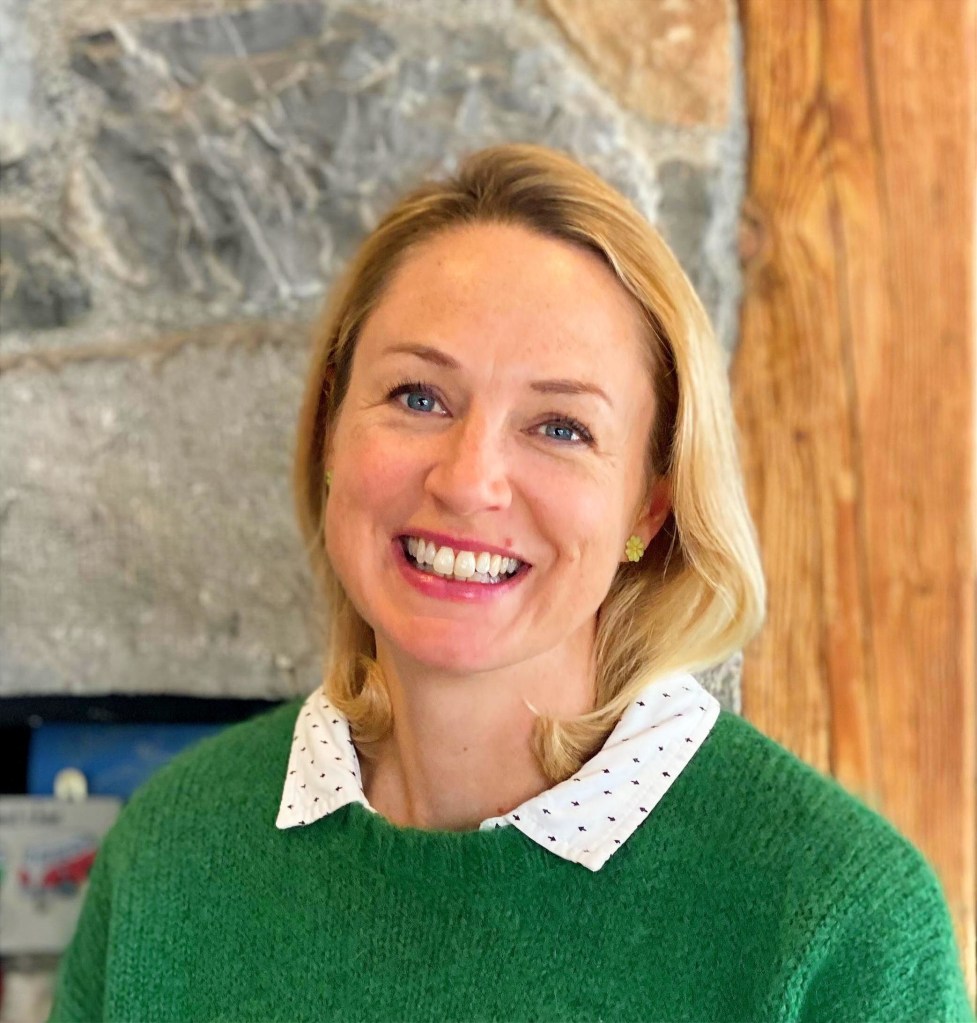
Ella Plaisted is a freelance translator working from French and Spanish into English. She recently completed an MA in Specialized Translation at the University of Geneva, where her dissertation explored strategies for translating children’s literature for young readers with dyslexia. She has a strong interest in accessible storytelling and continues to develop this focus alongside her translation practice. Ella lives with her family in the French Alps.
***

World Kid Lit is a nonprofit that aims to bring diverse, inclusive, global literature into the hands and onto the bookshelves of young people. We rely on grants and donations to support our work. If you can, please support us at Ko-fi. Thanks!

We earn a small commission every time you buy books via the affiliate links on our site, or via our booklists at UK Bookshop.org. This is a much appreciated donation towards our work. Thank you!
 World Kid Lit