By Karin Redclift
After I read and reviewed the Animal Encylopedia series, translator Sylvia Notini generously answered a few questions about the series.
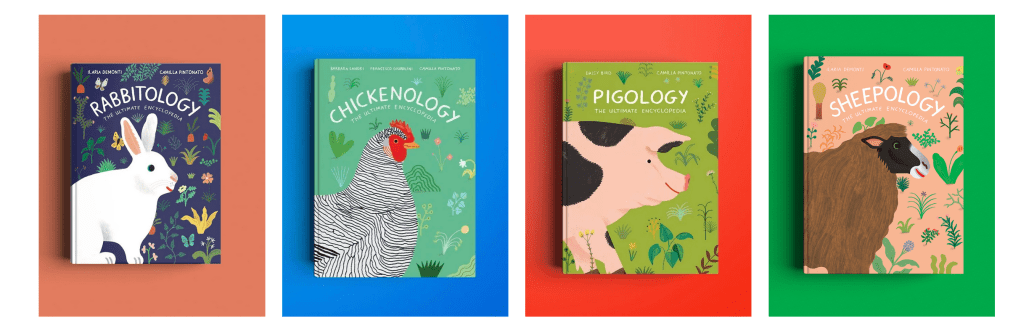
Karin Redclift: Sylvia, Chickenology, and its companions blend scientific facts with playful illustrations. How do you approach translating this kind of hybrid text—infusing facts with humor and play? Did the illustrations help inspire you in any way?
Silvia Notini: When I translate, whether I’m working on a children’s book, an exhibition catalog, or an academic essay, my focus is on the words. The words of the source language, and then my own words in the translation. The English has to sound right. When it does, I know the translation will hold. The English is a translation of the original, but it also takes on a life of its own.
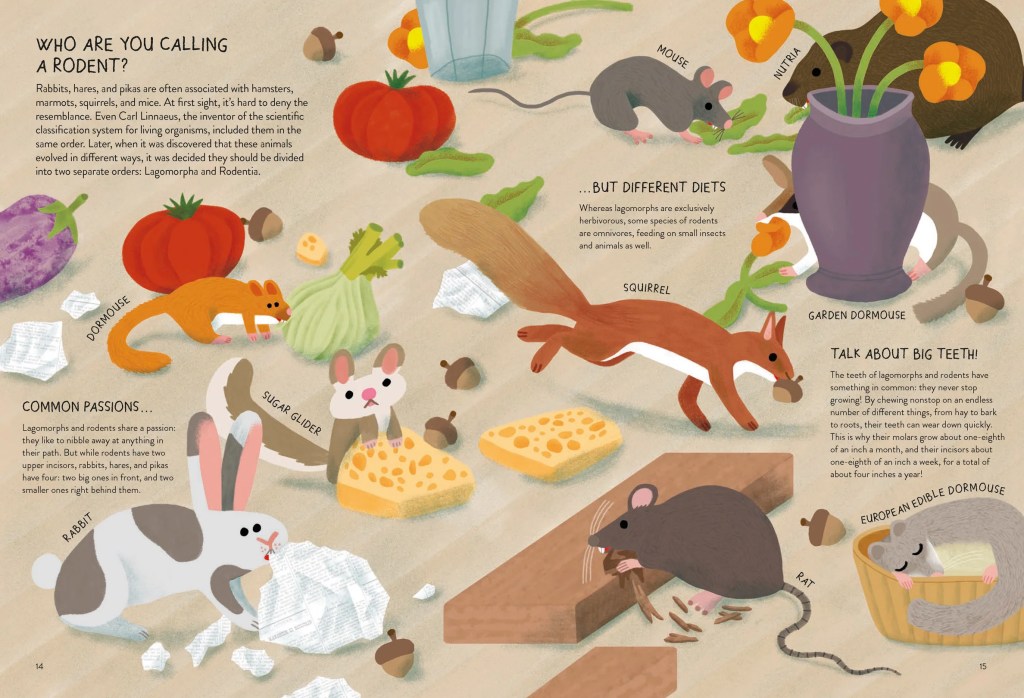
When I’m working on a children’s book that has a lot of text, like the -ology books, Sea Wonders, or a series for kids 8 to 11 I’m translating right now, first I work on the language, and then I look at the images. The images help me improve what I’ve written. They might offer me that small ingredient that was missing. Or reassure me that I got it right.
Most texts don’t have illustrations. Novels generally don’t, non-fiction rarely does. (Exhibition catalogs do include artworks, of course—which can be very inspiring!). Last year, I translated a wonderful book about the Old Testament (The God of Our Fathers, written by Aldo Cazzullo, to be published in the spring by HarperCollins). Although there wasn’t a single illustration, the author did such a brilliant job of retelling the stories from the Old Testament I could envision each and every one. Vividly. But with children’s literature, it’s completely different. The illustrations and the text go hand in hand. With the -ology books, and with Sea Wonders as well, first I had to get the science right, which meant that I had to focus on the efficacy of the language. But having illustrations to go with the text was a gift! As I continued to work on the texts I could also see with my own eyes what was being described.
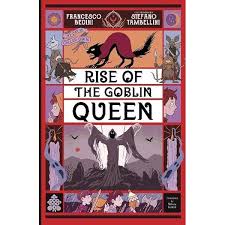
Recently, I translated a chapter book for children aged 8-11, a tale of Greek and Norse mythology, sorcery, and battling goblins. In Rise of the Goblin Queen, written by Francesco Bedini, illustrated by Stefano Tambellini, (Five Quills, Spring 2026), the main character and his friends must save the world! At first, it was difficult. I had lots of things to worry about. Not just translating the Italian, but the voice, the vocabulary. Do kids still say “Darn”? Are there some words I should be careful about using? What do you call that kind of kid’s jacket in British English —turns out it was simply “jacket”…. But it was when I started looking at the absolutely fabulous illustrations that I thought, I can do this. You have to become enamored of the text and the subject you’re translating to be able to succeed. I think it was when my eye fell on the picture of the baby brother with pointy ears, a pacifier in his mouth, sleeping peacefully under a dinosaur blanket, that I knew I was going to love doing this translation.
Several years ago, at the Bologna Children’s Book Fair, I noticed a German picture book about a group of toys waiting to see the doctor: Fünfter sein, written by Normal Junge, illustrated by Ernst Jandl, published by Babalibri. In the story, a toy frog has lost its crown, a stuffed bear has a broken arm, and another toy has a broken nose. I don’t know a word of German, but the illustrations told me that the text, hence the story, had to be amazing. A few years later, the book came out in Italian—very little text but so perfect and combined with the illustrations one of the most beautiful children’s books I have ever seen. I’m always looking for an excuse to give it to someone as a gift.
KR: You have translated over 200 books, from academic works to kidlit. What unique challenges or fun surprises did you face while working on the -ology series? There are so many interesting facts. I learned a few things. Did you learn anything new?
SN: Children’s books are the hardest to translate! At least, they are for me. You cannot let the audience, the future readers of the text, out of your sight. Throughout the process, you are communicating with them. The translation, like the source text, has to be just right for the children in the target group. You have to listen closely to what you’re writing. This is true of every text, of course, but more so when you are dealing with children.
For the -ology books, I had to do lots of research. I learned so much about chickens, rabbits, and sheep. I didn’t know that chickens were so smart! I was also very amused and rather intrigued to learn that there are a lot of great books out there about these animals—books I would never have picked up to read if it hadn’t been for the translations. One of my favorites is A Short History of the World According to Sheep by Sally Coulthard. There’s also Mark Hawthorne’s The Way of the Rabbit. For Sea Wonders. The Octopus, the Cuttlefish, and the Squid there were literally dozens of books to choose from for my research. I also watched the film My Friend the Octopus for inspiration. And of course, you can find endless amounts of information on the internet. But I always prefer to discover and read books on the subject.
KR: The -ology books are rich in puns, idioms, and visual wordplay. Do you remember one particular moment where you had to creatively adapt a joke or metaphor for English readers while keeping its original charm? What is your process for handling these challenges?
SN: I clearly remember translating the description of the Himalayan Rabbit. The Italian text likened that particular species to a spy because it goes by different names depending on the country. The section ended with the words, in Italian, “Il mio nome è Bond… James Bond.” But “My name is Bond, James Bond” just wasn’t funny. Then suddenly it came to me: “My name is Bunny, James Bunny…” Whether or not they had ever seen a James Bond movie, I imagined kids laughing about the words, maybe repeating them.
Something similar happened with the description of the Enderby Island Rabbit. That’s the breed that was taken from Australia to the Auckland Islands in 1865 to repopulate it. The breed remained isolated for over 130 years. The Italian said, “Ben fatto, Robinson Crusoe,” but, again, it wasn’t that funny in English. And suddenly I thought, what if I change it to Rabbitson Crusoe? “Well done, Rabbitson Crusoe!” There is no magic formula for translating humor. But if you imagine being with the young reader, you’ll probably figure out how to make them laugh.
KR: Sylvia, thanks for sharing those fascinating insights into your translation brain and the thought processes behind your choices. Keeping the reader in mind is essential in any translation, especially in kidlit. Grazie mille!

About Syliva Notini
Sylvia Notini was born in Boston and grew up in nearby Lexington. After receiving a Ph.D. in Romance Languages and Literatures from Harvard University, she moved to Bologna, Italy, where she raised a family while teaching English at the university and working as a freelance translator. Read more about her on her website.
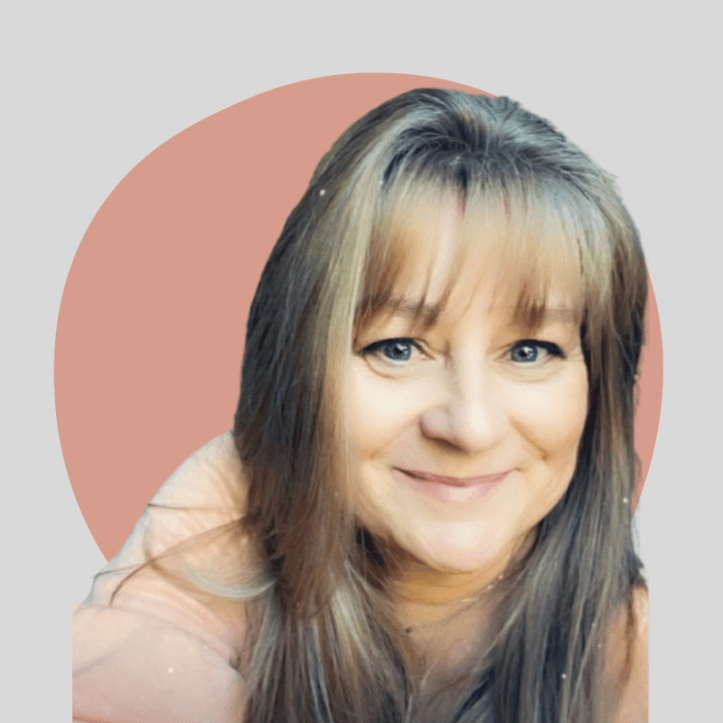
About Karin Redclift
Karin Redclift is a German native writer, translator, and proofreader. Raised in southern Germany, she loves reading and writing kidlit, Tai Chi, the outdoors, her family, and rescue dog Charlie. She bridges cultures and generations through storytelling, with publications including the German translation of Emily of New Moon by L.M. Montgomery and an updated version of the German classic Maya the Bee. Her flash fiction appears in the Bolts of Fiction anthology. Find her at www.KarinRedclift.com.

World Kid Lit is a nonprofit that aims to bring diverse, inclusive, global literature into the hands and onto the bookshelves of young people. We rely on grants and donations to support our work. If you can, please support us at Ko-fi. Thanks!
We earn a small commission every time you buy books via the affiliate links on our site, or via our booklists at UK Bookshop.org. This is a much appreciated donation towards our work. Thank you!
 World Kid Lit