Professional translator and word artist Denise Muir — the author behind “Literary Life in Italy” — talks about translation,
How did you discover The Distance Between Me and the Cherry Tree and how did you decide to translate it? Can you tell us a bit about what’s special about the book, what it brings to the English-language literary landscape?
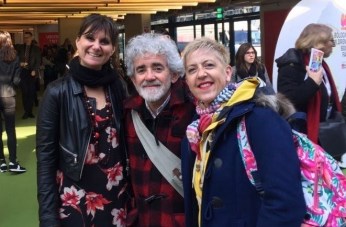
Denise Muir: The story behind The Distance between me and the Cherry Tree is a nice one, and I like to think the book found me. The short version (!) is that, 7 years ago, I encountered (and translated a sample of) another book about a cherry tree (My grandfather’s a cherry tree by Angela Nanetti) which won a place in an anthology of widely translated international children’s books that have never made it into English. This book’s journey stopped there, I’m afraid, as I didn’t feel confident enough at the time to pitch it to UK publishers. It was a beautiful story, poignant with poetic and comedic flourishes. Fast forward to 2016, after several summer schools, writing courses, international translation days, London Book Fairs, submissions to Book Trusts’ In Other Words programme, one published YA novel, contact made with Italian writers and publishers, and collaborations with literary agents that enabled me to actually talk to publishers about books at book fairs, my path crossed that of Hot Key Books.
For me that felt like a momentous day, to be sitting at the same table as a real live publisher. Fast forward another year (it’s true, things take time in the publishing world!), to when I got an email in late 2017 asking me to submit a sample for a book that had already been purchased from Rizzoli in Italy. And here are the two great coincidences: it was from Hot Key Books and it was a story about a cherry tree! It was an equally beautiful, bitter-sweet story, and it felt like I’d come full circle. I submitted the sample and… the book is now out there in the world, in my translation.
I think it’s important for books like The Distance Between Me and the Cherry Tree to make it into the hands of children and their parents everywhere, because it’s an insightful and uplifting story about what it feels like to lose your sight. That’s not something sighted people can easily imagine and anything that helps to broaden our understanding and empathy towards others can only be a good thing. It also contains a very powerful and poetic message. The protagonist’s struggle to cope with both the reality and thought of living her life “in darkness” is conveyed through her relationship with a cherry tree. It is both a measure of the reduction in her visual field (she can’t see it at all at the end) and also the place she imagines she will escape to when darkness finally falls on her, like Cosimo in Italo Calvino’s The Baron in the Trees.
Why does translating children’s literature matter? If someone said to you, huffily, “We have plenty of children’s books already in English, let’s read the ones we have,” how would you respond?
DM: Why does translating children’s literature matter? My answer might sound a little controversial, but it’s something I feel very strongly about. I began my career as a literary translator in Italy, where I volunteered in schools as a reading assistant and as a scout leader for a secular troop. I was shocked at how little access to books there was in the community and by how little children were encouraged to think for themselves. Being a predominantly Roman Catholic country, the children were being exposed to only one story about the world. At a time in their lives when carers and educators should have been broadening their minds, the community was actively working to do the opposite. I sought out stories from around the world, I brought in those I was reading to my own daughter in English, and I did my best to translate them into Italian and share them with the children. I felt it was so important to bring them glimpses of things and ways of thinking that were outside their experience, in a way to counter what I felt was the indoctrination of young minds. That probably all sounds very portentous, but it’s what drives me to continue to share stories that challenge what we know, what we think and what we do. If we are to grow into compassionate, understanding adults, this process has to happen while we are children.
DM: Girl Detached and I met halfway through my induction into the world of literary translation. I was collaborating with a group of Italian children’s writers (ICWA) and met their president in London one day. We hit it off right away and she explained to me how the original Italian novel had been withdrawn from bookstores and pulped when it came up against Italy’s gatekeepers. Again, a lot comes down to Italy’s connection with the Roman Catholic church and the influence this has on society. To be successful in Italy, a book has to be able to travel around schools – author events are an enormous part of the process and, traditionally, the publishing industry was almost entirely geared towards this channel. And while schools are supposed to be secular, they are not. So… to be successful there, a book has to be deemed “appropriate” in the classroom by teachers and parents. This is where Girl Detached was halted. It was commissioned by the publisher to be “edgy” and honest, but the resulting story – an honest and empowering account of how a shy, introverted 14-year-old teeters on the edge of self-destruction selling sexual favours to men but manages not to lose herself and rebuild her life – was not deemed appropriate for readers. I read the book, was immediately hooked, and agreed with the author to translate it in order to see if we could find it a new home in English. I spent the next three years promoting and pitching it at every opportunity. Again, it was another lucky coincidence that saw all the hard work pay off when Barrington Stoke’s then MD Mairi Kidd picked it up.
What are the characteristics of the Italian children’s-literature landscape that you find charming, peculiar, or otherwise different from the English? What are its particular challenges and joys?
DM: Italian children’s literature has a prestigious and important history. The great classics all have elements of social commentary and explorations of self and the other (Collodi, Calvino, Pitzorno, De Amicis…), themes that really resonate with me, and why I feel so driven to work with children’s books. This heritage has been carried forward and contemporary Italian authors are still writing amazing books that are entertaining, but which also have a hidden moral or experience that can broaden a child’s view or experience of the world and the people around them. This can be the inclusion of diverse protagonists or culturally diverse stories and settings. For example, being in the front line of the migrant crisis, Italian writers feel compelled to bring young readers stories that can help them to understand the lives of the people, young and old, arriving in their country, stories which are often ignored or misrepresented in the broader media. I feel this is absolutely vital given the times we are living in. This may seem over-serious for children’s fiction, but I think the English language market produces so many entertaining, fun, wacky and clever stories that a country that is masterful at writing the deeper ones can be an important addition to the widest possible literary diet for young people.
DM: If I had to recommend some Italian books for young people, I’d suggest:
Anything by Davide Morosinotto – in my mind, he is part of the new generation of Italian children’s writers. He has mastered the art of ingenious storytelling and engaging writing style, holding his readers absolutely mesmerized by the twists and turns, the exotic places, the fantastic plots, while remaining true to Italy’s literary heritage. With fun and flair, he invites his readers to think (without them even realizing it) about issues as huge as truth and war and pasta, and a whole lot more!
Anything by Angela Nanetti – Angela has never been translated into English, but she is one of the most talented and insightful writers of literary fiction for children (not to mention one of the most published and translated around the world) that I have come across in Italy. She can do anything from picture book to YA, reality to fantasy, historical or contemporary, and will sweep you away with a tortured love story on a windswept island in Mistral, flood your senses while you laugh out loud at the City of the Popcorn Circus or take you back to noble society in 19th century Italy during the fight for independence in Il Sogno di Cristina, or leave you with your heart in your mouth, wringing your hands at the story of two teenage boys, in love, in southern Italy, who were made to pay for their “sins”, in Il Figlio Prediletto.
One more that I have to mention is Antonio Ferrara, again because of how he takes readers to somewhere they could never normally go, smashing stereotypes in the process: 1) Mia (Mine) – where the reader is inside the head of a teenager who kills his girlfriend. We hardly ever hear the perpetrator’s side of the story but if we are to understand why women continue to be killed by their partners, and try to prevent it, we have to understand both sides of the story.
Likewise, in Ero Cattivo (I Was Bad) , the narrator is a young boy who lives in a children’s home. When he does eventually get out, he continually offends is removed time and again from his foster families. To be inside the head of the young person labelled as a “lost cause” is the first step in actually being able to help them turn their lives around.
 World Kid Lit
[…] 10 Sept Italian Children’s Books in Translation: ‘Absolutely Vital Given the Times We Are Living In’ […]
LikeLike
[…] Written by Paola Peretti, illustrated by Carolina Rabei, translated from Italian by Denise Muir […]
LikeLike