By Wang Li
“Hello! My name is Xing-ming—Xing has the meaning of star, Ming has the meaning of tomorrow. I like my name. My parents say I’m the youngest in the family, and stars feel small under the night sky—just like me. A name is like a blessing… even a kind of spell. Well—it’s more like a feeling of who you are.” The young man says to me with a bright smile.
Xing-ming’s first picture book’s English version, Otter’s New Neighbors—his graduation project ten years ago—will be published by Charlesbridge on May 26, 2026. Karen Boss, a senior editor from Charlesbridge, fell in love with the artwork in the book. And then as she says, “Once I read the story, I was even more sure we should publish the North American edition.”
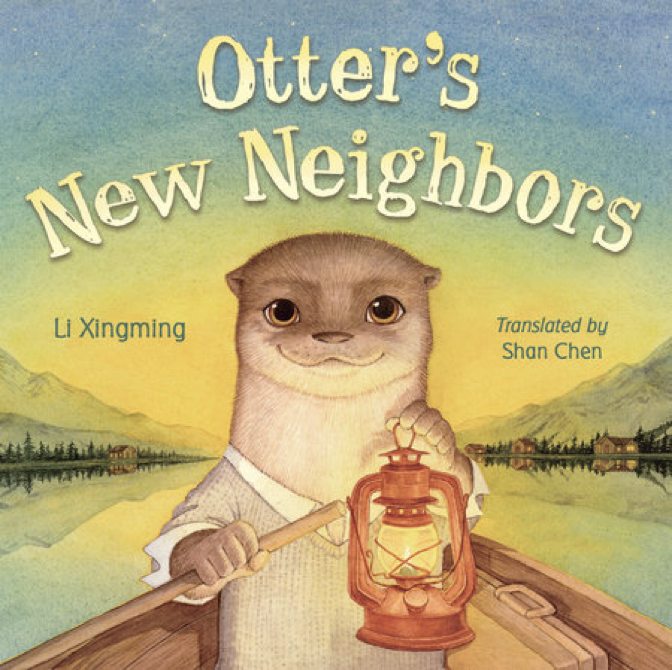
Mr. Otter, a reflection of Xing-ming himself, is the main character. When Otter moves into his lake house, his new neighbors arrive one by one, each bringing a thoughtful gift to welcome him. Then a loud knock startles everyone. A bear appears—and breaks the door! Mr. Otter’s reaction to the bear is “a great message for kid readers to think about,” says Karen.
The Chinese version of the book has brought readers joy, comfort, and inspiration. It has also witnessed the artist’s own growth.
“From an idea to a story, from a story to a picture book, and from a picture book to a good picture book—there are mountains and rivers in between,” says Yang Zhong, Xing-ming’s professor and mentor, founder of the Picture Book Studio at the Central Academy of Fine Arts. Even for an “exceptionally talented student” like him, the journey was not easy.
For his graduation project, Xing-ming began with big ambitions. He set out to create a Chinese wuxia story (martial arts and chivalry), a genre rich in history, grand in scope, and boldly heroic…but it didn’t work. He wasn’t facing his true self: gentle, sensitive, and afraid of loneliness. For a long time, he found it hard to say no, worried that refusing others would leave him lonely. While working on this book, he slowly found his way back to his inner self.
“I deliberately disconnected from the outside world for a while—drawing alone, not showing anyone, just for myself. I watched movies alone, wandered through forests… exploring my inner world.”
“These characters I create will always stay with you,” Xing-ming says—maybe to himself. Each character in the book is inspired by someone in his life: Beaver is a close friend from architecture school, a symbol of friendship, and the antelope couple represents love. After finishing the book, Xing-ming says, “I finally had the courage to say no. I realized I didn’t enjoy motorcycle gatherings—I’d rather stay home and read. When I told my friends honestly, our relationships actually became stronger.”
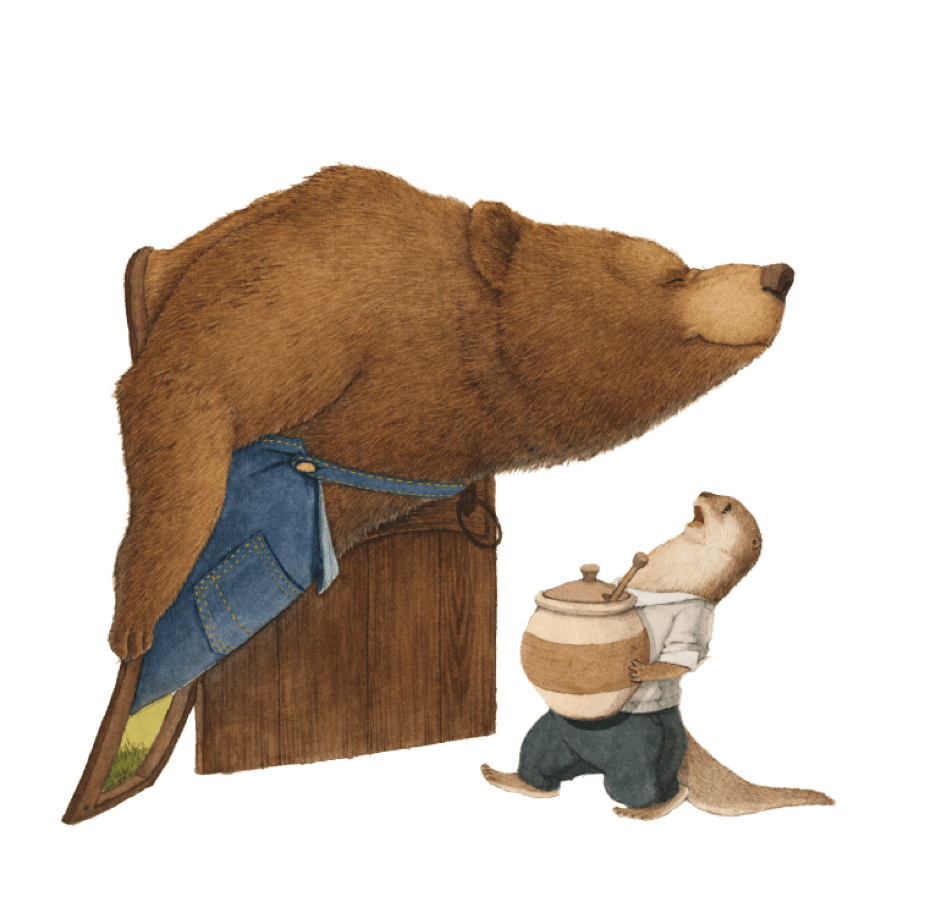
“I’m a skilled drawer—especially good at drawing details and creating atmosphere—but my teacher said, ‘That’s just showing off techniques,’” Xing-ming recalls with a laugh. “In this book, I left a lot of white space. That was a brave choice.”
He speaks often about how much intimate personal emotion he poured into the work. “I realized that to create, you have to face yourself honestly. I became a picture book maker after that book—and I’ve kept creating ever since.”
Xing-ming’s work is loved by his readers and fans. Through his art, you can glimpse his sensitivity and sincerity. He is just as warm and approachable. His mentor Yang Zhong says, “After graduation, we are still connected—almost like mother and son.” A pioneer in picture book education in China, Yang is widely respected and deeply loved by her students. At the same time, she believes a person’s sense of beauty can’t be taught—it’s shaped by childhood and environment. Xing-ming grew up in a home filled with music and art, where dinnertime was often accompanied by classical music in the background. But he was also bullied at school. As a child, he would sit alone in a corner of the playground, holding a favorite stone and wondering, “Is this stone connected to the stones in the sky—to the stars?” He would hope the stone could transfer his pain into the vast universe.
Ma Hao-yue, Xing-ming’s editor from Poplar, describes her relationship with Xing-ming as “like siblings.” She recognized his talent and invited him to lunch the first time they met. She cares not only about his work but also about his life. “I love to stay behind the scenes and witness creators grow and thrive,” she says. “We’re willing to give Xing-ming time and space.” A passionate editor, she has even traveled at her own expense to visit authors.
Years after Xing-ming’s graduation, his mentor Yang Zhong still offers guidance. She encourages her students to widen their horizons: “Picture books hold everything—psychology, education, philosophy, music…” When she founded the picture book studio at one of China’s top art academies twenty years ago, picture books were still something new in the country. This year, Chinese illustrator Cai Gao received the Hans Christian Andersen Award. In the years between, picture books in China have grown rapidly—sometimes with a sense of rushing ahead. But Yang Zhong has never lowered her expectations for her students. She refers to an ancient Chinese saying, “Aim and learn from high, and you may reach the middle; aim and learn for the middle, and you may fall below.” Xing-ming’s growth reflects her hope for her students’ roles: observers, participants, and leaders in the world of picture book creation.
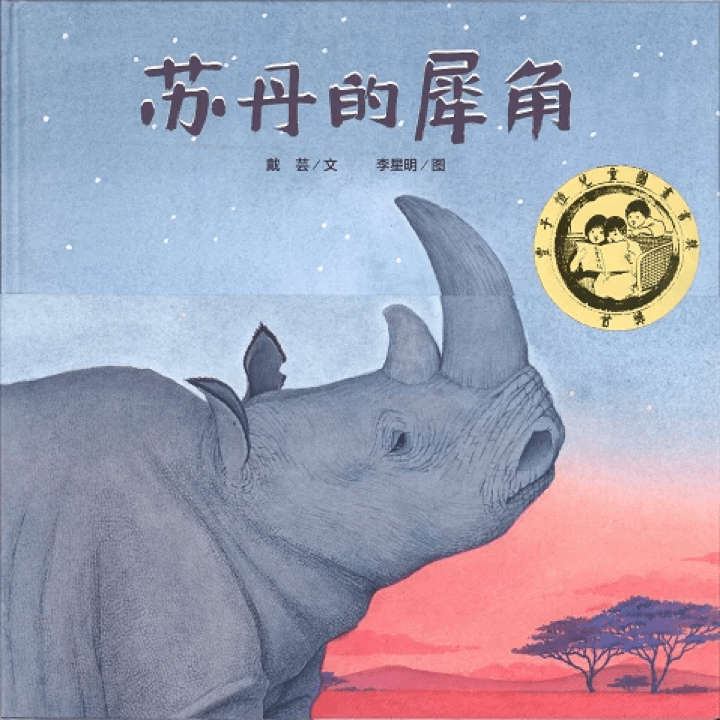
Later, Sudan’s Rhino Horn, written by Dai Yun and illustrated by Xing-ming, won the prestigious prize of the Feng Zikai Chinese Children’s Picture Book Award. Recognition and various invitations followed. “Three years ago, I became very anxious when drawing,” Xing-ming says. “I asked myself: Is this good? Will people like it?” After winning the award, he felt unworthy, chasing an imagined image of what a “real artist” should be. “I even became afraid to draw. Drawing used to heal me, give me energy—why did it become painful? Like chains… like a blade.” Once again, he turned inward—studying religion, psychology, philosophy, and music.
“When I looked again at Otter’s New Neighbors, I realized that even though I was unsure back then, with my teacher’s encouragement, I had already found the answer.”
That answer seems to have layers. In the story, the bear represents things unexpected, illness, even death, something that destroys what came before. “But the most important thing,” Xing-ming says, “is to accept it—repair what’s broken and heal from it.”
He reflects, “You have to face yourself honestly. After winning the award, I forgot my own island.” Now, even though he considers his audience, he reminds himself not to forget why he creates. He has come to understand happiness as a kind of quiet peace—“like when I’m fully immersed in drawing.”
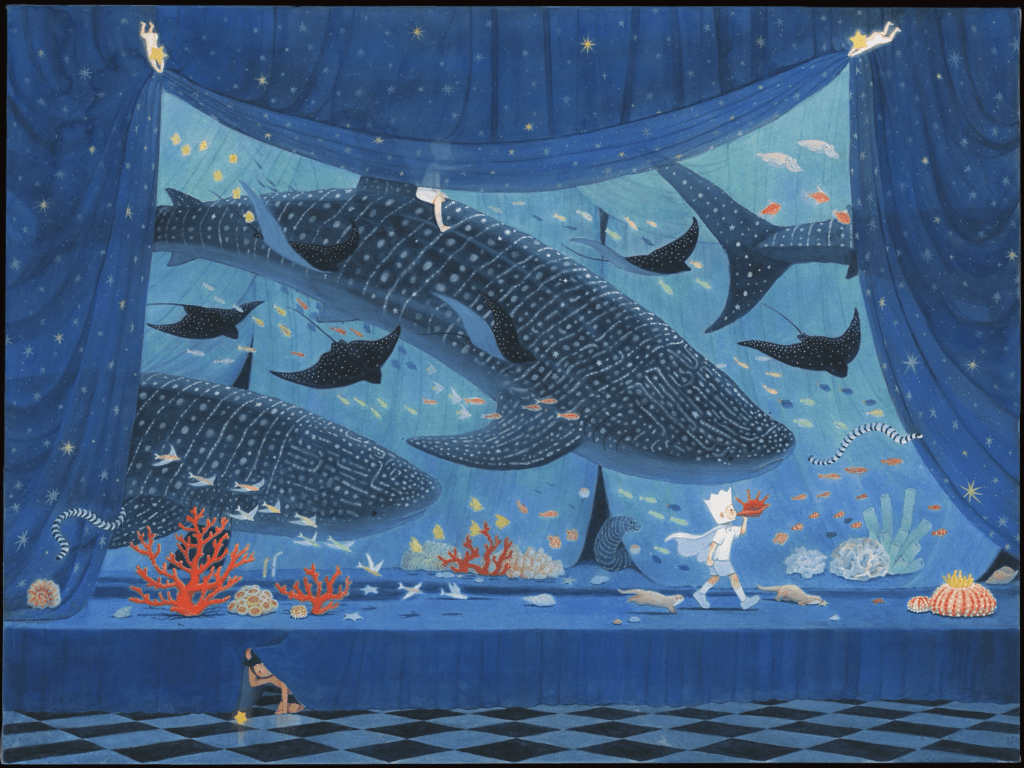
He is currently pursuing graduate studies at Tokyo University of the Arts in Japan, where he is honing his craft and learning to find his own way of seeing the world in everyday life.
Though Otter’s New Neighbors is a simple story about neighbors helping one another, at its heart is something deeper: connection. “Like the stars in the sky—they must shine, even faintly, to connect. If a star forgets being a star, it goes dark… or disappears. So you have to become a little light. Only then can lights connect with each other. You must protect your inner self to truly connect with others.” Xing-ming’s sincere voice travels across the ocean.
This is Xing-ming—Xing has the meaning of star; Ming has the meaning of bright (and tomorrow). May you find your own light in his books.
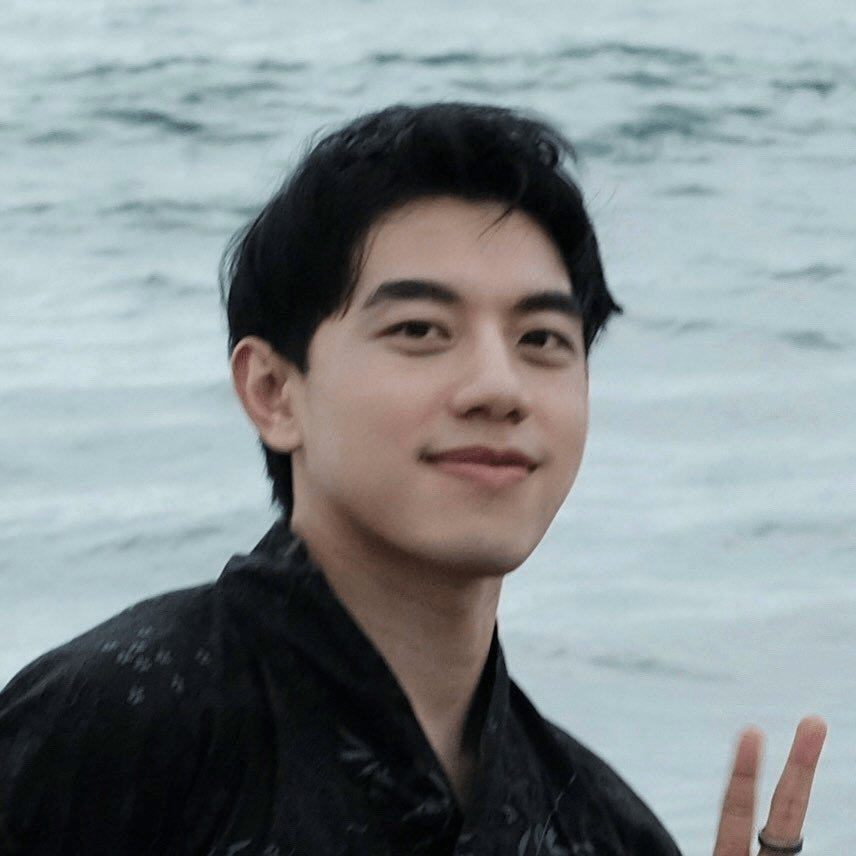
Li Xing-ming is a Chinese artist and picture book maker. He attended the Central Academy of Fine Arts Picture Book Creation Studio.He received the first award in the China Central Academy of Fine Arts Graduation Design Award as well as JIA Excellence Award. He is the illustrator of Sudan’s Rhino Horn, which won the Grand Prize of Feng Zikai Chinese Children’s Picture Book Award.
You can follow him on his instagram or visit him at his website.
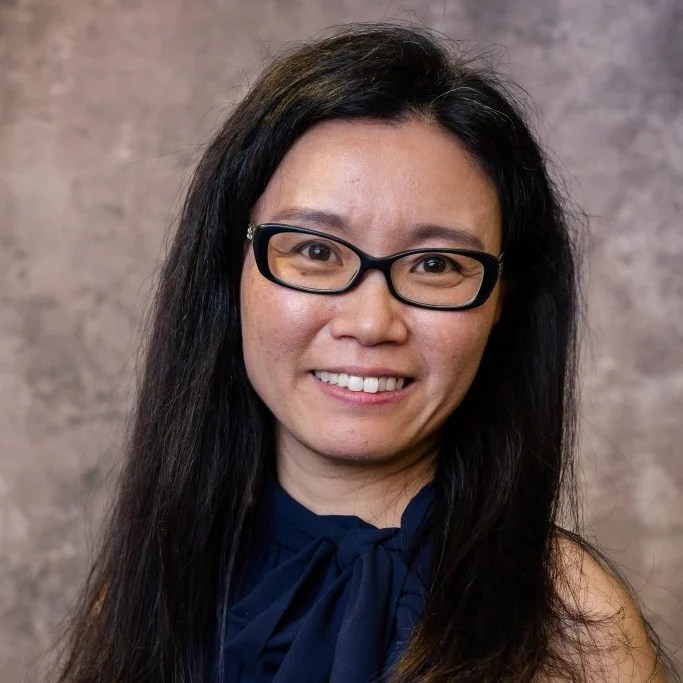
Wang Li is a children’s book writer and translator. She was a 2025 SCBWI Work In Progress Winner (Picture Book), 2025 Art Omi Translation Lab resident. She won the 2024 Pitch-Perfect Translation Grant, along with several other writing awards. Find her at her website, where you can take a peek at the stories she’s brewing up.
***To write this article, I had the pleasure of interviewing Li Xing-ming, Yang Zhong, Ma Hao-yue, and Karen Boss. I am deeply grateful for their time, sincere and unique insights, as well as expertise in children’s literature. Each conversation brought warmth, depth, and inspiration to this work, making the entire interview process both meaningful and truly enjoyable. —Li
Support World Kid Lit!

World Kid Lit is a nonprofit that aims to bring diverse, inclusive, global literature into the hands and onto the bookshelves of young people. We rely on grants and donations to support our work. If you can, please support us at Ko-fi. Thanks!
We earn a small commission every time you buy books via the affiliate links on our site, or via our booklists at UK Bookshop.org. This is a much appreciated donation towards our work. Thank you!

