This is the second of two articles celebrating the illustrator Cai Gao, recently awarded the prestigious IBBY Hans Christian Andersen Award for Illustration in recognition of her lifetime contribution to children’s literature. See here for our interview with literary translators Li Wang, Fiona Sze-Lorrain and Helen Wang about the irresistible appeal of Cai Gao’s work.
By Stephanie Gou
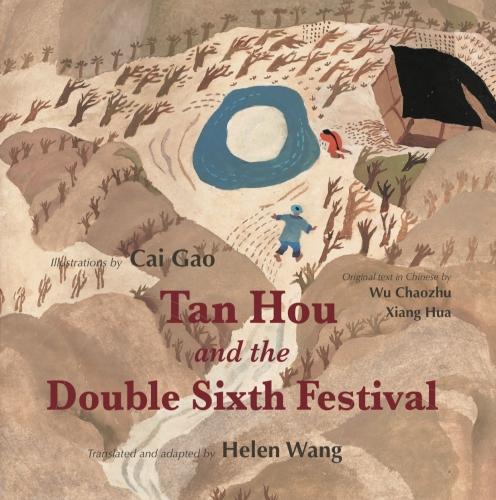
My first encounter with Cai Gao’s work was at the London Book Fair, where I came across the English edition of Tan Hou and the Double Sixth Festival, in English translation by Helen Wang. I was immediately drawn to her approach to the title—it moves away from a literal rendering and instead captures the story’s simple, legendary essence. What began as curiosity gradually deepened, especially as I compared her work with multiple adaptations of Mulan. It was then that I began to understand what makes Cai Gao’s art so distinctive: a vitality that seems to grow directly from the earth.
In discussions of picture books, it is often assumed that young children—particularly those in the early years (roughly under the age of seven)—are most responsive to bright, high-contrast colours, such as vivid reds and yellows that are easy for the developing eye to register. Cai Gao takes a different path. Her palette is grounded in earth tones, offering something quieter but no less engaging.
Her illustrations are marked by a strong sense of texture. Rather than flat colour, she builds surfaces through layered brushstrokes, creating subtle variations within a single tone. The effect recalls the grain of earthenware—warm, weighty, and slightly resistant to the eye. This tactile quality connects to a child’s sensory world: the memory of playing with mud, touching grass, or holding sand. It invites young readers not just to look, but to almost feel the image.
I use the term “earthenware aesthetics” to describe this visual language—one that emphasises texture, material weight, and a sense of groundedness, in contrast to the smooth, polished surfaces often associated with more decorative styles.
Cai Gao’s attention to detail reveals a compelling blend of childlike perception and artistic imagination. In Tan Hou, for example, chickens are not rendered with naturalistic feathers. Instead, each feather becomes a dense decorative unit, resembling repeated stamped motifs on rice paper. This approach draws from traditional Chinese paper-cutting and embroidery, yet it also feels strikingly modern in its composition.
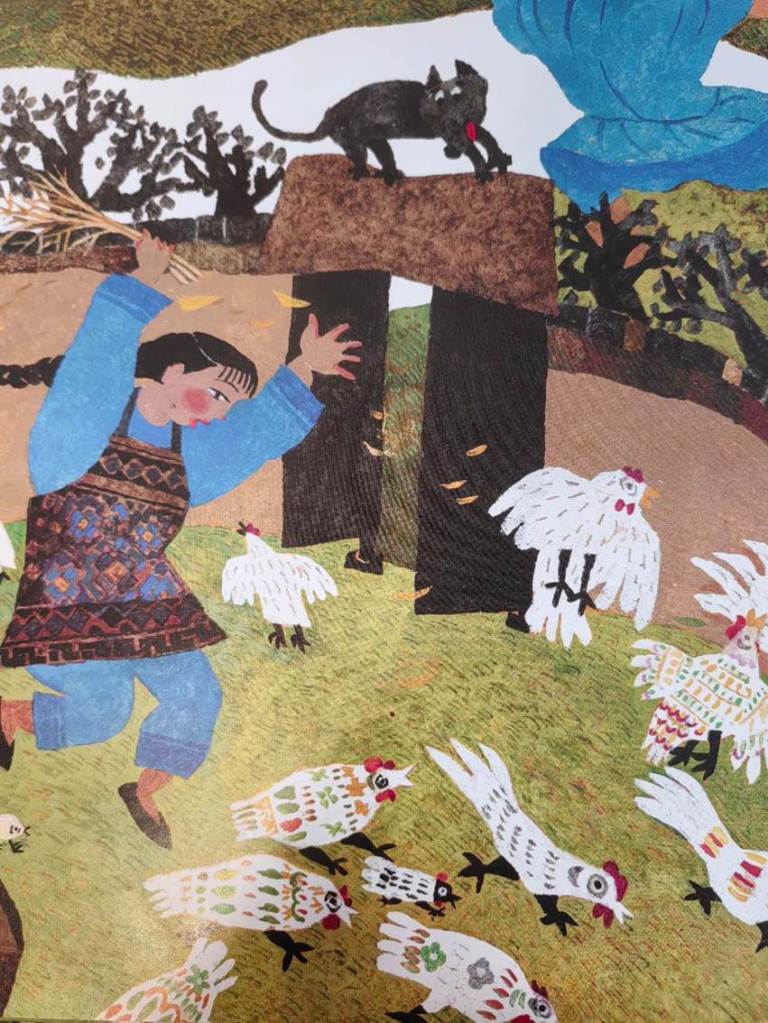
Her use of space is equally thoughtful. In one scene, a figure leans in a dynamic, off-balance pose, countered by chickens scattering in different directions. Together, they create a sense of movement across the page. The ochre background is not simply a backdrop—it functions as negative space, allowing the main colours to stand out. Even a small detail, like a black cat perched on a rooftop, helps guide the viewer’s eye upward, adding lightness to the composition.
Cai Gao also approaches text with a sense of independence. Her illustrations do not merely follow the words; instead, they expand and reimagine them. Folk tales and historical narratives can sometimes feel distant or overly familiar, but her work brings them closer to the child’s world—lively, open, and full of possibility.
Her images feel less like something painted and more like something shaped—kneaded and formed, then fired in the kiln of memory. In this sense, her work resonates with a broader Chinese artistic and narrative tradition, where the land is not just a setting but a source of life, memory, and identity.
Through this, Cai Gao reminds us that visual storytelling in picture books can be grounded as much in touch and material as in sight. Her work points to an aesthetic that is not only about lightness and fluidity, often associated with ink traditions, but also about weight, texture, and an intimate connection to the earth.
* Stephanie Gou first wrote this book review in Chinese and translated it herself into English with the help of translation software.
Tan Hou and the Double Sixth Festival
Written by Wu Chaozhu and Xiang Hua (as《晒龙袍的六月六》)
Illustrated by Cai Gao
Translated from Chinese by Helen Wang
Published by Balestier Press, 2017
Buy from Bookshop.org US / Waterstones UK
***
Stephanie Gou is a journalist, children’s book translator, and founder of the Lit-up Mandarin Book Club. Raised in Inner-Mongolia (China) and living in the UK since 2003, she is a columnist for FT Chinese (Education) and a PhD researcher at Loughborough University’s Storytelling Academy (UNESCO Chair in Storytelling Education for Sustainability). Stephanie bridges Eastern and Western perspectives through storytelling, focusing on affirming children’s identity and wellbeing by connecting them to their heritage while supporting their journey in a multicultural society.
Support World Kid Lit!

World Kid Lit is a nonprofit that aims to bring diverse, inclusive, global literature into the hands and onto the bookshelves of young people. We rely on grants and donations to support our work. If you can, please support us at Ko-fi. Thanks!
We earn a small commission every time you buy books via the affiliate links on our site, or via our booklists at UK Bookshop.org. This is a much appreciated donation towards our work. Thank you!

