By Johanna McCalmont
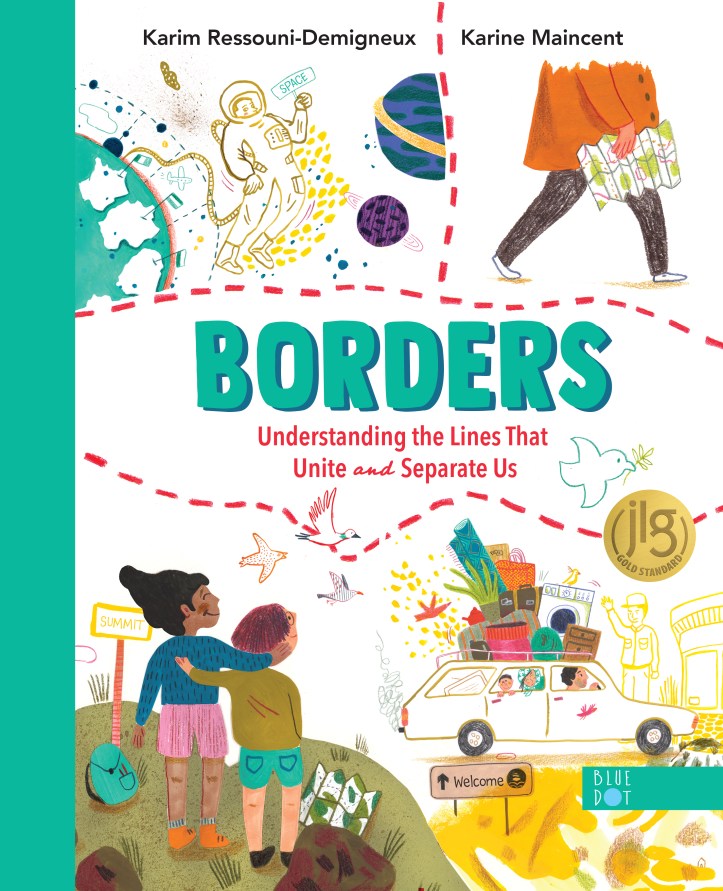
This week translator Johanna McCalmont talks to author Karim Ressouni-Demigneux about his first book to be translated into English (by Johanna herself), the non-fiction book Borders illustrated by Karine Maincent (Blue Dot Kids Press, 2026).
World Kid Lit: Would you like to tell us a bit about yourself?
Karim Ressouni-Demigneux: I was born in France, and I lived most of my life in Paris. I’ve always been a city person, but last year I moved to Brazil and am in the middle of setting up a farm. I’m 61and I had been thinking about how to spend the last part of my life for a while, and I was also a bit worried about things like climate change. I know Brazil well and I’ve always wanted to live here, so that’s how I ended up here. Getting a farm with cows and planning to grow coffee too was a bit of a surprise though!
WKL: You’ve been writing for young people for a while. How did you start writing for children and teens?
KRD: While I was finishing my PhD on art history, I wrote a text about my grandfather’s death. I had put myself into the shoes of a child, so friends who had read it suggested it would be a good book for children. I sent it to various publishers, got a few rejections and decided to go back to finishing my dissertation. About a year later, a publisher got in touch and decided to publish Ce matin mon grandpère est mort (Rue du monde, 2003). After that, I continued writing for children and teens, with commissions coming in. I was only getting short contracts at the university, so when La Cité, a YA series took off, I became a full-time writer. I think you can talk to kids about all sorts of things. I tend to write in a way that is innocent, without overthinking it too much.
WKL: Borders is out this month. Can you tell us a bit about the book? How did you come to write it?
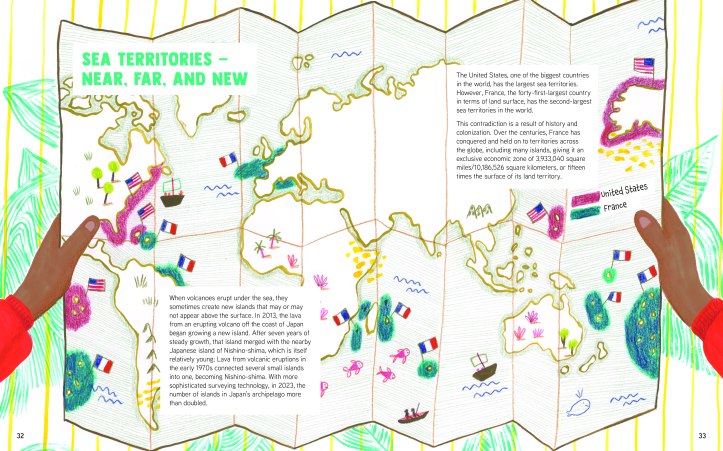
KRD: Borders, as the title suggests, is all about borders across the world. Before I started writing it, I knew a bit about the topic, but I hadn’t realised the extent to which borders are actually human made. It’s also about the borders we might not necessarily be aware of, like ones on the Internet or in space, and how we manage all sorts of borders to try to control and possess them. There are also some comical elements in the book, as well as few dreamier parts, like the end of the book. On the final spread there’s a promise of what lies beyond, the idea that it’s not always a threat, but can be beautiful too.
I came to the book because I knew the publisher at Kilowatt editions, Galia. One day she asked if I knew anyone who would be a good match for the topic and I thought to myself ‘That’s one I’d like to write!’ When writing for children, I take the same approach as I do when writing for adults. There are so many angles when it comes to the topic of borders. It’s a subject that has always interested me. When I lived in Paris, I used to volunteer with La Cimade, an organisation founded by the protestant youth movement in 1939, that works with undocumented migrants. Its slogan is ‘freedom doesn’t have borders’ and it campaigns for the free movement of all people. So the topic of borders was one that very much interested me.
WKL: Did anything unexpected emerge as you worked on this project? Did it evolve during your process? At what stage did Karine Maincent come in?
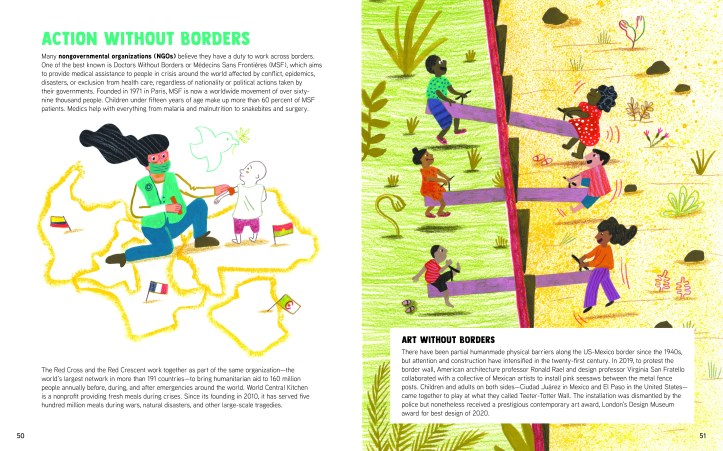
KRD: The thing that surprised me – happily – was the wide range of perspectives you can cover when looking at borders and their history: geographical, historical, artistic and even a more melancholic perspective. Karine the illustrator came in after I had written the texts. A few small changes were made to the text after she had created the illustrations, but it wasn’t a parallel collaboration. When I write – both non-fiction and fiction – I like knowing that the illustrator will find things in the text, things that will also help make ideas clearer. They take over part of the work in a way. The text is informative, but the images add to it and help highlight various elements. It’s one thing to describe colonial borders and the straight lines, for example, but another thing to see an image of the colonisers actually doing it.
WKL: Borders covers an impressive number of topics! It goes way back to the creation of the Earth and then looks at how humans have lived and interacted with each other all over the world. It concludes with current challenges faced today, like wars and climate change. I really enjoyed working on so many topics myself and often ended up reading further into various subjects as I researched terms and considered various adaptations for the US publisher, like the sizes of different airports. Was it difficult deciding on the topics to include? How did you research it?
KRD: I used the Internet a lot. You can find a lot of information on websites, like the United Nations and the European Union institutions’ websites. I also use libraries a lot, I tend to go to print sources because you have more certainty that the information is reliable. I was used to researching various topics from my PhD and also from when I worked as a journalist. This was my first big non-fiction project outside my own area of expertise, though. But I really enjoy the research side. It’s about pulling out the most important points and figuring out how to communicate that information. I spent several months on the research and then I had a couple of months to write the text. I like having a deadline!
WKL: This is your first book to be translated into English. How did you find the editing process?
KRD: There were a few questions that came in from the US publisher. They asked about some of my sources, so I shared my material with them. For the German version, I believe the section on Israel and Palestine was expanded and includes more detail than the original French version.
WKL: Which children’s authors do you admire? Did you have favourite books as a child yourself that have stayed with you? Any recommendations for our readers?
KRD: As a child I read a lot of series like the ‘pink’ and ‘green’ series we have in France. I read a lot of the Black Stallion books. So I don’t really remember a particular writer. Now I enjoy reading books by my colleagues and seeing what’s popular at book fairs and festivals. One book I often recommend is La Petite Casserole d’Anatole (Anatole’s Little Saucepan) by Isabelle Carrier. It’s about disability, but uses simple metaphors to explore the complex theme in a profound way. Even though it’s for younger readers, I often recommend it to teens who have maybe lost interest in reading, because it is actually quite deep.
WKL: And finally, are you working on anything right now that you can tell us about? Do you have any more books coming out in English?
KRD: At the moment, I’m so busy with the farm and getting everything sorted here that I don’t have time to write, but I’ll come back to it when the time is right. I’ve got a few ideas for another series and maybe I’ll write a diary about my life here in Brazil. As for English translations, I’d love to see La Cité translated. There is a lot of me in it even though it’s not autobiographical. It’s a series for teens about that time in life when everything seems possible, both the best and the worst. It’s about how kids grow up today in a world that is both physical and virtual, and how that compares with the time I grew up when everything was analogue. I loved the few years I spent writing that series and the interaction with the readers in France.
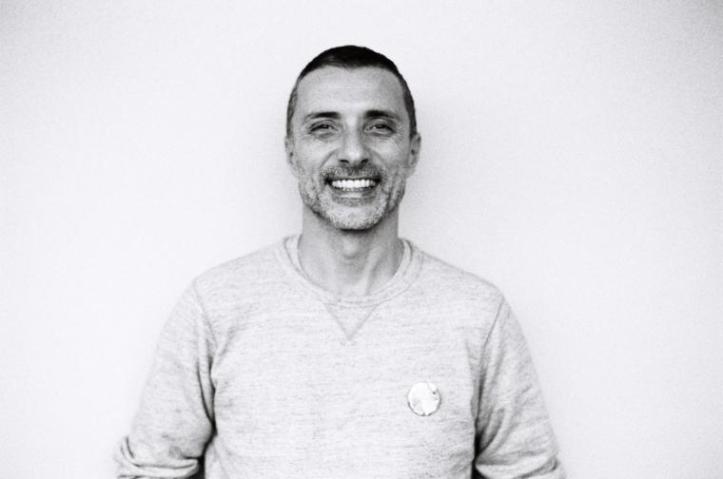
Karim Ressouni-Demigneux holds a doctorate in art history and was born in France to a Moroccan father and a French mother. He works in journalism and literature, writing especially for young people. He has travelled and lived all over the world, including Morocco and Brazil and regularly leads trips to China, where he has also lived.
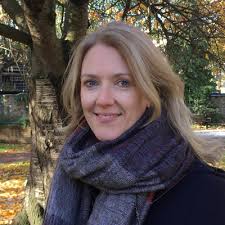
Johanna McCalmont grew up in Northern Ireland and now lives in Brussels, Belgium, where she enjoys helping others to communicate effectively across cultures and languages through her work as a translator and interpreter. She translates and interprets from French, German, Italian and Dutch and is one of the co-editors of this blog. Read more about her here.

