by Gelsey Phaneuf
Author María José Ferrada and translator Lawrence Schimel talk about their latest children’s poetry collaboration When You Were a Cloud, illustrated by Azul López and published by The Emma Press.
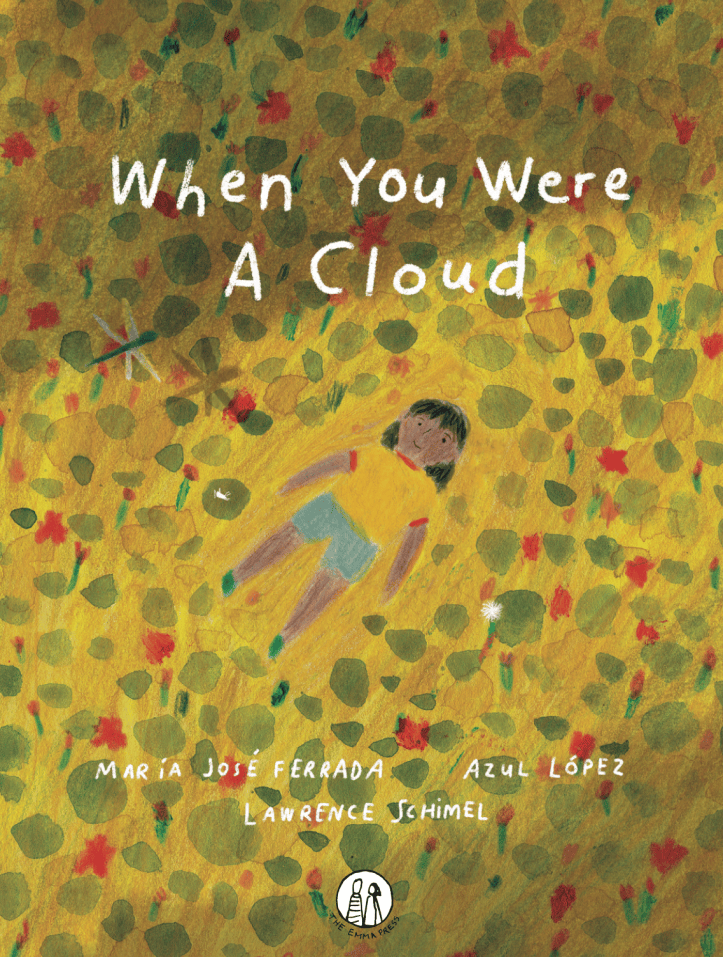
Gelsey Phaneuf: When You Were a Cloud is an international project, with a Chilean author, a Mexican illustrator living in Europe, an American translator living in Spain, and a publisher based in the UK. Lawrence, could you please share with readers how this project came to be published by The Emma Press?
Lawrence Schimel (LS): In this case, I as the translator (and a fan of the work of both María José and Azul López) had read the book when it won the Premio Hispanoamericano de Poesía para Niños in 2018. I had translated other books published by Fondo de Cultura Económica in Mexico, and the originating editor shared an early PDF of the project with me. But the editors in English who are willing to publish children’s poetry, let alone children’s poetry in translation, are sadly few and far between…
I had already translated two books of children’s poetry for The Emma Press: Poems the Wind Blew In, written by Basque poet Karmelo C. Iribarren and published with newly commissioned illustrations for the English edition by artist Riya Chowdhury, and Balam and Lluvia’s House, written by Guatemalan poet Julio Serrano Echeverría and illustrated by Spanish artist Yolanda Mosquera.
While each of these books has a unique voice, I felt that When You Were a Cloud (both poetry and art) would resonate with and complement the other volumes I’d already translated for The Emma Press; they all share a way of looking at and finding wonder in the small details of the world. And the editors agreed! Since Chile is the Guest Country at the Frankfurt Bookfair in 2027, there was also a special translation grant that they could apply for to help support the project.
There are so many beautiful themes that connect the poems together–such as imagination, observation, uncertainty, and transformation. Is there one idea or image that was a driving inspiration for you, María José, as the author; and Lawrence, as the translator?
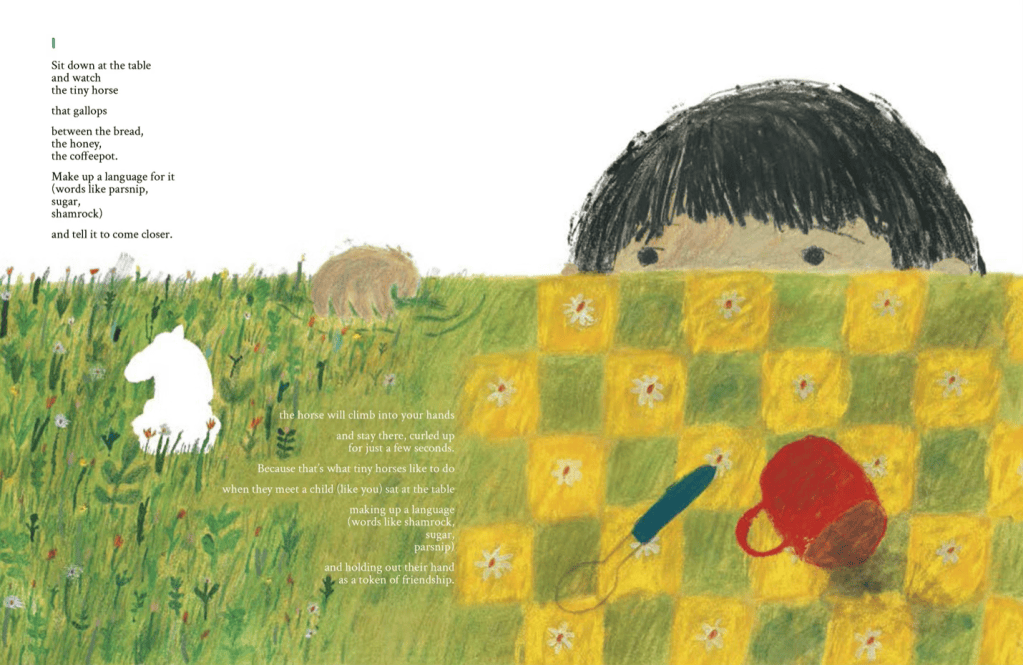
María José Ferrada (MJF): In poetry I work with many images, so it’s difficult to choose just one. Perhaps I can pick two. The first is one that appears not just in this but in several of my books, as if it were an image stuck in my head: the little horse that gallops across the table. I like that image because it takes something from reality (the horse) and, with the help of the imagination, transforms it. It is something very simple: make the horse small, which in turn gives rise to many possibilities. It gallops along the table; it sleeps in your pocket; it climbs into your hand. The protagonist is the everyday world with its inhabitants and elements. The world which, if we’re willing, allows us to play with it.
I also like the image of the mountain that takes a nap for 100 or 200 years. It’s inspired by a small mountain in front of the house of my maternal grandparents. They are no longer in this world, but I still pass by there from time to time and look at that mountain. Time passes differently for it: what for us is a lifetime or various generations is but a blink for it. I’ve always felt that these kinds of comparisons help us to not give so much importance to the problems we might have, for them to have a different weight. I like to be the ant of the mountain.
LS: I love the image of the forest coming to visit the house to greet its relatives who are now wooden furniture. And the related image of furniture as the fruits ripening on a carpenter’s carefully-tended tree.
Lawrence, can you give us an example of a line or phrase in the Spanish poetry that was particularly rewarding or interesting to translate into English?
LS: María José’s voice is always a joy to translate, and also it’s a challenge to make it seem as natural and effortless in English. My goal as a translator is to recreate the reading experience.
And the editing process is important, too. I try to be faithful to the original text, whereas the editor, in this case, Emma Wright, needs to be faithful to the readers of the book. So if something wasn’t working for her, she might make a suggestion, and a lot of times I was fine with them, but sometimes I would offer an alternative, that would satisfy both of us.
Sometimes its a question of personal preferences or house style. (Observe vs. watch, journeys vs. travels, emerge from vs. come out of, etc.)
And sometimes the English had serendipities that weren’t in the original, like the unexpected rhyme of “vowels” and “the language of owls,” which we kept as the echo felt almost like the repeating “hoo hoo” of an owl’s call.
For new readers, María José, where does the title When You Were a Cloud come from?
MJF: Cuando fuiste nube is the title of the book from the first edition in Spanish. It is the image of one of the poems, an image that also has to do with how we relate with other inhabitants of the land and the sky, in this case. Our bodies have water and calcium, which is to say that we share elements with the clouds and stars. I like to think that I am distantly related to them, and I imagine that some kids will also enjoy that.
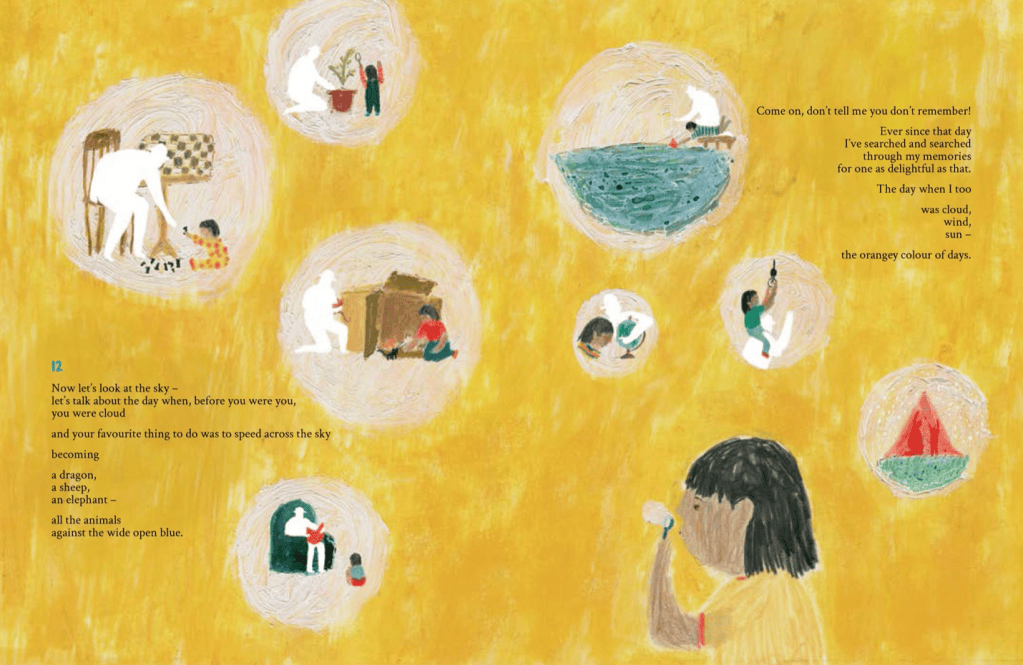
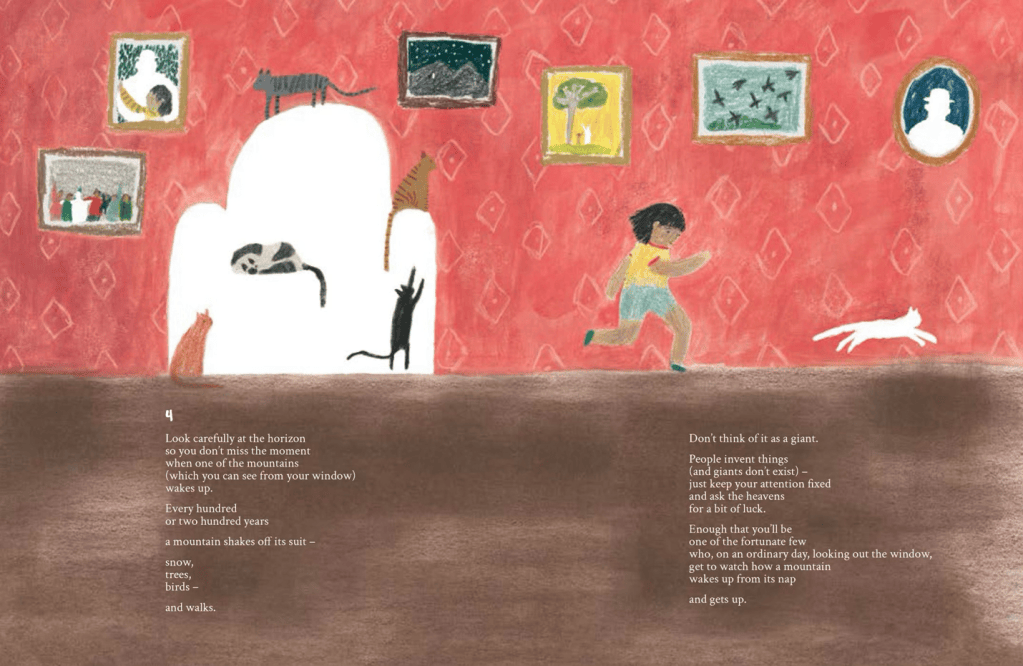
When I listened to María José read poem 4 in a recording, I did not have the illustrations in front of me, so it was surprising to see how the illustrator, Azul, interpreted the words and related them to cats. María José, did you provide any context to your poems to help Azul illustrate them? Did her illustrations help you read your poems in a different way?
MJF: The poem is not about cats. Azul, the illustrator, made the cats, because the child who appears in the illustrations lives in the world, not just in function of the poem. And in that world there are many things that are moving and playing with him, beings that he loves or misses and in that sense the illustration gives a broader image. Azul took that liberty and it was very important that she did so, because it expanded the book.
The book provides all the original Spanish poems in the back, as well as guidance to readers on how to engage with the poems in English and Spanish. What would you each say to a parent or librarian who is hesitant to read or talk about poetry with children?
MJF: I would say that poetry is a friendly language, close to the way in which children play with the things they know and with language. So I think they won’t lose anything by trying, perhaps the exact opposite.
LS: I think it is almost always adults who are afraid of poetry, not children themselves. The whole world is still new to young readers, including different ways of discovering it, in words and pictures. They don’t learn to be afraid of poetry unless adults instill that in them, through example.
When You Were a Cloud can help adults who read the book together with a younger person remember how to see the world through a child’s eyes. It can help them find wonder and magic in so many tiny details and moments. That is the power of poetry, and especially María José’s poetry!
Thank you, María José and Lawrence!
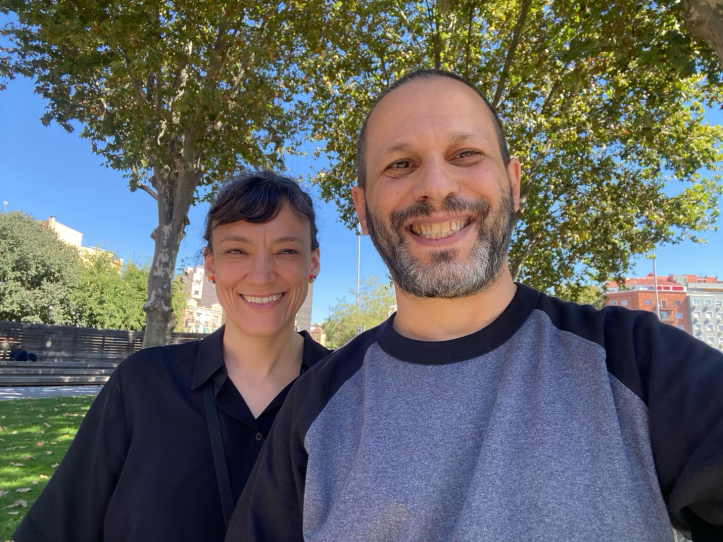
María José Ferrada (l.) and Lawrence Schimel (r.). Courtesy Lawrence Schimel
María José Ferrada (Chile, 1977) is a journalist and writer. Her books have been translated into twenty languages. She was shortlisted for the 2026 Hans Christian Andersen Award and has received numerous literary prizes, including the Cervantes Chico Prize, the Iberoamericano SM de Literatura Infantil y Juvenil, the Premio Poesía Ciudad de Orihuela, the Premio Hispanoamericano de Poesía para Niño, and the New Horizons Prize from the Bologna Children’s Book Fair. She lives in Villarrica, Chile.
Lawrence Schimel (New York City, 1971) is an author, publisher and translator. His translations into English have won a Batchelder Honor from the American Library Association, a PEN Translates Award from English PEN (three times), a National Endowment for the Arts Translation Fellowship (with Layla Benitez-James), and have been Highly Commended in the CLiPPA, among other honours. He started the Spain chapter of the Society of Children’s Book Writers and illustrators and served as its Regional Advisor for five years. He also coordinated the International SCBWI Conference in Madrid and the first two SCBWI Bologna Book Fair conferences. He lives in Madrid, Spain.
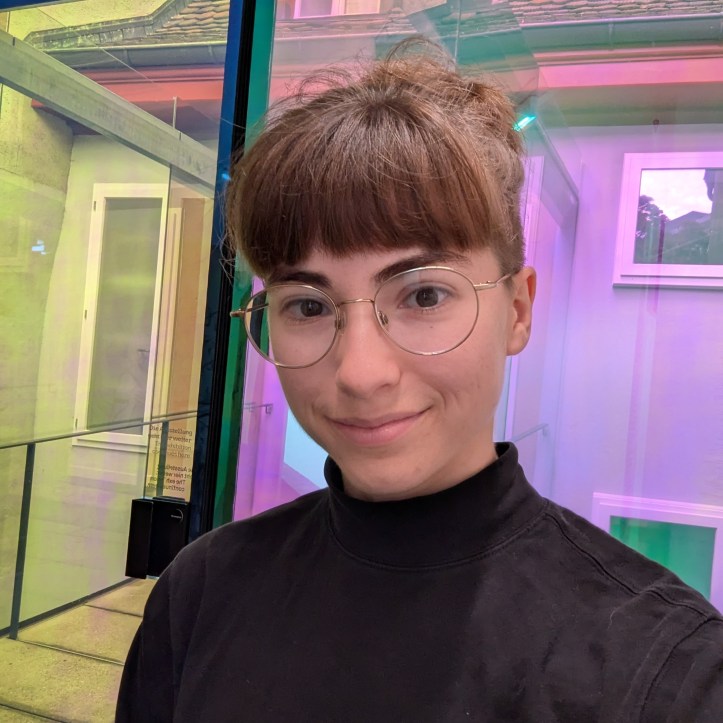
Gelsey Phaneuf is the associate publicist at NorthSouth Books. She is a member of USBBY and currently serving on the IBBY North America regional conference committee. She is also a board member for Books Across Borders. She is a passionate champion of children’s books in translation. She holds a B.A. in English from Vassar College and is an alumna of the Columbia Publishing Course. She also works with children as a dance instructor. Gelsey lives with her partner and their two dogs in Massachusetts. Find more of her children’s book thoughts at: https://substack.com/@picturebookscout

World Kid Lit is a nonprofit that aims to bring diverse, inclusive, global literature into the hands and onto the bookshelves of young people. We rely on grants and donations to support our work. If you can, please support us at Ko-fi. Thanks!
We earn a small commission every time you buy books via the affiliate links on our site, or via our booklists at UK Bookshop.org. This is a much appreciated donation towards our work. Thank you!

