
by Jackie Friedman Mighdoll
This week we meet author and illustrator Farida Zaman, who shares more about the creation of her picture book Samina Goes to a Wedding: Celebrations from a Bangladeshi Marriage, published earlier in 2026 by Owlkids Books.
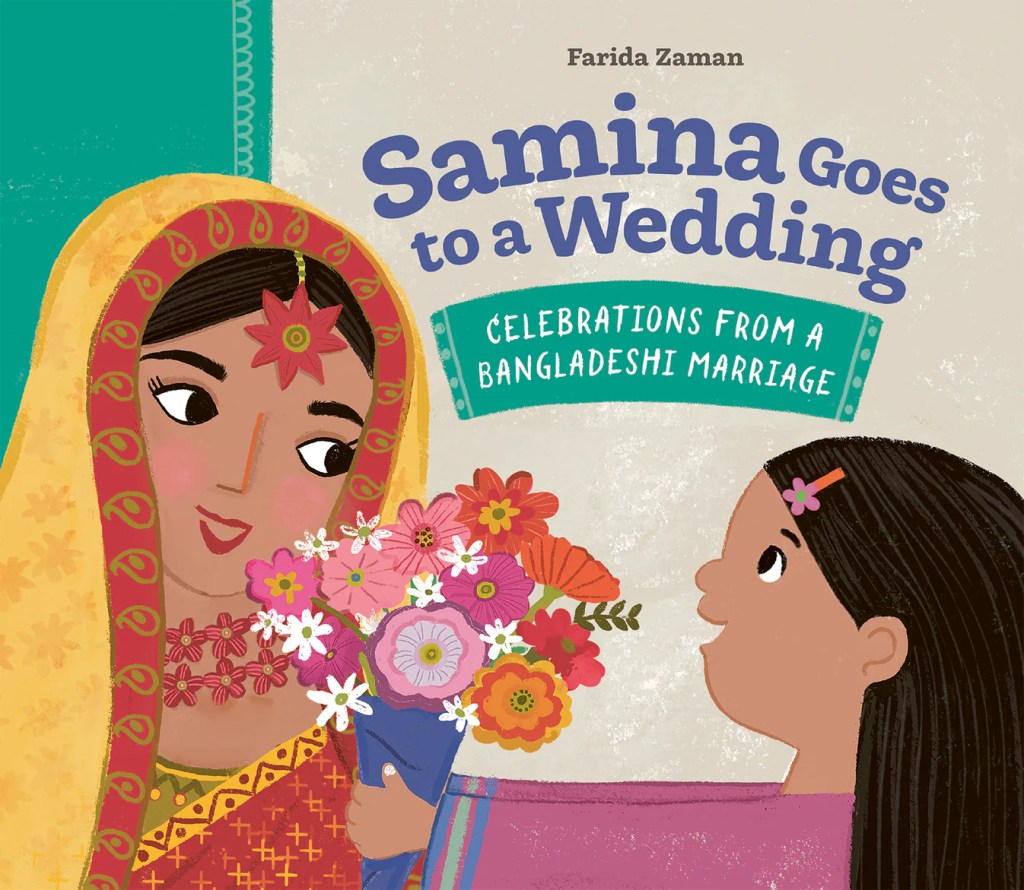
Jackie Friedman Mighdoll: I was excited to meet you in Bologna and to discover your book about a Bangladeshi wedding. I felt like I was invited along with Samina in discovering the fun and rituals. Can you tell us more about your inspiration?
Farida Zaman: My inspiration is based on my family weddings and the travels we did to attend them, as I didn’t grow up in my country of origin, Bangladesh. I was fascinated by the festivities, colour, creativity, and spirit of these weddings.
I still remember my aunt’s Bangladeshi wedding like it was stitched together from colour and sound. It was many moons ago, but in my mind it’s still bright—reds, golds, and the soft shimmer of silk moving through rooms that suddenly felt too small for all the people in them. The house was never quiet for the clink of bangles, the rustle of saris as people passed like flowing paint.
I remember watching my aunt get ready as if dressing was its own ceremony within the ceremony. Her hair being pinned, jewelry appearing piece by piece until she looked transformed, almost unrecognizable for a moment, then suddenly very familiar again.
The food is still vivid, too. The long tables filled with aromatic rich biryani, spicy curries, and a variety of sweets and desserts. Everything tasted like a celebration.
Even now, when I think back, it doesn’t feel like a memory I’m looking at. It feels like a room I can still walk into.

JFM: I’m curious about whether you had to change any aspects of the wedding to modernize it in the book?
FZ: The wedding I remember from my childhood was many years ago, but emotionally it still feels very familiar to weddings today. The heart of it hasn’t really changed—family gathering together, the excitement, the chaos, the food, the music, and all the little rituals that make a Bangladeshi wedding feel so rich and layered.
What has changed are some of the details around it. Weddings today can feel much bigger and more stylized. There are professional decorators, choreographed dances, elaborate photo booths, social media moments, and a much faster pace. Growing up, the weddings I attended felt a little more intimate and handmade. Family members were deeply involved in everything, and there was a warmth in that slightly imperfect busyness that I really wanted to preserve in the book.
At the same time, I didn’t want the story to feel frozen in the past or overly nostalgic. I wanted children reading it today to recognize themselves in it. So while some visual details and settings may feel contemporary, I tried to hold onto the emotional truth of the weddings I remember as a child—the wonder of seeing everyone dressed up, the sensory overload, the joy of being surrounded by extended family, and the feeling that something important and magical was unfolding around you.
For me, it became less about documenting a perfectly accurate wedding from one era and more about capturing the timeless feeling of being a child inside a Bangladeshi wedding celebration.
JFM: Do you have an ideal reader in mind for your picture books? Could you tell us about them?
FZ: Samina Goes to a Wedding is primarily aimed at children aged four to eight years old, particularly readers who enjoy richly illustrated picture books centered around family, celebration, and culture.
The book is for children who may see their own experiences, traditions, clothing, and family dynamics reflected in the story—something that can create a powerful sense of recognition, pride, and belonging. For South Asian children, especially, I hope the book feels familiar and affirming, allowing them to see aspects of their culture represented with warmth and care.
At the same time, the story is also for children who may be unfamiliar with South Asian weddings and traditions. I hope it offers an inviting introduction to a different culture through the eyes of a child, showing both the beauty of cultural traditions and the universal emotions within them—excitement, nervousness, family connection, and joy.
Ultimately, I wanted the book to feel both specific and universal: rooted in a particular cultural experience, while also reminding readers that celebrations, family, and the desire to belong are things many children can relate to.

JFM: I love hearing about the process of creation. Did this book change over time? What led to those changes?
FZ: The book changed quite a lot visually as I developed the illustrations and spent more time thinking about the emotional experience of the story. In the beginning, the artwork was much simpler, but as the project evolved, I found myself leaning more deeply into the decorative elements—the patterns on the fabrics, the textures, the jewelry, and the atmosphere of the wedding itself. I wanted the world to feel immersive and celebratory, almost as though readers could step directly into the event alongside Samina.
A big part of those changes came from memory and research. As I worked, I kept returning to family photographs, memories from weddings I attended in Bangladesh, and references to traditional clothing and jewelry. That process encouraged me to add more specificity and richness to the visuals. The details became an important storytelling tool rather than just decoration.
The characters also evolved over time. I spent a lot of time refining expressions, poses, and body language so the emotions felt believable and warm. One of the biggest challenges was making sure the characters stayed visually consistent while wearing multiple outfits throughout the book. That required constant cross-referencing and adjusting as the pages developed.
Stylistically, the book also pushed me toward a way of working that feels much more natural to me now. During the process, I became increasingly interested in layering textures, patterns, and collage-inspired elements into the illustrations. By the end of the project, I felt much more confident in that visual language, and it has continued to influence the work I’m making now.
JFM: You’ve covered making Bengali tea and fasting for Ramadan in previous books. How do you decide what to cover? Are there other important family events that you want to take on next?
FZ: Making tea, preparing for Ramadan, attending weddings—are things that stayed with me because they were tied so strongly to memory, atmosphere, and connection. They may seem ordinary from the outside, but they hold so much emotion, care, and identity within them.
When deciding what to cover, I often think about experiences I rarely saw represented in children’s books when I was younger. I’m interested in capturing both the big celebrations and the quieter domestic moments that shape family life and cultural identity. I want the stories to feel authentic and lived-in, full of the sensory details that make these experiences memorable—food, clothing, patterns, routines, sounds, and conversations.
I also think about how children engage with stories. A wedding, making tea, or fasting during Ramadan can all become entry points into conversations about family, belonging, and tradition. For children unfamiliar with these experiences, the books can open a window into another culture in an accessible and joyful way. For children who do recognize these moments, I hope the stories offer familiarity and a sense of being seen.

JFM: Do you have favourite Bengali stories from your childhood or your children’s childhood?
FZ: My grandmother would read Thakurmar Jhuli (Grandmother’s Bag of Tales) to me. It was our special time together, which opened the doors to Bengali fairytales for me. My favourite stories were Ghostly Legends (Bhooter Golpo), stories featuring playful, spooky, friendly and helpful ghosts. I found them very endearing. The other stories I loved from this book were stories about magical fish, wishes, and journeys to distant, mystical lands, which always intrigued me.
I read these stories to my children as well as other Bangladeshi children’s literature like Goopy Gyne Bagha Byne (The Adventures of Goopy and Bagha) and Tuntunir Boi stories about witty animals, musicians, and magical adventures. My kids loved these stories and much as I did as a child.
JFM: Would you like to share what’s coming next?
I recently completed a new picture book that I wrote and illustrated called Embroidered, coming out with Owl Books in Spring 2027. It’s an intergenerational story told from the perspective of a kantha blanket that is passed down through four generations, eventually reaching the present day.
The story travels from village life to the city in Bangladesh, and eventually to Canada. It’s a quiet, layered, almost poetic story with rich illustrations and a gentle pace meant to be shared with children ages 3–8. The blanket itself carries the memories, traditions, and history of the family, slowly revealing its story through the layers of stitching and wear.

This project feels especially personal to me because I had a blanket like this growing up—one that I later passed on to my daughter, and then my son. Working on this book brought back many memories, and I’m really excited for readers to eventually hold it in their hands.
About Farida Zaman

Farida Zaman considers herself a global citizen. Her work reflects a natural flair for capturing diverse cultures and stories inspired by travel, history, and lived experiences. She trained in fine art and illustration at the Chelsea School of Art and later at Wimbledon School of Art in London, where she graduated top of her class with honours. As a storyteller, Farida creates heartfelt and engaging stories that celebrate culture, identity, and belonging, allowing children to see themselves reflected in her stories.
Jackie Friedman Mighdoll is co-editor of this blog. She is passionate about discovering and sharing the diversity of the world with children. She writes books for kids and translates from Japanese to English. In a prior career, she founded a program teaching world languages to children, starting with newborns. She shares great finds On Beyond!
Support World Kid Lit!

World Kid Lit is a nonprofit that aims to bring diverse, inclusive, global literature into the hands and onto the bookshelves of young people. We rely on grants and donations to support our work. If you can, please support us at Ko-fi. Thanks!

We earn a small commission every time you buy books via the affiliate links on our site, or via our booklists at UK Bookshop.org. This is a much appreciated donation towards our work. Thank you!

