By Katy Dycus
Faroese translator Marita Thomsen discusses what it’s like to translate from a very “place specific” language, how translating Faroese books for children keeps her connected to her roots, and why Bárður Oskarsson’s books (which she has translated from Faroese into English) have enduring international appeal.
Katy Dycus: You are perhaps the most prolific living translator of Faroese literature into English, of both adult and children’s literature. How did you get your start in translating children’s literature specifically?
Marita Thomsen: The first literary translation gigs that I had were children’s literature, largely because historically Bókadeild Føroya Lærarafelags has been the most outward-looking publishing house in the Faroe Islands and they publish children’s and young adult literature. They travel to the Bologna and Frankfurt children’s book fairs and have been doing it for decades, even before I started translating. Almost twenty years ago, I first started translating the Faroese children’s book author and illustrator Bárður Oskarsson.
My first degree is in translation: English and French into Spanish, and Spanish into English (I studied in Peru), and when I first started translating I didn’t work with Faroese at all. I was already established as a technical translator and interpreter but didn’t work with the Faroese language. But when I moved to London to do a Masters in conference interpreting, I got in touch with some people in the Faroe Islands and asked, is there anything I can work into English? Occasionally, I work into Faroese, but mostly into English.
KD: You are a well-known translator of novels and poetry. Do you find that translating children’s literature is a completely different experience?
MT: On one occasion, a bilingual Faroese/English poetry collection called Darkening/Myrking, I worked with the author, Sissal Kampmann, on the go as she was creating the text. On that project, she was writing as I was translating so I didn’t know where we were going. At one point I thought we were finished because things had come full circle, and then I got another batch of poems. So, I now try to expect the unexpected in terms of what will come up and what will be challenging in every genre!
Children’s literature is often more compressed than a novel aimed at adults or YA; in that sense it’s often more like poetry. Also, it is primarily meant to be read aloud. I always read children’s literature aloud to myself, and willing victims, in the translation process. Again, much like I would poetry.
There is an added layer of complexity with children’s literature, which is the difference in expected reading age between the Nordic region and the UK, which I’m most familiar with in the English-speaking world. In most Nordic countries children start to learn to read at six, in the UK at four. So, and I have experienced this with Bárður Oskarsson’s books, a publisher might want the text tailored more to be read by children on their own, with everything that entails in terms of vocabulary and storyline complexity. However, these books were very much intended to be read aloud to children. So, I have had to explain and defend that to UK publishers. Children’s literature can teach you a lot, but I don’t think its primary function is to serve as learn-to-read textbooks.
As for process, when I receive a text, any text, I translate it, send it to the author, and sometimes ask them questions. By dint of being Faroese, I perhaps have fewer questions about a text written in Faroese because I know the places and the traditions of the Faroe Islands, so I’m often familiar with what they’re referring to. Sometimes my questions are along the lines of asking if it’s OK to add a clarification or make something more explicit, if I’m not sure someone outside the Faroe Islands will understand a certain reference. I’ll add a couple words, for example, to make it clear that two characters are standing down by the waterfront – much of Faroese literature is closely intertwined with nature and set in the local environment.
When you translate from a language that is so place specific, the authors will write references that everybody who is Faroese will know, so they don’t have to explain any of it – what they’re doing, where the characters are standing. So, there’s often little context as to where these characters are located. This is not an issue in picture books, however, because you’ve got images to guide you. The exception to all of this is, of course, Bárður Oskarsson because his work could be set anywhere.
KD: Is he the most well-known author you’ve translated?
MT: Probably the best-known living author. However, a book with texts by William Heinesen I translated was just published this spring: The Wise Man from the Sea: Time and Place, Spirit and Eternity. William Heinesen is one of the great Nordic writers of the 20th century. I don’t know exactly what a measure of “well-known” is, but he has an Encyclopaedia Britannica entry.
KD: You mentioned Bárður Oskarsson’s books could be set anywhere. They’ve been tranlsated into fifteen languages. What makes his books so universal?
MT: I think it’s because, at heart, they’re not necessarily children’s books, they are philosophy books. They are philosophy vignettes. He’s a philosopher both in his visual work and textual work. At heart, he’s a bit of an existentialist and every one of his books is about existence and what it is to be human. Questions are asked and never answered.
The question is asked in this picture format that is very well suited to look at and to read aloud with children. I think that’s it. These books go to the heart of what it is to be human. The Flat Rabbit is, in essence, about how we encounter death, but also a parable about what you do about the suffering of a stranger. It strikes a chord and it’s different because there’s no religious prescription to anything Oskarsson does. He doesn’t have a reference framework that tells you how you should react.
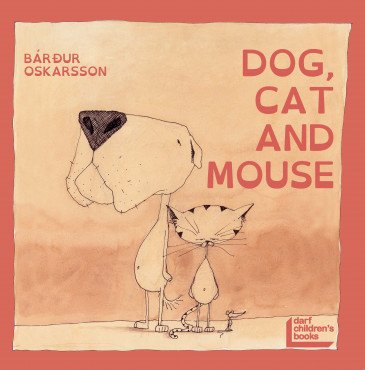
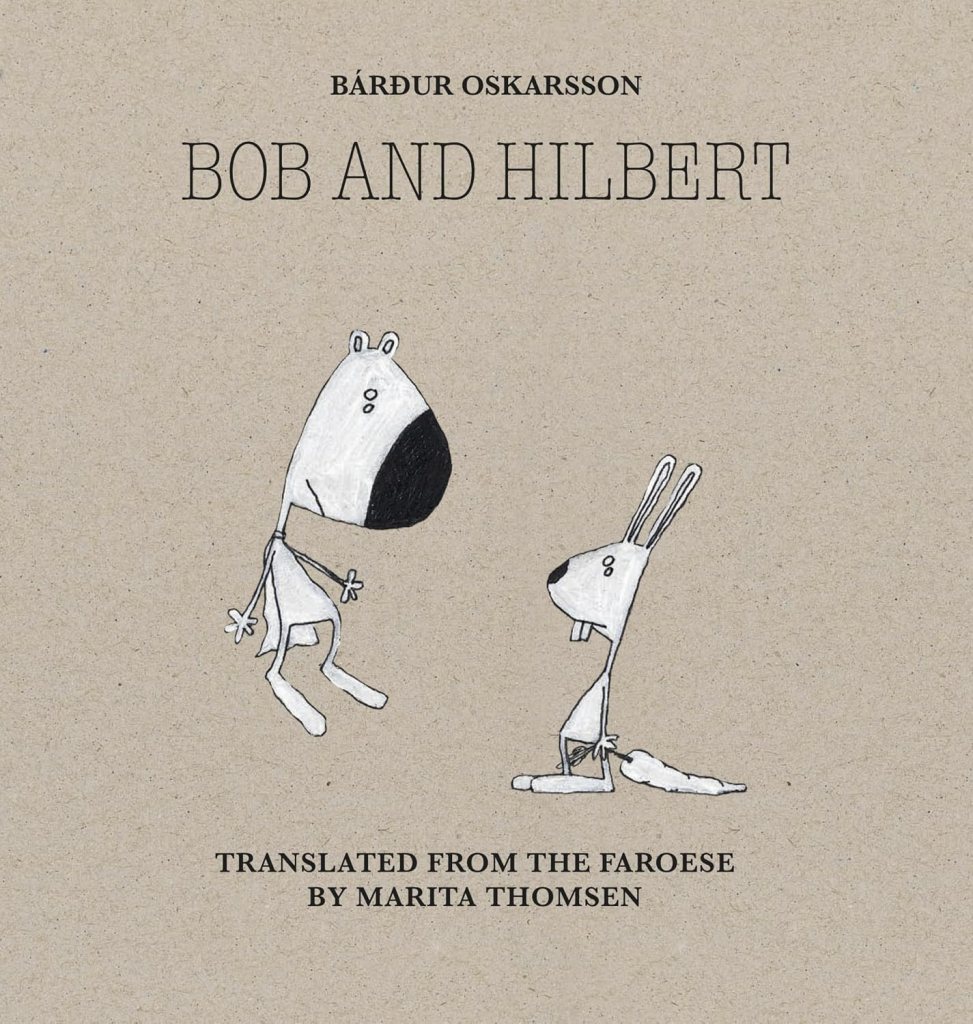
It’s very open ended and relevant, and that is perhaps what appeals. His book Bob & Hilbert asks, who do you believe and why do you believe them? A Dog, A Cat and A Mouse is one of the first books he did, and it’s about conflict. It asks, how do you deal with conflict, and is it necessarily always bad? What measure of confrontation is necessary? In all of his books, there is humor, which appeals to both children and adults.
Every person at any age can find relevance and something to take away from Oskarsson’s books, which reflect the intergenerational lines of the village. The Faroe Islands is a small society and families are large and close knit. You can live a lifetime in one area of town, so there are generations interacting.
The Faroes are small yet they are as composite as any place, and you have a spectrum. There are people whose lives are rigidly regimented by their religious convictions, and others that are not. Politically, we’ve got everything from left to conservative right. In terms of existential convictions, we also find a range. But maybe what is, to a degree, very Faroese is a measure of stoicism, and I don’t think it’s only Faroese. I feel like I encountered it in the Andes Mountains of Peru.
While obviously no one would claim that the Faroese are indigenous, as such, there are hard things about growing up in a place that’s in the middle of the ocean with so few people and close kinship. The remoteness, the isolation, the exposure to nature and its extremes. I think when you grow up like that as opposed to a big city, you know that you are a small part of existence. Your country is small and you are just a fraction of the web. You are keenly aware that you are a small link in this chain.
And it’s also a culture where animals are not bred in captivity, they’re bred for everyone to see. We all know that come autumn the animals will get slaughtered. We have a whale hunt, and the whales are slaughtered in public. When you live in a culture where generations are close, you also experience death. Death is in nature, and death is in human culture. It’s not hidden. And I think that also generates a certain awareness that life is cyclical. So, there’s a stoicism in that seasons come and go. Life waxes and wanes, and we are very close to each other. Humans have quirks and foibles, and that needs to be approached with compassion. When you live so close together, you can see each other’s quirks and foibles and you have to make space for them, because otherwise life becomes intolerable. And it can become intolerable on a small island.
KD: Since you’re no longer based in the Faroes, when you’re translating do you ever feel the need to go back home so you’re in that setting, so you can experience those local sensations?
MT: I lived in London for ten years, but now I’m in Staffordshire, which is more rural. I live near the forest. I feel a great need to be in the Faroe Islands, but I don’t need it for recall. If I read a text, I’m there.
In relation to children’s literature, I’ve been going to the Faroes with my son. He’s been in school there for a couple months now. That has reconnected me with the world of children and how they speak. When I was little, speech was influenced by Danish and now it’s influenced by English. Faroese children now grow up in a very globalized Faroe Islands, especially in the capital. Nature hasn’t changed, though of course the climate is more volatile, as everywhere, but the culture moves and the way people speak.
***
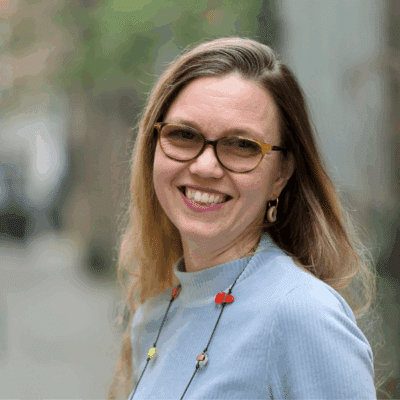
Marita Thomsen is a translator and interpreter who loves stories in all guises. Her published works from Faroese, Danish and Spanish include: the first Faroese queer poetry collection The Suntrap by Beinir Bergsson, the lyrical novel On the Other Side is March by Sólrún Michelsen, the play Castle of Joy by Búi Dam, which had a sell-out run at the Barbican, and award-winning children’s books by Bárður Oskarsson. Marita has contributed to Circumference Magazine, Asymptote Journal and anthologies published by Pushkin Press and Dedalus Books. Her translation of Dead Men Dancing by Jógvan Isaksen received the 2024 Petrona Award.
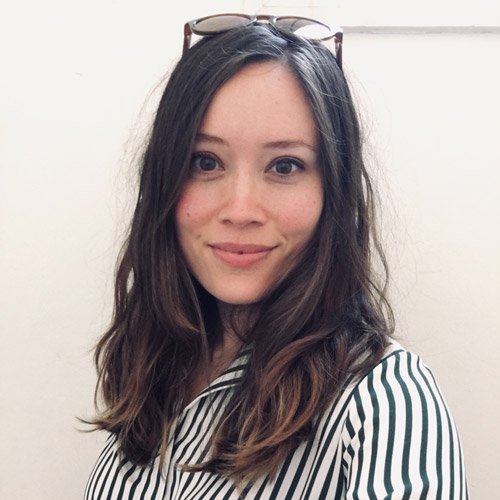
Katy Dycus works for an academic department of anthropology. Her essays and reviews appear in Necessary Fiction, Appalachia, and Harvard Review, among others.

World Kid Lit is a nonprofit that aims to bring diverse, inclusive, global literature into the hands and onto the bookshelves of young people. We rely on grants and donations to support our work. If you can, please support us at Ko-fi. Thanks!
We earn a small commission every time you buy books via the affiliate links on our site, or via our booklists at UK Bookshop.org. This is a much appreciated donation towards our work. Thank you!

